

A dual fuel generator runs on either gasoline or propane, switched with a selector on its control panel instead of needing two separate machines. The trade-off is measurable, not theoretical: on Champion Power Equipment’s 3,400-watt dual fuel inverter generator, the manufacturer’s own spec sheet lists 3,100 running watts on gasoline against 2,790 running watts on propane, a 10 percent cut. Whether that trade is worth it comes down to how you actually store fuel, how long your outages run, and how much power you need at once.
How a dual fuel generator works
Underneath the badge it is still one engine with one alternator producing the same AC output regardless of fuel; only the fuel delivery changes. The gasoline side uses a normal carburetor fed from an onboard tank, complete with a choke or primer for cold starts. The propane side runs through a regulator connected to an external cylinder by a hose, feeding vaporized propane into the same intake. A fuel selector switch on the panel tells the carburetor which circuit to draw from. Because the same intake and ignition timing have to work reasonably well on both fuels rather than being optimized for either one, neither fuel gets the engine’s full potential, and propane in particular gives up some output, covered next.
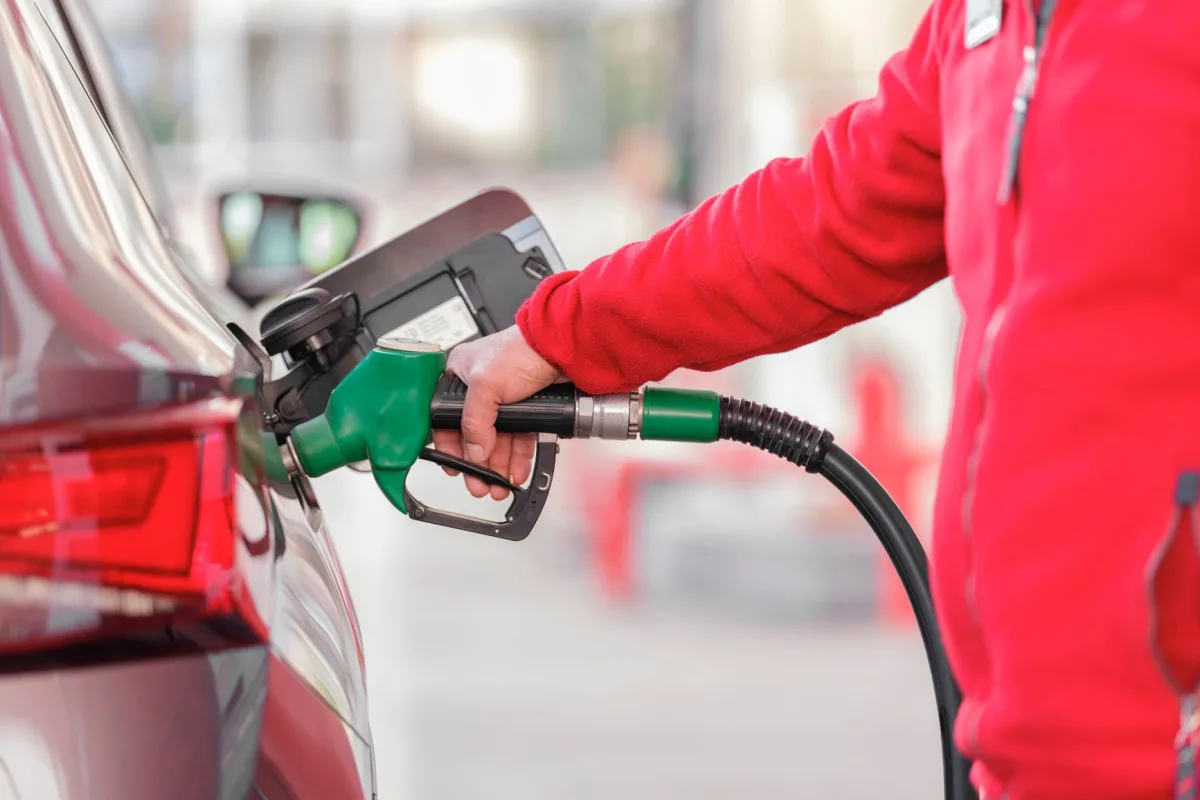
Dual fuel generator power loss: gasoline vs propane
Propane simply carries less usable energy per gallon than gasoline. The Department of Energy’s Alternative Fuels Data Center lists gasoline blended with 10 percent ethanol (nearly all US pump gas) at roughly 112,000 to 116,000 Btu per gallon, versus 84,250 Btu per gallon for propane, a gap of about 27 percent. That is why a dual fuel generator’s propane rating is always lower than its gasoline rating, typically by around 10 percent once the engine and carburetion are accounted for, not the full 27 percent, because the engine still converts propane fairly efficiently once it is burning.
| Metric | Gasoline | Propane |
|---|---|---|
| Starting watts | 3,400W | 3,060W |
| Running watts | 3,100W | 2,790W |
| Fuel supply | 1.6-gallon onboard tank | 20 lb cylinder, about 4.7 gallons |
| Runtime at 25% load | 7.5 hours | 14.5 hours |
Worked example using Champion’s own figures above: at 25 percent of each fuel’s own running-watt rating, the generator draws 775W on gasoline and 697.5W on propane. Over the listed runtimes that works out to 775W x 7.5h = 5,812.5Wh (5.81kWh) from the 1.6-gallon gas tank, and 697.5W x 14.5h = 10,113.75Wh (10.11kWh) from the 20 lb propane cylinder. Propane runs longer mainly because its container holds far more usable fuel, not because the fuel itself is more efficient.
How long gasoline and propane actually store
Propane does not oxidize or break down in the tank, so a sealed cylinder filled today is still good fuel years later; the cylinder itself, not the propane inside it, is the part that ages and eventually needs recertification. Gasoline is the opposite. Untreated gasoline starts to degrade within about three months as light compounds evaporate and it oxidizes, which is why a generator that sat all summer can be hard to start in a fall storm. A fuel stabilizer added to fresh gasoline at the bottle’s stated ratio can extend that to roughly a year or more, but it slows degradation rather than reversing it, so treat fuel before it sits, not after you find it has gone stale. For anyone who keeps a generator specifically for occasional outages rather than routine use, that difference alone is a reason to lean on propane for the fuel that sits untouched for months.
Cold weather and propane
Propane does not freeze solid in any climate a US household will see; it stays liquid under pressure and only needs to boil off into vapor to feed the regulator. The problem in cold weather is the rate of that boil-off. As the ambient temperature drops, a propane tank’s internal pressure and vaporization rate both drop with it, so a nearly empty cylinder in freezing weather may not be able to keep up with a generator’s full demand even though there is technically fuel left. Regulators can also frost over in cold, humid air because the propane itself cools sharply as it expands on the way through, and heavy demand accelerates that cooling. The practical fixes are to keep a cylinder more full rather than less through winter, since more liquid surface area means faster vaporization, and to avoid running a propane generator at its rated maximum load in very cold weather. Gasoline is less fussy about temperature; the main cold-weather issue is a harder start, which the engine’s choke is built to handle.
Switching fuels safely
On typical consumer dual fuel generators you cannot switch fuels while the engine runs. The standard sequence is to stop the engine, close off the fuel you were using, move the selector, open the new fuel supply, and restart; Champion Power Equipment’s own instructions for its LPG selector, for example, call for sliding the switch and turning the fuel valve 90 degrees clockwise before starting on propane. Check your own model’s manual for the exact order, since panel layouts differ by brand. Whichever fuel is running, the same rule applies every time: never run a generator indoors, in a garage, or in any partly enclosed space, even with doors open. Carbon monoxide from a portable generator’s exhaust has no smell and can reach a lethal concentration in a garage within minutes.
Running cost per kWh: gasoline vs propane
Using national average prices checked September 2026: regular gasoline averaged $4.157 a gallon for the week of September 7, 2026, per the Energy Information Administration’s weekly survey. The EIA’s residential propane survey runs only from October through March, so its most recent published figure is $2.674 a gallon from late March 2026; treat that as the latest available read rather than a September number, and check a local supplier for a current quote since propane pricing varies widely by region.
| Metric | Gasoline | Propane |
|---|---|---|
| Price used | $4.157/gal | $2.674/gal |
| Fuel used | 1.6 gal | 4.7 gal (20 lb cylinder) |
| Cost to fill | about $6.65 | about $12.57 |
| Energy delivered at 25% load | 5.81 kWh | 10.11 kWh |
| Cost per kWh delivered | about $1.14 | about $1.24 |
Despite propane’s lower per-gallon price and much longer runtime, it comes out slightly more expensive per kWh delivered in this example, because it holds about 27 percent less energy per gallon than gasoline, which erodes most of the price gap. That is the opposite of what many owners assume going in. The gap is close enough that either fuel’s real-world cost can flip with local pricing, so run the same arithmetic with your own numbers; plug your generator’s running watts and hours into our watts-to-kWh calculator to check a different model. One more wrinkle: a propane exchange cylinder from a hardware store rack is commonly filled to only around 15 lb rather than a full 20 lb, which pushes its real cost per kWh higher than a full fill would.
When a battery beats a dual fuel generator
For outages measured in hours rather than days, and for anything indoors, a battery-based power station is the safer and quieter option. It produces no exhaust at all, so it is the only backup that is safe to run in a bedroom or apartment, and it makes no engine noise. A BLUETTI AC180 Portable Power Station (1,152 Wh, $449) has enough capacity to carry a CPAP, a router and a phone charger through a multi-hour outage: at a combined 90W draw, applying the standard 85 percent inverter-loss factor gives a runtime of 1,152Wh x 0.85 / 90W, or about 10.9 hours. There is no fuel to store, no oil to change, and no carburetor to clean after a season of sitting. A dual fuel generator still wins for outages measured in days, for a well pump, or for a central air conditioner’s compressor surge, loads well beyond what a portable power station’s inverter is built to handle. For the full trade-off see our power station vs generator comparison, and use our power station sizing guide if a battery could replace the generator rather than sit alongside it. Either way, a dual fuel generator does not get to skip the upkeep that any generator needs; see our generator maintenance guide for the schedule, and consider whole-home battery backup if the goal is covering the whole house rather than a handful of circuits.
Frequently asked questions
Is a dual fuel generator worth the extra cost over a single-fuel model?
Only if you will actually use both fuels. The flexibility to run on stored propane or on gasoline from a station is not free: dual fuel models list roughly 10 percent lower running watts on propane than the same unit on gasoline, per manufacturer specs such as Champion’s. If you will only ever burn gasoline, a single-fuel generator with the same running-watt rating typically costs less for the same output.
How much less power does a generator make on propane?
About 10 percent less running watts is typical, based on published specs across several dual fuel models. Size your loads against the propane number if you plan to use propane at all, not against the higher gasoline rating, or you risk overloading the generator the moment you switch fuels.
How long can you store propane for a generator?
Indefinitely, once the cylinder is filled and sealed. Propane does not oxidize or break down the way gasoline does; the cylinder itself is the part that ages and eventually needs recertification, not the fuel inside it.
Can you switch a dual fuel generator between gasoline and propane while it is running?
No, not on typical consumer models. Stop the engine, close the fuel valve you were using, move the selector switch, open the other fuel supply, then restart, following your model’s manual for the exact sequence, since panel layouts differ by brand.
Is propane cheaper than gasoline for running a generator?
Not necessarily. Using national average prices checked September 2026, the worked example above puts propane at roughly $1.24 per kWh delivered against about $1.14 on gasoline for the same generator, because propane carries about 27 percent less energy per gallon than gasoline. Run your own local prices through the same arithmetic before assuming either fuel wins.