
Most households need a power station between 1,500Wh and 2,500Wh with at least 1,800W of continuous output. That covers a fridge, internet, phone charging, lighting and a gas furnace blower for roughly a day. But the right number depends entirely on what you plan to run and for how long, and the arithmetic that gets you there takes about five minutes.
Quick answers by use case
If you want the short version, find your situation in the table below, then read on to check the reasoning. Every figure here already assumes you will lose 10–15% of the advertised capacity to inverter losses, which is covered in detail further down.
| What you want to do | Capacity | Output | Example |
|---|---|---|---|
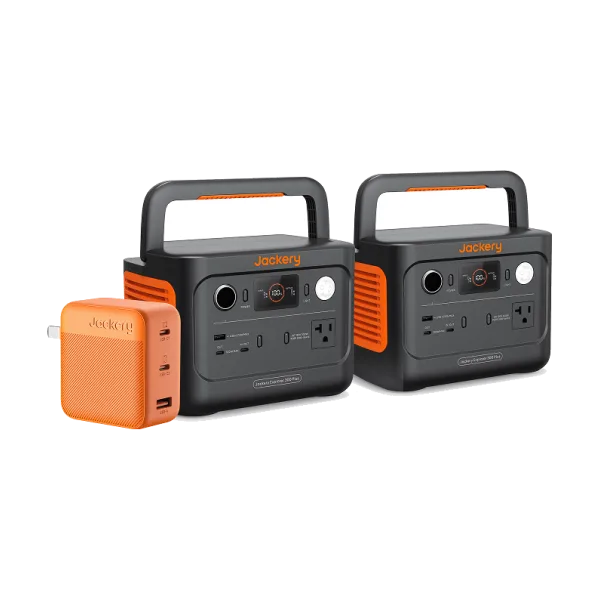 Charge phones, cameras and a laptop for a weekend Charge phones, cameras and a laptop for a weekend | 300–500Wh | 300W | Jackery Explorer 300 Plus |
| Run a CPAP machine for two nights | 700–1,000Wh | 300W+ | EcoFlow River 2 Pro |
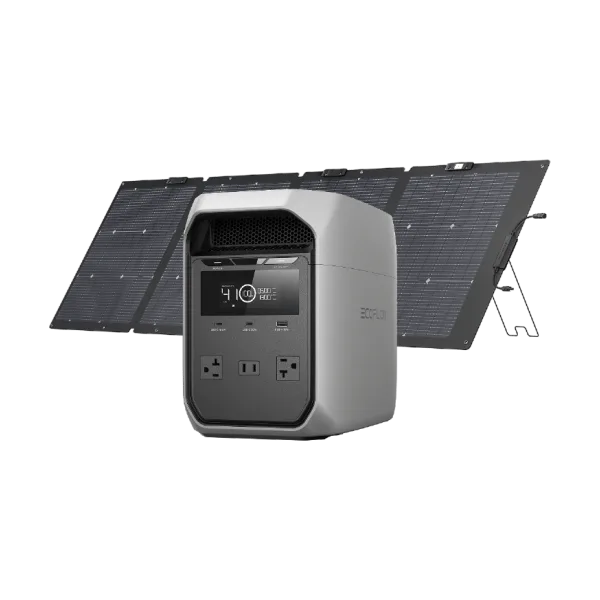 Car camping with a 12V cooler and lights Car camping with a 12V cooler and lights | 1,000Wh | 1,000W+ | EcoFlow Delta 3 Classic |
| Keep a full-size fridge cold for 24 hours | 2,000Wh+ | 1,800W+ | Bluetti AC200L |
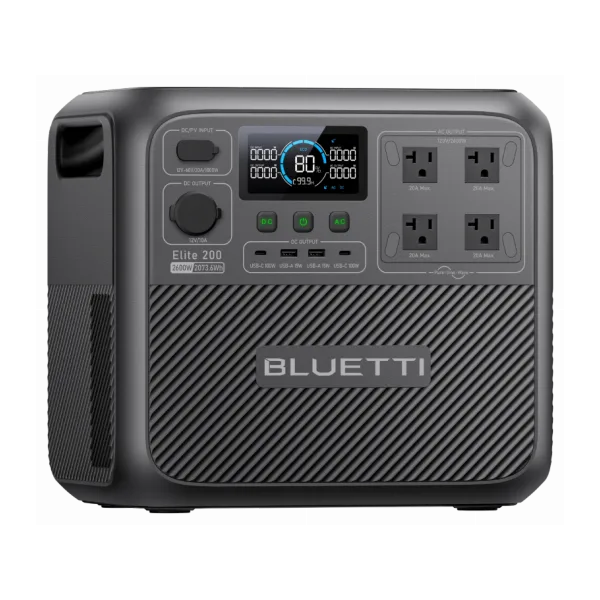 Run a gas furnace blower through a winter outage Run a gas furnace blower through a winter outage | 2,000Wh+ | 2,000W+ | Bluetti Elite 200 V2 |
| Back up several essential circuits for a few days | 3,000Wh+ | 3,000W+ | Bluetti Apex 300 |
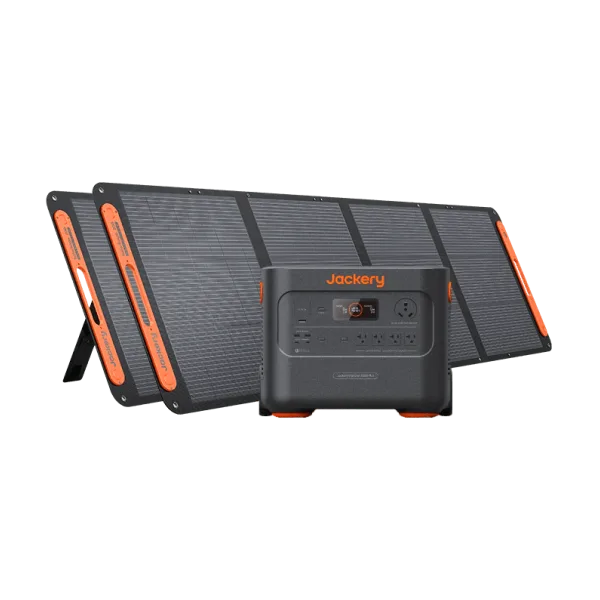 Full-time van or RV with Starlink and a fridge Full-time van or RV with Starlink and a fridge | 2,000Wh + 400W solar | 2,000W+ | Jackery Explorer 2000 Plus |
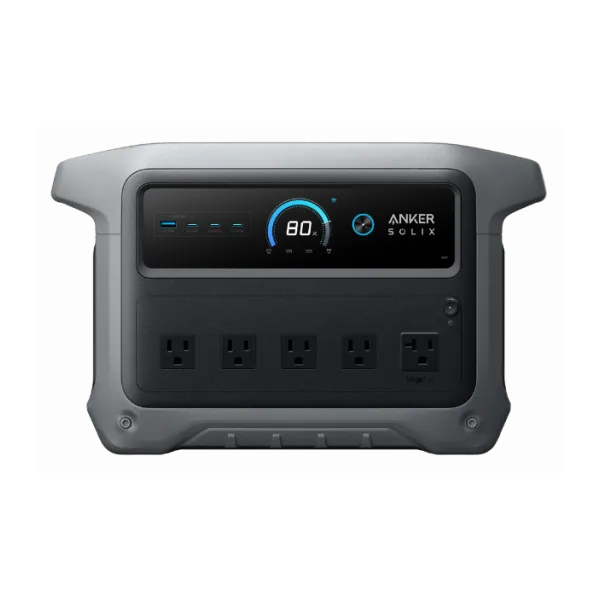 Job site power tools away from a socket Job site power tools away from a socket | 1,000–2,000Wh | 2,400W+ | Anker SOLIX C1000 Gen 2 |
The mistake almost everyone makes
Nearly everyone shops by price. They pick the largest unit within budget, and then discover it either does not start what they needed or dies hours too early. Size is not a budget decision. It is an arithmetic one.
The reason the mistake is so common is that power stations are sold on one number — capacity in watt-hours — and that number answers only half the question. Capacity tells you how long. It tells you nothing about whether the thing turns on at all. Those are two separate specifications, governed by two separate parts of the machine, and a unit can be generous on one and hopeless on the other.
Work through the three steps below and you will end up with two numbers instead of one: a watt-hour figure and a watt figure. Shop against both.
Step 1: list what must stay on
Not what you would like powered — what genuinely must be. This distinction is worth being strict about, because it is usually the difference between a $600 purchase and a $2,400 one.
For most households in an outage the real list is short:
- The fridge and freezer. Not for comfort — for the several hundred dollars of food inside them.
- Internet and phones. Router, modem and chargers. Tiny loads with outsized value.
- Some lighting. A few LED lamps, not the whole house.
- Medical equipment. A CPAP, a nebulizer, an oxygen concentrator. Non-negotiable if it applies to you.
- Heat, in winter. If you have a gas furnace this means the blower only, which is a much smaller job than people assume.
What is usually not on the list: electric ovens, clothes dryers, central air conditioning, electric water heaters and anything else that makes heat with electricity. These are enormous loads, and a portable battery is the wrong tool for them. If you need those running you are looking at a whole-home battery system or a generator, not a portable unit.
Write the list down before you look at any products. The order matters. Once you start browsing, the specification of whatever you are looking at quietly becomes the requirement, and you end up justifying a purchase rather than making one.
Step 2: add up the watt-hours
A watt-hour is one watt drawn for one hour. Multiply each item by its average draw and the number of hours you need it, then add the results together. The word average is doing a lot of work in that sentence and is the most misunderstood part of sizing — see the fridge note below.
| Item | Average draw | Over 24 hours |
|---|---|---|
| Full-size fridge (modern) | 40–80W avg | 1,000–2,000Wh |
| Chest freezer | 40–60W avg | 1,000–1,400Wh |
| Wifi router and modem | 10–20W | 240–480Wh |
| Laptop | 45–65W | ~300Wh |
| LED lights (four) | 40W | ~200Wh |
| Phone charging (two) | 10–20W | ~50Wh |
| CPAP, no humidifier | 30–60W | ~300Wh/night |
| CPAP, heated humidifier | 70–100W | ~600Wh/night |
| Gas furnace blower | 300–600W running | 1,500Wh+ |
| Starlink Mini | ~40W | ~960Wh |
| Television, 55in LED | 70–120W | ~400Wh (4h) |
| Coffee maker | 800–1,200W | ~100Wh per pot |
| Microwave | 1,000–1,500W | ~80Wh per 5 min |
A typical “keep the essentials alive” day lands around 1,500–2,500Wh. That is why 2,000Wh units are the most popular bracket on the market. It is not marketing, it is where the arithmetic points for most homes.
Notice how cheap the small things are and how expensive the heat-producing things are. A router costs you a few hundred watt-hours across an entire day. A coffee maker costs a hundred watt-hours in five minutes. Anything with a heating element — kettle, toaster, hair dryer, space heater — will empty a battery faster than everything else on your list combined.
The fridge deserves its own paragraph
A fridge does not draw its rated wattage continuously. The compressor cycles on and off, typically running about a third of the time in a cool room, so a fridge with a 150W compressor averages something closer to 50W across the day. People who size using the label figure end up buying two or three times more battery than they need. This is common enough that we wrote a separate guide on refrigerator wattage, and it is worth reading before you commit to a number.
Step 3: check the inverter, not just the battery
Capacity decides how long. Output decides whether it starts at all. A 2,000Wh battery paired with a 1,000W inverter cannot run a 1,500W kettle for one second. It will simply refuse, or trip, and no amount of stored energy changes that.
Two output numbers matter:
- Continuous output — what the inverter sustains indefinitely, in watts. Add up everything you might have running at the same time and stay under this.
- Surge or peak output — a brief allowance, usually a second or two, for motors starting. Compressors, pumps and power tools draw three to seven times their running wattage at the instant they start.
That surge is why a fridge averaging 50W still needs an inverter rated far higher. The compressor might pull 600–1,200W for a fraction of a second every time it kicks in.
| Appliance | Running watts | Startup surge |
|---|---|---|
| Full-size fridge | 100–250W | 600–1,200W |
| Chest freezer | 100–200W | 500–1,000W |
| Gas furnace blower (PSC motor) | 400–600W | 1,200–2,000W |
| Sump pump, 1/3 hp | 600–800W | 1,500–2,500W |
| Well pump, 1/2 hp | 1,000W | 2,000–3,000W |
| Circular saw | 1,200–1,500W | 2,300W+ |
| Space heater | 1,500W | 1,500W, no surge |
Most households want at least 1,800W of continuous output. 2,400W is comfortable. Below 1,000W you are limited to electronics and lighting, which is fine if that is genuinely all you need and a waste of money if it is not.
Why you never get the number on the box
Advertised capacity is the raw cell rating. What reaches your appliance is meaningfully less, for three reasons that stack.
Inverter losses
Converting stored DC into household AC costs roughly 10–15% of the energy. A 1,000Wh unit realistically delivers 850–900Wh to something plugged into its AC socket. Charging a laptop or phone from the DC or USB-C ports skips part of that conversion and is noticeably more efficient, which is worth knowing when you are rationing.
Cold weather
Lithium cells lose capacity as temperature drops. At freezing you might see 70–80% of the rated figure, and most batteries refuse to charge below 0°C entirely unless they have a heating system built in. This matters enormously if the battery lives in a garage, a van or an unheated basement, which is exactly where people tend to store them.
Age
Every battery loses capacity over its life. A LiFePO4 pack rated for 3,000 cycles to 80% means that after 3,000 full charges it holds 80% of what it did when new. That is a good result — older lithium-ion chemistries reach the same point in a few hundred cycles. Our chemistry comparison covers why the difference is so large and why it should shape your purchase.
So add 30% to your calculation. If your loads come to 1,800Wh, shop for 2,300Wh or more. Sizing exactly to your arithmetic means being short within a year, in the cold, on the day you actually need it.
Sizing by scenario
Weekend camping
Phones, a camera battery, a couple of lights, maybe a small fan. Realistically 200–400Wh across a weekend. A 300–500Wh unit is right, and the deciding factor is usually weight rather than capacity, because you will be carrying it. Anything above about 1,000Wh stops being genuinely portable for one person.
Car camping and overlanding
Add a 12V fridge, which is the big change: 300–600Wh per day on its own. A 1,000Wh unit gets you two days, and paired with 100–200W of solar you can stay out indefinitely in decent weather. Check the solar input rating before buying panels — some units accept far less than people assume, and the panel that came bundled is often not the one you want.
Van life and full-time off-grid
Here the arithmetic changes character, because you are not surviving an event, you are living a life. Budget 1,500–3,000Wh per day with a fridge, laptop work and Starlink. You want 2,000Wh+ of storage and 400W+ of solar, and you need to think about charge rates and recharge time rather than capacity alone. Our solar sizing guide covers the panel side properly, and the off-grid RV section covers the vehicle-specific parts.
A short power cut
Four to eight hours, a few times a year. You need the fridge, the router and some light: roughly 400–800Wh. A 1,000Wh unit is comfortable and costs a fraction of a home system. Honestly, for outages this brief the food in your fridge is fine without any intervention at all — an unopened fridge holds temperature for about four hours, and a full freezer for a day or more.
A multi-day outage
This is the scenario that justifies real money. Three days of essentials at 1,500–2,500Wh per day is 4,500–7,500Wh, which no single portable unit holds. Your options are an expandable system with extra battery modules such as the Bluetti Apex 300 or EcoFlow Delta Pro 3Check price on Amazon, a unit plus solar to recharge during daylight, or a permanently installed home battery. Solar is the part people skip and then regret — without a way to recharge, even a very large battery is a one-shot device.
CPAP and medical equipment
Size generously and buy a second charging route. A CPAP without the heated humidifier draws 30–60W, so a 1,000Wh unit covers two or three nights. Turning the humidifier off in an outage roughly doubles your runtime. If the equipment is genuinely life-sustaining, treat a battery as one layer rather than the whole plan, and ask your utility about a medical baseline registration, which in many areas gets your address prioritized for restoration.
When to buy expandable instead
If your answer sits near a boundary, or you suspect your needs will grow, buy into a system that accepts extra battery modules rather than a sealed unit at the top of your budget.
Expandable systems cost more per watt-hour at the entry point and less overall if you ever expand. They also let you spread the cost across years, which for a purchase this size is often the deciding practical factor. The catch is that you are committing to one manufacturer’s ecosystem — expansion batteries are not interchangeable between brands, and a discontinued line can leave you stranded. Buy expandable from a brand with a long product history and a large installed base.
You can see which units accept expansion batteries using the comparison tool.
Five sizing mistakes worth avoiding
- Sizing on peak wattage instead of average. The fridge problem. It inflates your requirement by a factor of two or three.
- Ignoring the inverter rating. Buying capacity you cannot use, because nothing heavy will start.
- Forgetting the recharge. A battery with no solar and no generator is a single-use device in a real outage.
- Including heat-producing appliances. Kettles, heaters and hair dryers belong on a generator or on nothing.
- Sizing exactly. No headroom for cold, for age, or for the load you forgot.
Frequently asked questions
What size power station do I need to run a refrigerator?
For a full 24 hours, look for at least 2,000Wh of capacity and 1,800W of continuous output. A modern full-size fridge consumes roughly 1,000–2,000Wh per day because the compressor only runs about a third of the time, but it needs the higher output rating to survive the 600–1,200W surge each time that compressor starts. For a shorter outage of eight to twelve hours, 1,000Wh is enough.
Is 1,000Wh enough for a power outage?
For an outage of a few hours, comfortably. It will hold a fridge, a router and lighting for roughly eight to twelve hours. For a multi-day outage it is not enough on its own, and you would want either an expandable system or solar panels to recharge it during daylight.
How long will a 2,000Wh power station last?
Divide the usable capacity by your average load. After inverter losses a 2,000Wh unit delivers roughly 1,700–1,800Wh. Running a fridge alone at an average 60W, that is around 28 hours. Running a fridge, router, lights and phone charging together at an average 100W, roughly 17 hours. Add a 1,500W space heater and it is closer to one hour.
Should I prioritize capacity or output?
Both, but if you have to compromise, get the output right first. Insufficient capacity means running out early, which is inconvenient. Insufficient output means the appliance never starts at all, which makes the purchase useless for that job.
Can a power station run a whole house?
Not in the way people usually mean. A large portable unit can run essential circuits — fridge, lights, internet, a gas furnace blower — if you connect it through a transfer switch. It cannot run central air conditioning, an electric oven, an electric water heater or an electric dryer. Those need a permanently installed home battery system or a generator. Our home battery cost guide covers the three routes and what each actually covers.
Is it better to buy one large unit or two smaller ones?
Two smaller units give you redundancy and let you put power in two places at once, which is genuinely useful — one at the fridge, one in the bedroom. One large unit gives you more capacity per dollar, a stronger inverter, and the option to expand later. For most people one larger expandable unit is the better buy, with a small second unit added later if the need appears.
Do I need a pure sine wave inverter?
Yes, and effectively every reputable power station now has one. Modified sine wave output can damage or refuse to run sensitive electronics, motors and medical equipment, and it is a particular problem for furnace control boards. If a listing does not say pure sine wave, treat that as a reason not to buy it.
Still not sure? Our picker walks you through the same three steps and narrows the catalogue to units that meet both of your numbers, or you can browse all power stations and filter by capacity directly.