

A NEMA 14-50 outlet is a 240-volt, 50-amp, four-prong receptacle with two hot wires, a neutral and a ground, most often installed for electric vehicle charging, an RV hookup, or an electric range. It resembles a dryer outlet but carries more current on a different pin layout, so the two are not interchangeable.
What a NEMA 14-50 outlet is
The four prongs break down as two ungrounded, or hot, conductors, a grounded neutral, and an equipment ground. Because it carries two hots, a NEMA 14-50 outlet can deliver 240V to one large appliance, or 120V from either hot to the neutral for two separate loads, which is exactly how RV shore power uses it. The receptacle itself is rated 50A at up to 250V; the 14 in its name is simply NEMA’s configuration number for this four-wire pin pattern, not a voltage or amperage figure.
Wire gauge, breaker size and the 80% rule
A NEMA 14-50 outlet is fed by 6 AWG copper wire on a 50A, two-pole breaker for a typical run up to about 50 feet. Longer runs need a heavier gauge to keep voltage drop under 3 percent; some installers use 8 AWG aluminum instead of copper, sized up a step to offset aluminum’s lower conductivity. Our amps-to-watts calculator converts the outlet’s rating into watts for comparison against an appliance’s nameplate, and the watts-to-amps calculator works the other direction for a different appliance’s draw.
NEC 210.19 treats any load running three hours or longer as continuous, and a continuous load may only draw up to 80 percent of the breaker’s rating: 50A x 0.8 = 40A at 240V. That 40A figure, not the 50A stamped on the breaker, is the real ceiling for anything left running for hours, such as EV charging or a space heater plugged into the circuit.
Does a NEMA 14-50 outlet need GFCI protection
Under the 2020 and 2023 NEC, usually yes. Section 210.8(F) requires ground-fault circuit-interrupter protection for an outdoor outlet on a single-phase branch circuit rated 150V to ground or less and 50A or less, which covers a NEMA 14-50 outlet mounted outside or on a detached garage. The 2023 edition extended the same rule to garages with a floor at or below grade and to accessory buildings. Many EV charging cables already include listed ground-fault protection inside the connector, to UL 2231 or UL 2594, which can satisfy NEC 625.54 without a second GFCI device at the outlet, but whether that applies is a question for the electrician pulling the permit, since each state and county adopts a new NEC edition on its own schedule and some still enforce the 2017 or 2020 code.
What a NEMA 14-50 outlet is used for
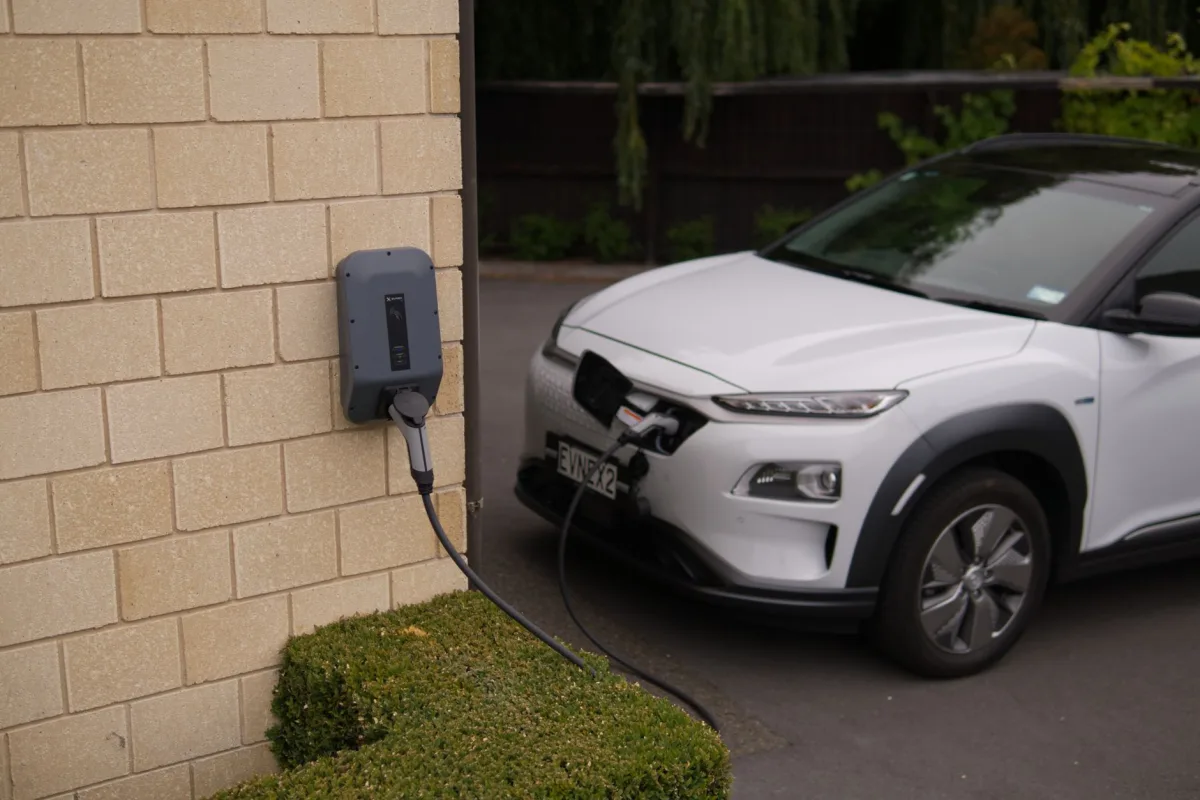
Electric vehicle charging is the most common reason homeowners add a NEMA 14-50 outlet today. A vehicle maker’s portable charging cable, connected through a NEMA 14-50 adapter, typically caps output at 32A at 240V for an added safety margin below the 40A continuous ceiling: 32A x 240V = 7,680W, or about 7.7kW. At roughly 3 to 4 miles of range per kilowatt-hour of typical EV efficiency, that adds about 20 to 30 miles of range per hour of charging, depending on the vehicle. A hardwired Level 2 charger on the same size circuit can draw the full 40A continuously for faster charging, but it is separate listed equipment, not a plug-in adapter.
RV parks and driveways use the same receptacle for what campers call 50-amp service, and that name causes real confusion: it is not one 240V circuit. The two hot legs feed the RV’s power center as two independent 120V, 50A circuits sharing a neutral, so the coach gets up to 100A of 120V power split across two panels rather than 50A at 240V. That’s why an RV’s 120V air conditioners and outlets work normally when plugged into a 14-50 pedestal. More on wiring a whole setup is in our off-grid RV power guide.
Electric ranges and ovens have long used a NEMA 14-50 outlet, or the older three-prong 10-50, because nameplate ratings up to 12,000W were common, even though thermostatically cycled heating elements rarely draw the full 50A continuously. Arc welders are the other frequent user: a 240V stick or MIG welder’s duty cycle keeps its average draw well under its peak, so the welder’s own nameplate amperage, not a continuous-load calculation, sets the breaker size.
NEMA 14-50 vs 14-30 vs 6-50
All three receptacles run at 240V, which is why they get confused, but they are not interchangeable. The detail that matters most is whether a neutral wire is present: without one, a receptacle can only feed 240V-only loads. For comparison, the smaller 14-30 dryer circuit is covered in our dryer wattage guide.
| Feature | NEMA 14-50 | NEMA 14-30 | NEMA 6-50 |
|---|---|---|---|
| Amperage | 50A | 30A | 50A |
| Voltage | 120V/240V | 120V/240V | 240V only |
| Conductors | 2 hot, neutral, ground | 2 hot, neutral, ground | 2 hot, ground (no neutral) |
| Copper wire size | 6 AWG | 10 AWG | 6 AWG |
| Typical breaker | 50A two-pole | 30A two-pole | 50A two-pole |
| Common use | EV charging, RV shore power, ranges | Electric clothes dryers | Arc welders, air compressors, some older EV adapters |
What it costs to install a NEMA 14-50 outlet
A basic NEMA 14-50 outlet installed in a garage with panel capacity nearby and a short wire run typically costs $300 to $800, checked September 2026. Add $100 to $300 for a longer conduit run, and $800 to $2,500 if the panel needs a new breaker slot or a full capacity upgrade to carry the added 50A load. Electricians typically charge $75 to $150 an hour and the job itself takes 2 to 4 hours; a permit and inspection are part of a compliant installation and worth weighing against the scope of a full whole-house battery backup if you’re considering bigger electrical work at the same time.
Hire a licensed electrician
None of this is a do-it-yourself panel job. Sizing the breaker correctly, running new circuit conductors into a live panel, and confirming grounding, GFCI and permit requirements is exactly the work a licensed electrician is trained and insured to do safely. Never attempt wiring inside an electrical panel yourself. If you’re adding backup power with a generator rather than a battery, don’t connect it to a NEMA 14-50 outlet or any household circuit by back-feeding; that bypasses the utility disconnect and can injure utility workers, and it requires a listed transfer switch installed by a licensed electrician instead. Run any generator outdoors, well away from windows and doors, because it produces carbon monoxide.
Frequently asked questions
Is a NEMA 14-50 outlet 120V or 240V?
Both are present. There is 240V between the two hot pins, and 120V from either hot pin to the neutral pin, which is how an RV pedestal splits the outlet into two separate 120V, 50A circuits.
Can I plug a Tesla or another EV directly into a NEMA 14-50 outlet?
Not directly. You need the vehicle maker’s portable charging cable with a NEMA 14-50 adapter, which typically limits output to around 32A, about 7.7kW, at 240V, below the circuit’s 40A continuous limit.
What is the difference between a NEMA 14-50 and a 6-50 outlet?
A 6-50 has no neutral pin, just two hots and a ground, so it can only feed 240V-only loads like a welder. A 14-50 adds the neutral, which lets it also supply 120V loads, the reason RVs and most EV charging adapters use the 14-50 rather than the 6-50.
Does a NEMA 14-50 outlet need a GFCI breaker?
In most cases yes, if it’s outdoors, on a detached garage, or, under the 2023 NEC, in a garage with a floor at or below grade, per Section 210.8(F). Some listed EV charging cables include their own ground-fault protection, but whether that satisfies your local code is a question for the electrician pulling the permit.
How much does it cost to add a NEMA 14-50 outlet?
A straightforward garage installation with panel capacity nearby typically runs $300 to $800; a panel upgrade to make room for the new 50A breaker can add $800 to $2,500 on top of that.