

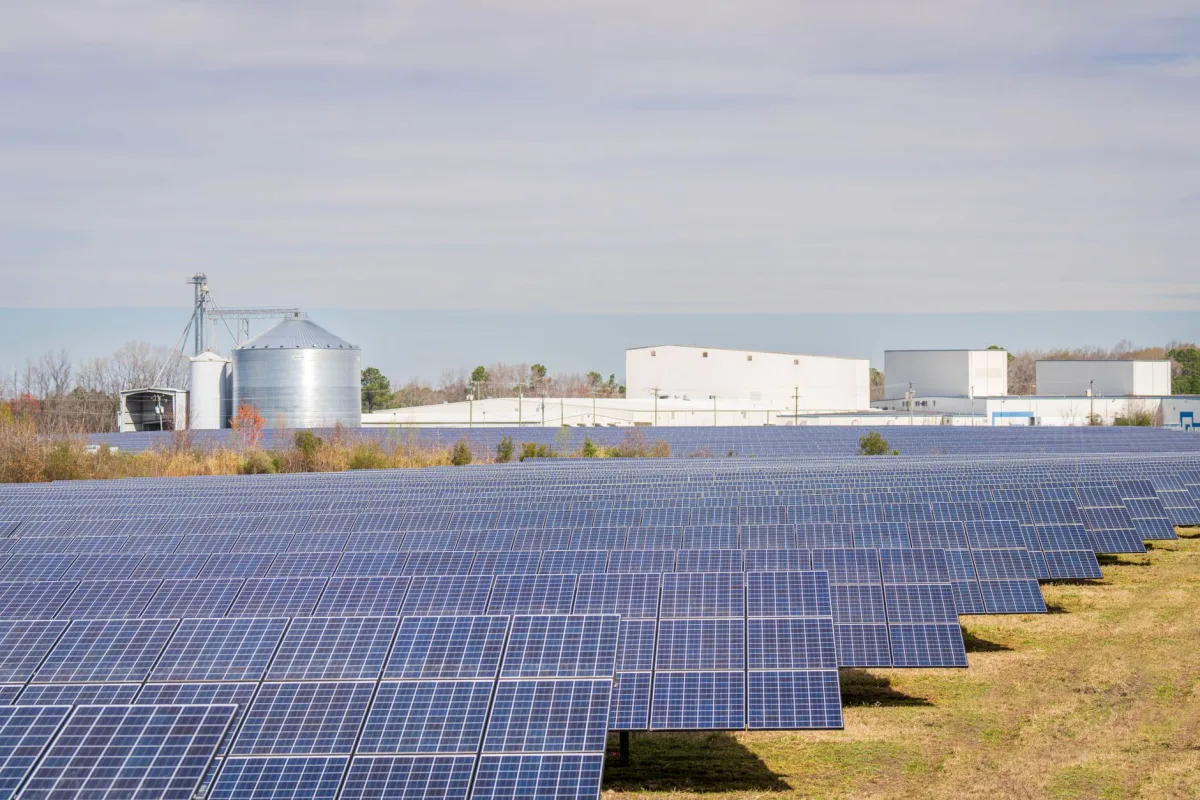
LiFePO4 batteries are the standard chemistry for solar energy storage because they hold up to roughly 3,000 to 6,000 charge cycles at 80% depth of discharge, versus 300 to 1,000 for older lithium-ion (NMC) cells and 300 to 500 for flooded lead-acid, and they don’t carry NMC’s higher thermal-runaway risk. That cycle-life gap is the main reason LiFePO4 has replaced lead-acid and NMC in home solar banks over the past few years.
Why LiFePO4 leads solar energy storage
Lithium iron phosphate (LiFePO4, or LFP) swaps the cobalt-based cathode used in NMC lithium-ion for an iron-phosphate one. The iron-phosphate bond is more thermally stable, so an LFP cell resists the thermal runaway that has driven high-profile NMC battery fires, and it degrades more slowly the deeper and more often it gets cycled. That is the property that matters for solar: a bank that charges and drains on most sunny days needs a chemistry built for thousands of cycles, not hundreds.
| Chemistry | Typical cycle life to 80% capacity | Usable depth of discharge |
|---|---|---|
| LiFePO4 (LFP) | 3,000-6,000+ cycles | 80-100% |
| NMC lithium-ion | 300-1,000 cycles | around 80% |
| Flooded lead-acid | 300-500 cycles | around 50% |
Manufacturer figures, checked September 2026: Renogy rates its Core Series 12V 50Ah LiFePO4 battery at 3,500 cycles to 80% depth of discharge, and PECRON rates the WB12200 12V 200Ah at 3,500-plus cycles under the same standard. Both numbers assume a full discharge-and-recharge cycle at room temperature; partial cycles and moderate temperatures tend to push real-world life beyond the spec sheet. For the fuller chemistry-by-chemistry breakdown, see our LiFePO4 vs lithium-ion comparison.
Sizing a battery bank from your daily usage
Start from how much energy your loads actually use in a day, in kWh, then work back through two losses: the depth of discharge you plan to keep the battery within, and the round-trip loss through the inverter. Runtime for any power station follows capacity in Wh x 0.85 (typical inverter efficiency) / load in watts, so sizing a bank is the same formula solved for capacity instead of runtime.
Say a cabin draws 12 kWh a day and you want one full day of storage while cycling the bank to no deeper than 80% depth of discharge, the range that gets you the cycle counts above, plus a 15% inverter round-trip loss: 12,000 Wh / 0.80 / 0.85 = 17,647 Wh, call it 17.6 kWh of nominal capacity. Five of the PECRON WB12200 Lithium 12V 200Ah Deep Cycle LiFePO4 Battery units (2,560 Wh each, $399) add up to 12.8 kWh, short of the target; seven reaches 17.9 kWh. A smaller top-up bank built from four of the Renogy 12V 50Ah Deep Cycle Lithium Iron Phosphate Battery | Core batteries (640 Wh each, $197) adds 2.56 kWh, more useful for extending an existing 12V bank than building one from scratch.
If stacking individual cells is more hardware than you want to manage, packaged whole-home units bundle the cells, BMS and often the inverter into one box: the Jackery HomePower 3000 ships 3,072 Wh for $1,399, and multiple units stack for more capacity. Run your own numbers with our solar battery calculator, and read how to size a solar system before you buy panels to match the bank.
12V, 24V or 48V: why bigger banks move to 48V
Small point-of-use batteries like the ones above are wired at 12V because that matches RV and marine equipment. Whole-home systems almost always run at 48V instead, and the reason is current, not voltage. Power in watts equals volts x amps, so at a fixed power draw, current falls as voltage rises. A 3,000W load pulls 250A at 12V (3,000W / 12V) but only 62.5A at 48V (3,000W / 48V). Lower current means thinner, cheaper cable and less energy lost to resistive heating over the same wire run, which is why nearly every whole-home and off-grid inverter on the market is built around a 48V bus. A 24V system splits the difference and mostly shows up in mid-size RV and marine setups that need more headroom than 12V without the cost of a dedicated 48V inverter.
Cold-weather charging limits and self-heating packs
Every LiFePO4 cell has a hard floor for charging, not just discharging: manufacturers including Battle Born, SOK and LiTime specify a minimum charge temperature of 0°C (32°F) and use the battery management system to block charging below it. Charging a cold LFP cell forces lithium metal to plate onto the anode instead of intercalating normally, and that plating is permanent capacity loss rather than a temporary dip. Discharging is more forgiving; most packs will still discharge down to around -20°C (-4°F), just not recharge there.
Self-heating LiFePO4 batteries solve this by building a heating element into the pack itself: when an internal sensor reads below roughly 0°C, the BMS diverts a small amount of stored energy to heating pads bonded to the cells, and once the pack reaches about 5°C (41°F) it lifts the charge lockout and lets the charger through. Renogy and several other brands sell a self-heating line specifically for this reason. If a bank lives in an unheated shed or an uninsulated RV bay through winter, check the spec sheet for a stated low-temperature charge cutoff before buying, since budget packs sometimes skip the protection and let a cold charge quietly damage the cells.
Cost per kWh of cycle life: the real math
Sticker price alone is a poor way to compare batteries because it ignores how many kWh a cell will actually deliver before it wears out. Dividing price by capacity times rated cycles gives a cost per kWh cycled, which predicts long-run value better than price per Wh does.
| Battery | Capacity | Price | Rated cycles (80% DoD) | Lifetime kWh delivered | Cost per kWh cycled |
|---|---|---|---|---|---|
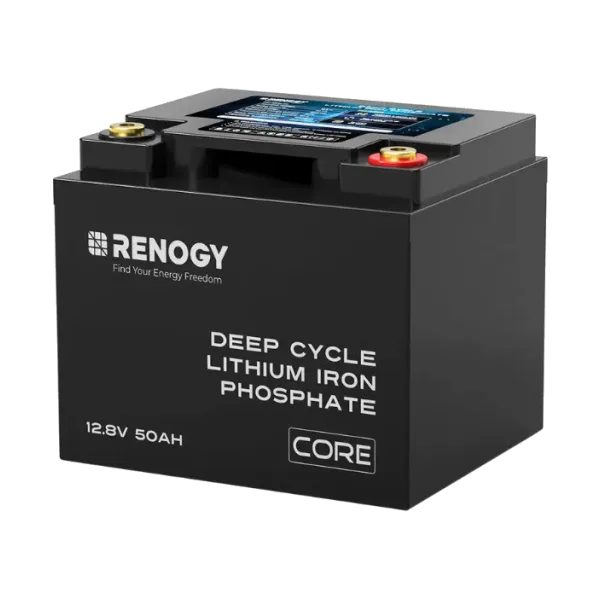 12V 50Ah Deep Cycle Lithium Iron Phosphate Battery | Core 12V 50Ah Deep Cycle Lithium Iron Phosphate Battery | Core | 640 Wh | $197 | 3,500 | about 2,240 kWh | about $0.09 |
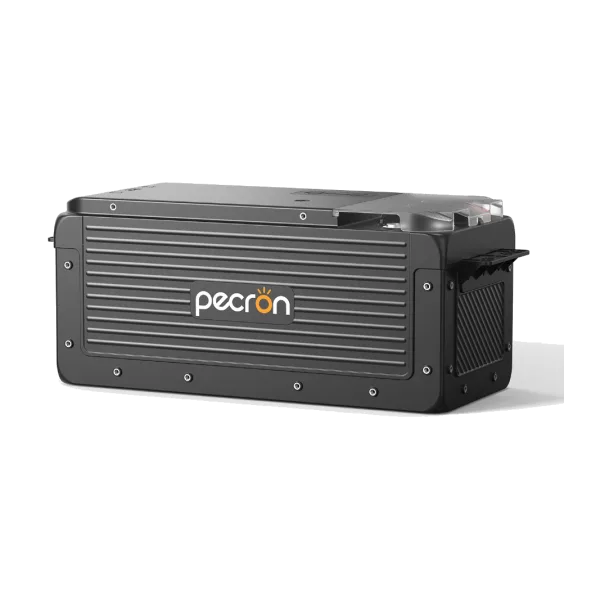 PECRON WB12200 Lithium 12V 200Ah Deep Cycle LiFePO4 Battery PECRON WB12200 Lithium 12V 200Ah Deep Cycle LiFePO4 Battery | 2,560 Wh | $399 | 3,500 | about 8,960 kWh | about $0.04 |
The arithmetic behind those last two columns: 0.64 kWh x 3,500 cycles = 2,240 kWh of lifetime throughput for the Renogy battery, and its $197 price divided by 2,240 kWh works out to about 8.8 cents per kWh cycled. The PECRON scales the same way, 2.56 kWh x 3,500 cycles = 8,960 kWh, and its $399 price divided by 8,960 kWh comes out closer to 4.5 cents per kWh cycled, roughly half. Bigger LiFePO4 batteries tend to cost less per kWh cycled than small ones because the BMS, terminals and enclosure don’t scale with capacity, so sizing up beats buying several small units unless portability is the point. For the household-scale version of this math, see what a whole-house battery costs, and browse our home battery backup guide if a prebuilt unit fits better than a DIY bank.
Frequently asked questions
Can I mix old and new LiFePO4 batteries in the same bank?
Not safely in parallel unless the units share capacity, chemistry and roughly the same age and cycle count. A weaker or older cell in a parallel string gets pulled to match the voltage of stronger neighbors, which drives uneven current and speeds up its decline further. Match batteries by model and purchase date, or keep mismatched units on separate charge controllers instead of paralleling them.
How long do LiFePO4 batteries actually last in years, not cycles?
Divide the rated cycle count by how often the bank actually completes a full cycle. A battery rated for 3,500 cycles that goes through one full cycle a day lasts about 9.6 years (3,500 / 365); the same battery cycled every other day lasts closer to 19 years. Partial cycles and a shallower depth of discharge push real-world life higher than either estimate.
Do LiFePO4 batteries need a special solar charge controller?
They need a charge controller with a LiFePO4-specific charge profile, which most MPPT controllers sold in the past few years include as a selectable battery type. The main difference from lead-acid is a flatter absorption stage and no float-stage overcharge, since LFP cells don’t need a trickle charge to stay healthy once full.
Is a 48V LiFePO4 bank safe to install myself?
Running new circuits into a home’s electrical panel, or connecting a battery bank’s inverter output to back-feed existing wiring, is panel work for a licensed electrician. Wiring individual batteries together into a bank, and connecting that finished bank to a pre-wired inverter input, is within reach for an experienced DIYer, but any connection point that touches the home’s existing panel wiring needs a professional.
What happens if a LiFePO4 battery freezes solid?
The electrolyte in a sealed LiFePO4 cell doesn’t freeze at typical winter temperatures the way water does, but the chemistry stops accepting charge well before that point, around 0°C (32°F), and discharging gets sluggish below about -20°C (-4°F). Storing a battery outdoors in freezing weather is fine as long as it isn’t charged cold; bring it into a heated space to charge, or use a self-heating model instead.