

A standard 1,500-watt space heater running on a US 120-volt outlet draws 12.5 amps (Amps = Watts ÷ Volts, so 1,500 ÷ 120 = 12.5A). That single number explains almost everything else about space heaters: why they trip breakers, why they can’t share an extension cord with anything else, and why they are one of the worst loads you can put on a portable power station.
How many amps does a 1,500 watt heater draw?
Same question, same answer: 12.5A at 120V. Most “space heaters” sold in the US are built around this exact wattage because it sits close to the practical ceiling for a device plugged into a standard outlet — go materially higher and you’re into dedicated-circuit or 240V territory. If the box says 1,500W and your home wiring is 120V, 12.5A is the number, full stop. There’s no gray area here the way there is with a fridge or an air conditioner: a resistive heating element draws essentially the same current the whole time it’s switched on, because there’s no compressor cycling the load up and down.
Why 12.5A is close to the limit on a 15A circuit
Under NEC guidance, a continuous load — anything running 3 hours or more — shouldn’t exceed 80% of a breaker’s rating. On a 15A breaker, that ceiling is 12A. A 1,500W heater pulling 12.5A is already over that line, which is exactly why these units trip breakers on older 15A circuits, especially once anything else on the same run — a lamp, a phone charger, a second heater in the next room sharing a circuit — adds even half an amp more. A 20A circuit has 4A of headroom under its 16A continuous limit, which is why most manufacturers recommend plugging a 1,500W heater directly into a wall outlet on its own circuit, never into a power strip or a light-duty extension cord. Check any other appliance you’re tempted to share a circuit with using our watts-to-amps calculator.
Some larger shop and garage heaters run on 240V instead. A 5,000W 240V unit draws about 20.8A — less current than you might expect for the wattage, for the same reason a 240V dryer pulls fewer amps than a 120V appliance of similar wattage. But the heaters sold for living rooms and home offices are almost always 120V, 1,500W units, so 12.5A is the figure that matters for the overwhelming majority of readers. Use the amps-to-watts calculator if you’re working from a nameplate that only lists current.
Low and high settings change the number
Most 1,500W heaters have at least a low and a high setting, and the amp draw scales directly with wattage — this is one appliance where the math never surprises you:
| Setting | Watts | Amps at 120V |
|---|---|---|
| Low | 750 W | 6.25 A |
| Medium | 900 W | 7.5 A |
| High | 1,500 W | 12.5 A |
A thermostat cycles the heating element on and off once it satisfies a room’s set temperature, so average draw over an hour is lower than these peak figures. But the peak is what your breaker and your extension cord actually see, so size a circuit for the wattage printed on the heater, not the average you’d measure over an evening.
Oil-filled, ceramic and infrared: same amps, different pattern
The three common space heater types draw current differently over time even at identical wattage:
- Ceramic (fan-forced): reaches full 1,500W almost immediately and cycles hard as the thermostat satisfies and re-triggers — expect the full 12.5A in frequent, short bursts.
- Oil-filled radiators: draw the full rated wattage steadily while heating the oil reservoir, then cycle more slowly and for longer stretches once the oil is hot — same 12.5A peak, a gentler pattern.
- Infrared/quartz: often step between 750W and 1,500W rather than cycling fully off, so draw hovers between 6.25A and 12.5A instead of swinging to zero.
None of that changes the number that matters for circuit safety. Whatever the pattern, the peak on a 1,500W unit is still 12.5A, and that’s the figure to plan a circuit or extension cord around.
Running a space heater on a portable power station
A 1,500W heater is close to the worst load you can put on a battery, because it draws continuously at full output for as long as it’s switched on — there’s no compressor cycling off the way there is with a fridge or freezer, so there’s no rest for the battery. It’s a resistive load, which is a mercy in one respect: there’s no 3-5x startup surge like a compressor or motor pulls, so a station’s inverter isn’t at risk of tripping on inrush the way it would running a mini-fridge. The problem is simply sustained, unbroken draw.
Running an AC load through an inverter costs roughly 15% to conversion loss, so a 1,500W heater actually pulls about 1,765W from the battery pack itself (1,500 ÷ 0.85). Divide that into a station’s capacity and you get runtime on high:
| Station | Capacity | Runtime at 1,500W |
|---|---|---|
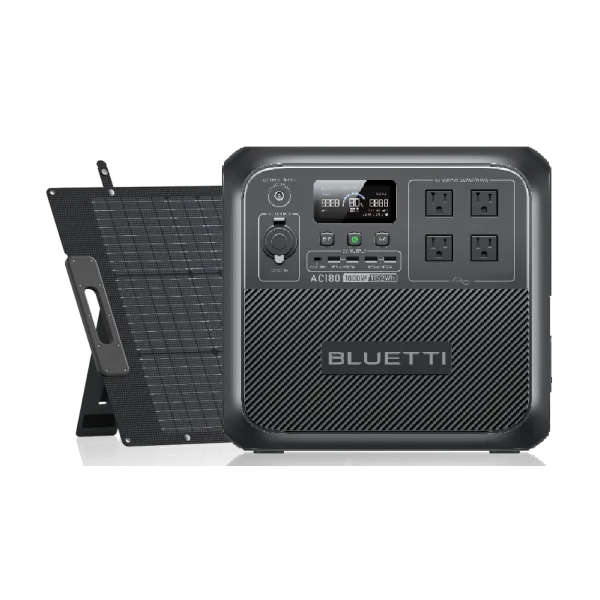 BLUETTI AC180 Portable Power Station BLUETTI AC180 Portable Power Station | 1,152 Wh | about 39 min |
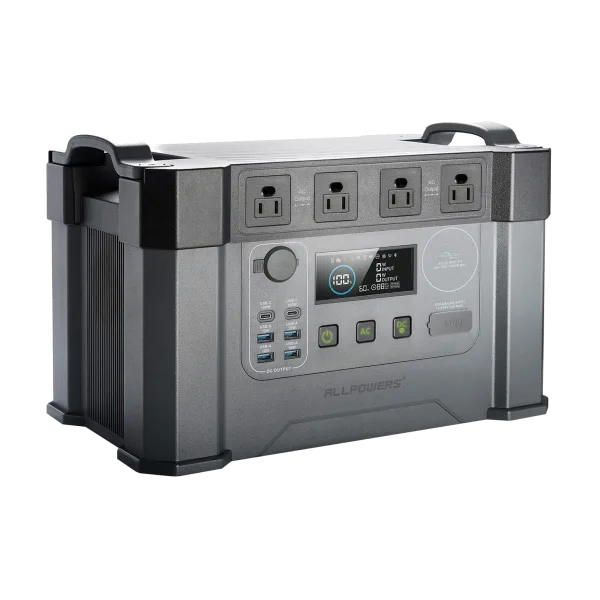 ALLPOWERS S2000 Pro Portable Power Station ALLPOWERS S2000 Pro Portable Power Station | 1,451 Wh | about 49 min |
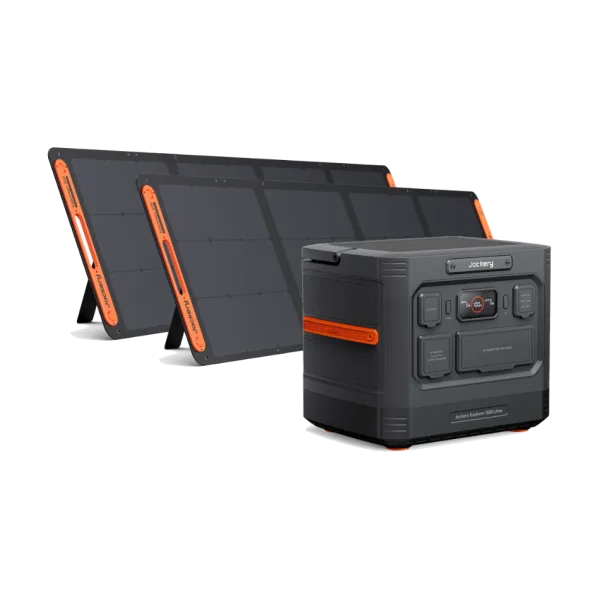 Jackery Portable Power Station Explorer 1500 Ultra Jackery Portable Power Station Explorer 1500 Ultra | 1,536 Wh | about 52 min |
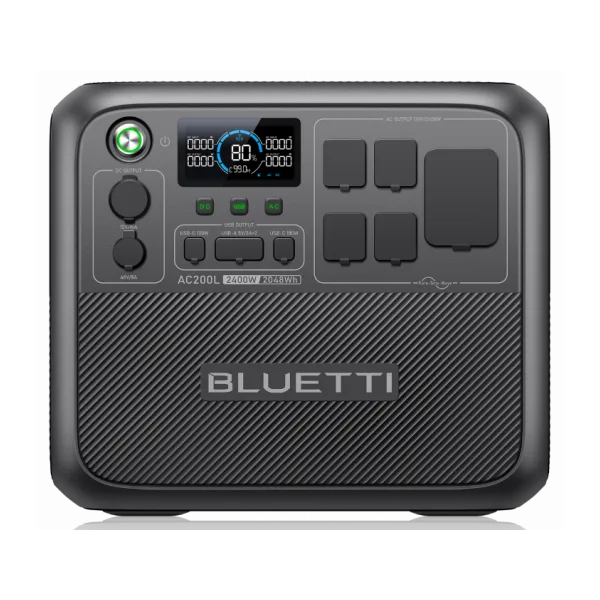 BLUETTI AC200L Portable Power Station BLUETTI AC200L Portable Power Station | 2,048 Wh | about 1h 10 min |
Even a 2,048Wh station like the BLUETTI AC200L Portable Power Station ($899, see current pricing across the catalogue) lasts only a little over an hour on high before it’s flat. Drop to the 750W low setting and the same station stretches to roughly two hours nineteen minutes, because battery-side draw falls to about 882W. That trade-off — half the wattage for roughly double the runtime — holds for any station running any heater, since the relationship between load and runtime is linear.
Smaller stations aren’t just short on runtime, they’re often mechanically unable to run a 1,500W heater at all. A station’s AC output rating is a hard ceiling, not a suggestion: plug a 1,500W heater into a unit rated for 500W AC output, like the EcoFlow RIVER 2 Max 500 Portable Power Station ($309, 499 Wh), and its inverter simply won’t deliver it — the unit will cut out or refuse to start. You need a station rated at least 1,800W AC to have any working margin above 1,500W; the BLUETTI AC180 Portable Power Station and ALLPOWERS S2000 Pro Portable Power Station both clear that bar, though as the table above shows, clearing the bar and running the heater for an evening are very different claims. See how LiFePO4 chemistry affects usable capacity for why the Wh figure on the box isn’t quite the whole story either — these packs discharge to near 100%, so unlike a lead-acid battery you aren’t losing half the rated capacity before you even start.
The honest takeaway: a portable power station is a poor match for a 1,500W space heater as a primary heat source. It’s fine for an hour of emergency warmth, better paired with layered clothing and a closed-off room than counted on for a full outage. If heat is a real outage risk where you live, work through how to size a system for your actual load before committing to a station — start from what size power station you actually need and the full appliance wattage chart, or filter by AC output and capacity directly in the power station finder.
How this page makes money. Some links here are affiliate links and we earn a commission if you buy through them — currently BLUETTI, ALLPOWERS, Mango Power, Renogy and MoonCool. Every other brand on this page is here because leaving it out would make the comparison useless to you, and we are paid nothing either way. Prices are each maker’s own list price at the time of writing and change often.