

How this page makes money. Some links on this page are affiliate links: if you buy through them we may earn a commission (on this page: BLUETTI and ALLPOWERS). Brands that pay us nothing are included wherever leaving them out would make a comparison less useful.
A modern full-size refrigerator draws 100–250 watts while the compressor is running, but averages only 40–80 watts across a full day — roughly 1,000–2,000 watt-hours per 24 hours. The gap between those two numbers is the whole story, and getting it wrong is the most expensive mistake in battery sizing.
The three numbers, and which one matters
Every refrigerator has three different wattage figures attached to it, and almost every sizing error comes from using the wrong one.
| Number | Typical value | What it is for |
|---|---|---|
| Running watts | 100–250W | The compressor while it is actually on |
| Startup surge | 1,000–1,500W | Sizing the inverter |
| Average draw | 40–80W | Sizing the battery |
The number most articles quote is the running figure; the label on the back of the appliance lists a higher maximum rating, not the running draw. The running figure describes a state the fridge is in for roughly a third of the day. If you multiply it by 24 you will conclude that your fridge needs 3,600Wh per day, buy an enormous battery, and be wrong by a factor of three.
Runs a full-size refrigerator averaging 60W for 24 hours, lowest list price first (estimated from each unit’s published capacity):
- PECRON E2400LFP Portable Power Station 2400W 2048Wh 29.7 hr
- ALLPOWERS R2500 V2 Portable Power Station 27.8 hr
- OUPES Mega 2 Home Backup & Portable Power Station 29.7 hr
- OUPES Mega 2 Pro Home Backup & Portable Power Station 29.7 hr
- ALLPOWERS R2500 Plus Portable Power Station 29.2 hr
- EcoFlow DELTA 3 Max Series Portable Power Station (2048Wh) 29.7 hr
- Power Station 2000 29.7 hr
- BLUETTI Elite 200 V2 Portable Power Station 30.1 hr
The number you want for capacity planning is the daily total, and the number you want for the inverter is the surge. Neither is printed on the appliance.
Duty cycle: why the average is so much lower
A refrigerator does not run continuously. A compressor cools the box down to the set temperature, shuts off, and stays off until the temperature drifts back up. The proportion of time it spends running is the duty cycle, and for a modern well-sealed fridge in a normally cooled room it is around 30–40%.
So a fridge with a 150W compressor at a 35% duty cycle averages about 52W. Across 24 hours that is roughly 1,250Wh.
Several things push the duty cycle up, and they are worth knowing because they are exactly the conditions you will be in during an outage:
- A hot room. A garage fridge in summer can run at 60% or more. Ambient temperature is the single biggest factor.
- Opening the door. Every opening dumps the cold air out. In an outage, this is the one thing entirely under your control.
- A nearly empty fridge. Thermal mass helps. A full fridge holds its temperature far better than an empty one, which is why filling gaps with bottles of water is genuinely useful advice.
- Failing door seals. On an older unit, worth checking with the paper test: close the door on a sheet of paper and see whether it pulls out with no resistance.
- Ice makers and auto-defrost. Both add real load. Defrost cycles can pull 400–500W for 20–30 minutes, up to a couple of times a day.
Plan for a higher duty cycle than the brochure implies. If the fridge is in a garage, a van or a room you are no longer cooling because the air conditioning is also off, use 50% rather than 35% and size accordingly.
Consumption by refrigerator type
Age matters more than almost anything else. Efficiency standards tightened substantially in 2001 and again in 2014, and a fridge from the 1990s can use three times the electricity of its modern equivalent while looking identical.
| Type | Running watts | Per 24 hours | Per year |
|---|---|---|---|
| Mini fridge, 1.7–4.5 cu ft | 50–100W | 550–900Wh | 200–330 kWh |
| Compact, 7–10 cu ft | 80–150W | 500–900Wh | 180–330 kWh |
| Full-size top freezer, modern | 100–200W | 1,000–1,500Wh | 350–550 kWh |
| French door with ice maker | 150–250W | 1,500–2,200Wh | 550–800 kWh |
| Pre-2001 full-size | 200–350W | 2,500–3,500Wh | 900–1,300 kWh |
| Chest freezer, 7 cu ft | 100–200W | 700–800Wh | 250–295 kWh |
| 12V camping fridge, 45L | 40–60W | 300–600Wh | — |
The 12V camping fridge line is worth dwelling on if you are outfitting a van or a car camping setup. A DC compressor fridge running directly from the battery skips the inverter entirely, which saves you the 10–15% conversion loss. Over a week off-grid that difference is real.
Where to find your own fridge’s figure
The reliable number is on the yellow EnergyGuide label, which gives estimated annual consumption in kilowatt-hours. Divide by 365 for daily watt-hours. A fridge rated 450 kWh per year uses about 1,230Wh per day. If the label is long gone, search the model number — manufacturers publish the figure, and it is usually more accurate than any estimate.
What ENERGY STAR certified fridges use
ENERGY STAR’s list of certified refrigerators is a check on those ranges. Full-size certified models, averaged by type (October 2026):
| Type (full-size, certified) | Average per year | Range | Per 24 hours | Average draw |
|---|---|---|---|---|
| Top freezer | 366 kWh | 263–506 kWh | ~1,000Wh | ~42W |
| Bottom freezer | 557 kWh | 200–799 kWh | ~1,530Wh | ~64W |
| Side-by-side | 636 kWh | 420–805 kWh | ~1,740Wh | ~73W |
These are certified models only, and they sit toward the low end of the full-size rows in the type table above. Models with an automatic ice maker average more in every type (453 kWh a year against 348 for top-freezers, 610 against 429 for bottom-freezers), partly because they are also larger. The 60W runtime figure used on this page falls between the first two rows. To check your own fridge, search its model number in the ENERGY STAR product finder and divide the annual kWh by 365.
Startup surge and why it decides your inverter
Compressor motors draw a large current spike at the instant they start, typically five to seven times the running current, lasting a fraction of a second. A fridge that runs at 150W can spike to 1,000–1,500W.
This is why the average draw is useless for choosing an inverter. Size the battery on the average and the inverter on the surge, and be generous on the surge, because a marginal inverter fails in the worst way: the fridge appears to work, then trips the unit hours later when the compressor restarts under a warm load.
In practice, look for at least 1,000W of continuous output and a 2,000W surge rating to run a modern full-size fridge; a router, lights and phone charging fit inside that, and you need about 1,800W continuous only if a microwave, kettle or heater shares the unit. Older fridges and anything with a start capacitor in poor condition need more headroom still.
A soft starter will not help here. They exist for air conditioners and larger motors, and they are excellent for that job, but they are not usually fitted or fittable to a domestic fridge. Buy the output rating instead.
How long each power station really holds a fridge
The arithmetic is straightforward once you have both numbers. Take the rated capacity, subtract 10–15% for inverter losses, then divide by your fridge’s average draw. The table below assumes a modern full-size fridge averaging 60W, with nothing else connected.
| Capacity | Usable | Fridge only | Fridge + router + lights |
|---|---|---|---|
| 300Wh | ~260Wh | ~4 hours | ~2 hours |
| 500Wh | ~430Wh | ~7 hours | ~4 hours |
| 1,000Wh | ~870Wh | ~14 hours | ~8 hours |
| 1,500Wh | ~1,300Wh | ~21 hours | ~13 hours |
| 2,000Wh | ~1,740Wh | ~29 hours | ~17 hours |
| 3,000Wh | ~2,600Wh | ~43 hours | ~26 hours |
| 5,000Wh | ~4,350Wh | ~72 hours | ~43 hours |
Treat these as optimistic. They assume a modern fridge, a room at normal temperature, a closed door and a battery in good health. In a July outage with the air conditioning off, halve them.
If you want a specific unit, the Bluetti AC200L and Jackery Explorer 2000 Plus sit in the 2,000Wh bracket that covers a fridge for about a day, while the EcoFlow Delta 3 Classic is a 1,000Wh option for shorter outages. Two days without cycling takes about 3,300Wh of rated capacity (48 × 60 = 2,880Wh, then ÷ 0.87). A 3,000Wh unit gives about 43 hours, and the Bluetti Apex 300 (2,764.8Wh, as BLUETTI lists it) about 40 hours, so plan on cycling the fridge or adding an expansion battery to reach two days. You can compare every model we track by capacity on the power stations page.
Which power stations hold a fridge for a day
The runtime table above is by capacity. This one is by unit, on the same assumptions: a modern full-size fridge averaging 60W, about 13% lost to the inverter, and a second column adding a router and lights for roughly 100W in total, which is the load implied by the last column of the table above. Because a compressor start decides whether a unit works at all, the table shows each maker’s continuous output and surge rating beside the hours, and it includes only models whose makers publish both.
Not every manufacturer publishes a capacity, a continuous output and a surge rating, so for a model that is not in this table, check the maker’s spec page for a surge rating before you count on it for a fridge. A fridge needs about 1,650Wh for 24 hours at 60W (24 × 60 = 1,440Wh, then ÷ 0.87), so anything under that is an overnight unit rather than a one-day one.
| Unit | Capacity | Output / surge | Fridge only (60W) | Fridge + router + lights (~100W) | List price |
|---|---|---|---|---|---|
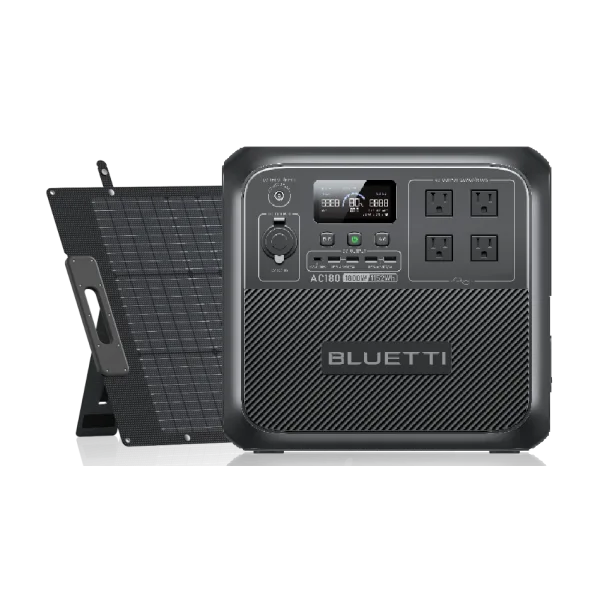 BLUETTI AC180 | 1,152 Wh | 1,800W / 2,700W | about 16 hours | about 10 hours | $449 |
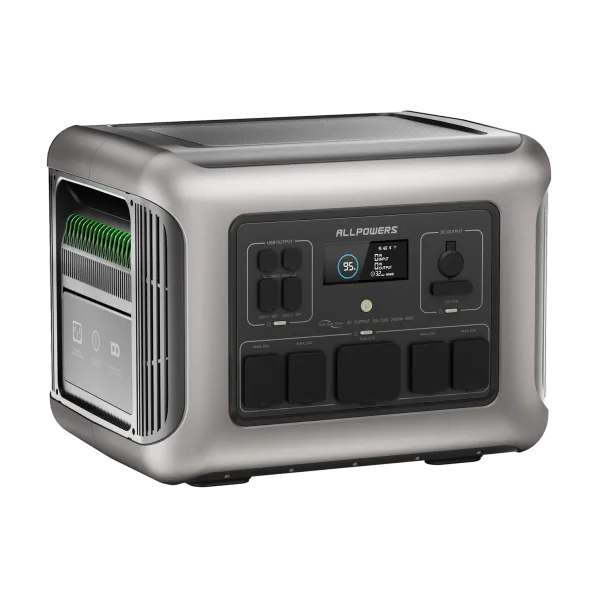 ALLPOWERS R2500 V2 | 1,920 Wh | 2,500W / 5,000W | about 27 hours | about 16 hours | $659 |
| OUPES Mega 2 | 2,048 Wh | 2,500W / 5,400W | about 29 hours | about 17 hours | $699 |
| OUPES Mega 3 | 3,072 Wh | 3,600W / 7,000W | about 44 hours | about 26 hours | $1,149 |
All four clear the floor this page recommends, 1,000W continuous and a 2,000W surge, so capacity does the sorting. The 1,152Wh AC180 gets through a night; the highlighted ALLPOWERS R2500 V2 is the lowest-capacity unit here that covers a full day. The hours assume a closed door and a normal-temperature room, so halve them in a hot one, as above.
How to measure your own fridge in 24 hours
Every figure above is an estimate. Your fridge, in your kitchen, is knowable for about $25 and one day of patience.
- Buy a plug-in energy monitor — the type that sits between the plug and the socket and reads cumulative kilowatt-hours.
- Plug the fridge in through it and reset the counter.
- Use the kitchen completely normally for 24 hours. Do not change your habits, because the habits are part of the measurement.
- Read the kWh figure and multiply by 1,000 to get watt-hours per day.
That single number replaces every estimate in this article and costs less than the difference between two sizes of battery. If you are planning a purchase over about $500, it is the highest-value twenty-five dollars in the process. While the monitor is out, run it on the freezer and the router as well and you will have most of your outage load list measured rather than guessed.
What to actually do in an outage
Before you spend anything, know that a fridge is more resilient than people assume. According to FoodSafety.gov, an unopened refrigerator keeps food cold for about four hours. A full freezer holds its temperature for about 48 hours, or 24 if it is half full, as long as the door stays closed.
That changes the strategy. For a short outage you do not need to power the fridge at all — you need to not open it. For a longer one, the efficient approach is cycling rather than continuous power:
- Run the fridge for roughly an hour, then disconnect it for two or three.
- Keep the door shut throughout. Decide what you want before you open it.
- Move the most perishable items into the freezer, which holds cold far longer.
- Fill empty space with water bottles or ice. Thermal mass is free runtime.
Cycling can stretch a battery to two or three times its continuous runtime, at the cost of paying some attention. If food safety is the concern, a fridge thermometer left inside is worth more than guesswork: 40°F is the threshold that matters, and above it the clock starts.
When food has to be thrown out
FoodSafety.gov’s rules are short:
- Fridge without power for 4 hours or more. Throw out its perishable food: meat, poultry, fish, eggs and leftovers. Up to 4 hours with the door kept shut, refrigerated food should be safe.
- Above 40°F for 2 hours or more (1 hour if temperatures are above 90°F): discard any perishable food.
- Freezer food that still has ice crystals, or reads 40°F or below, can be refrozen or cooked.
Keep an appliance thermometer in each compartment, with the fridge at 40°F or below and the freezer at 0°F or below; appearance and smell alone cannot tell you. If the fridge reads above 40°F at the end of an off period, shorten the cycling gap. For a long outage, FoodSafety.gov puts 50 pounds of dry ice at about two days for a fully stocked 18-cubic-foot freezer.
What a fridge costs you per year
At a US average residential rate of about 18 cents per kilowatt-hour (EIA, 2026), the annual running cost falls out of the table above:
- Modern full-size fridge at 450 kWh: about $81 per year
- French door with ice maker at 700 kWh: about $126 per year
- Pre-2001 fridge at 1,100 kWh: about $198 per year
- A second fridge in the garage: add the whole figure again, plus a penalty for the heat
The old fridge in the garage is one of the reliably worst deals in a typical home — it usually holds a few drinks, runs at a high duty cycle in an uncooled space, and costs more per year than the drinks are worth. Retiring it is one of the better items on our list of ways to cut an electricity bill.
Frequently asked questions
How many watts does a refrigerator use?
A modern full-size refrigerator uses 100–250 watts while the compressor runs, and averages 40–80 watts over a full day because the compressor cycles on and off. That works out to roughly 1,000–2,000 watt-hours, or 1–2 kilowatt-hours, per 24 hours.
Will a 1,000W power station run a refrigerator?
Usually yes, if the 1,000W figure is continuous output rather than capacity. A modern fridge runs at 100–250W and surges to around 1,000–1,500W on startup, so 1,000W continuous with a surge rating of 2,000W or more handles it. A unit with 1,000Wh of capacity is a different specification and will run a fridge for roughly 14 hours.
How long will a fridge run on a 2,000Wh battery?
About 29 hours for a modern full-size fridge averaging 60W with nothing else connected, allowing for inverter losses. Add a router, some lights and phone charging and it drops to around 17 hours. In hot weather, or with an older fridge, expect meaningfully less.
Does a refrigerator use more electricity when it is full or empty?
A full fridge uses slightly less, because the contents hold cold and reduce how often the compressor runs. The effect is small in normal use but becomes significant in an outage, when thermal mass is the only thing keeping the temperature down. Filling empty space with bottles of water is a genuinely useful preparation.
What size inverter do I need for a refrigerator?
At least 1,000W continuous for a modern full-size fridge, with surge capacity of 2,000W or more. A router, lights and phone charging fit inside that; size for 1,800W continuous only if a microwave, kettle or heater shares the inverter. The surge rating matters more than the continuous rating here, because a fridge compressor draws five to seven times its running current at startup.
How long does food stay cold without power?
An unopened refrigerator keeps food safe for about four hours. A half-full freezer holds for about 24 hours and a full freezer for about 48. The critical rule is keeping the doors closed — every opening costs a substantial share of the remaining time. Discard perishable food that has been above 40°F for two hours or more, or one hour if temperatures are above 90°F.
Can I run a fridge on solar alone?
Yes, with a battery in between. A fridge needs power overnight, so panels alone will not do it. As a rough rule, 400–600W of solar plus 1,000–2,000Wh of battery keeps a modern fridge running indefinitely in decent conditions. Our solar sizing guide works through the panel arithmetic.
Next step. Once you know your fridge’s daily figure, our power station sizing guide turns it into a capacity and an output number, and the picker narrows the choice to units that meet both.