

How many watts does a CPAP machine use? About 7–30 watts with the humidifier switched off and 20–70 watts with the humidifier and heated hose on. Plan on 30 and 70 watts, which works out to about 240–560 watt-hours across an eight-hour night and 90–205 kilowatt-hours a year. The blower is not what drains a battery. The heater is, and it is optional.
The three numbers, and which one matters
A CPAP has three separate wattage figures, and the sizing mistakes come from quoting one when you needed another.
| Number | Typical value | What it is for |
|---|---|---|
| Running watts, humidifier off | 7–30W | The blower on its own |
| Running watts, humidifier and heated hose on | 20–70W | What most people actually draw |
| Peak draw, as listed by ResMed | 73–104W | Sizing the inverter output |
| Energy per night | 240–560Wh | Sizing the battery |
The narrow peak range is the useful part. A CPAP cannot draw much more than its external power supply is rated for. ResMed’s AirSense 11 ships with a 65W supply and lists a 73.2W peak; the AirSense 10 before it has a 90W supply and lists 104W (the maker’s figures are below). The ceiling is built into the hardware.
So a CPAP is the opposite of a refrigerator. With a fridge the inverter output rating is the hard constraint. With a CPAP, output is a non-issue, because almost any power station on sale clears that peak several times over. The only question is how many watt-hours you have stored.
Why the humidifier decides everything
The blower is a small brushless DC motor moving air at low pressure, and it is genuinely efficient. Its draw tracks your prescribed pressure and how well the mask seals: around 6–8 cmH2O on a well-fitted mask sits near the bottom of the 7–30W band, while a prescription in the mid-teens, or a leak the machine spends all night compensating for, sits near the top.
The heated humidifier is a different kind of load. It is a resistive plate pulling 50–85W while it heats, and it cycles to hold temperature the way an oven element does, so what matters is the share of the night it spends switched on. In a warm bedroom on a low setting that might be 30% of the night. In a cold room on a high setting it can be most of it.
Things that push the night’s total up:
- Humidity setting. The biggest lever by a wide margin. High to off typically cuts the night’s energy by half to two thirds.
- A cold bedroom. The heater is fighting the room, so the same machine on the same settings uses noticeably more in January than in July.
- A heated hose. Adds roughly 10–20W, and it is warming whenever the humidifier is.
- Mask leak. The blower works harder to hold pressure, and on an auto-adjusting machine a leak can drive the pressure up as well.
- Machine age. Older units tend to sit 10–20W above a current equivalent for the same job, mostly in the power supply.
The humidifier is a battery decision, not a nightly one. Switching it off is the correct move when you are running from a power station in an outage, because it roughly doubles or triples your runtime. It is not a sensible way to save money on the electricity bill — the whole humidifier costs about twenty dollars a year to run.
How many watts does a CPAP machine use, by setup
The table below assumes an eight-hour night, which is the honest basis for anything battery-related. Multiply the per-night figure by your own average sleep hours if you use it less.
| Setup | Average watts | Per night (8 hrs) | Per year |
|---|---|---|---|
| Travel or mini CPAP, no humidifier | 15–30W | 120–240Wh | 45–90 kWh |
| Standard CPAP, humidifier off | 7–30W | 56–240Wh | 20–90 kWh |
| Standard CPAP, humidifier on, moderate setting | 20–55W | 160–440Wh | 60–160 kWh |
| CPAP, humidifier and heated hose, high setting | 35–70W | 280–560Wh | 100–205 kWh |
| Bilevel or BiPAP, humidifier off | 10–30W | 80–240Wh | 30–90 kWh |
| Bilevel or BiPAP with humidifier | 25–70W | 200–560Wh | 75–205 kWh |
| Machine left plugged in but idle, per 16-hour day | about 5W | about 80Wh | about 29 kWh |
The standard CPAP, humidifier-off row is the one to plan a battery around, because it is the configuration you should be in when the power is out. The rest of the table is what you use on a normal night at the wall, where none of it costs enough to think about. To turn any row into a bill figure with your own hours and rate, use the watts to kWh calculator.
What one maker publishes
The ranges above are wide because they cover every brand, pressure and humidity setting. ResMed prints hard figures for the AirSense 11 and the AirSense 10 before it in their user guides (AirSense 11, AirSense 10):
| ResMed figure | AirSense 11 | AirSense 10 |
|---|---|---|
| Power supply rating | 65W | 90W |
| Typical power consumption | 56.1W | 53W |
| Peak power consumption | 73.2W | 104W |
| DC accessory listed | Air11 DC/DC converter | Air10 DC/DC converter |
Those are ratings. ResMed has also published measured consumption (a 2015 sheet) for the AirSense 10 AutoSet at 8–15 cmH2O, humidity 6 and a 28°C heated tube: 7Wh with the device alone, 22Wh with the humidifier, 34Wh with humidifier and heated tube, and 5Wh on standby. The sheet does not state a time period. Read as hourly figures, that is about 56Wh for an eight-hour night without humidification and about 270Wh with everything on. Its AirCurve 10 bilevel machines measured a little higher: 9–10Wh device-only and 41–43Wh fully heated. The AirSense 10 guide itself says to turn the humidity level to Off when running from an external battery, to make the battery last. Size the inverter from the peak row and the battery from figures like these, or better, from your own machine.
Startup surge: there isn’t one
Refrigerators, pumps and air conditioners spike to several times their running wattage the moment the motor starts, which is why they need inverter headroom. A CPAP does not, and that is worth saying plainly rather than inventing a number for it.
The blower is a small DC motor spun up gently under electronic control, fed from a switch-mode power supply, so there is no locked-rotor inrush. The only transient is the brick charging its own capacitors at plug-in, lasting milliseconds and well inside what any inverter tolerates. The largest step the machine ever asks for is the humidifier plate switching on: a step to about 100W, not a spike to 500W.
Do not buy output capacity for a surge that does not exist. A 150W continuous pure sine inverter is technically sufficient, and in practice you will end up with something far larger anyway, because the capacity you need for a full night comes attached to a bigger inverter.
Pure sine wave matters more than watts here. Modified sine wave inverters — the cheap ones sold for cars — can make some medical power supplies buzz, run hot or refuse to start. Essentially every lithium power station on sale outputs pure sine, but confirm it on the spec sheet before you rely on the unit overnight.
How long each power station really runs a CPAP
The assumptions, up front, because runtime tables without them are worthless. Usable capacity is 85% of the rated figure, covering inverter conversion loss and the fact that a pack never delivers its full label. The load is 30W humidifier-off and 70W with humidifier and heated hose at a moderate setting, plus 8W for the inverter simply being switched on — a real cost most tables ignore, and one that matters enormously when the load itself is only 30W.
| Capacity | Usable | Humidifier off (38W) | Humidifier on (78W) |
|---|---|---|---|
| 300Wh | ~255Wh | ~6.5 hrs, short of a night | ~3 hrs |
| 500Wh | ~425Wh | ~11 hrs, one night | ~5 hrs |
| 1,000Wh | ~850Wh | ~22 hrs, two nights | ~11 hrs, one night |
| 2,000Wh | ~1,700Wh | ~44 hrs, five nights | ~21 hrs, two nights |
| 3,600Wh | ~3,060Wh | ~80 hrs, ten nights | ~39 hrs, four nights |
On the numbers. Capacity and output are manufacturer specifications. Expect 80–90% of rated capacity in real use after inverter losses, and less in cold weather.
Two rows deserve comment. The 300Wh bracket is the wrong tool. It is the size most often recommended for CPAP backup, and once the inverter’s own consumption is counted it does not reliably survive one eight-hour night. It gets you five or six hours and then stops, which is worse than useless if the point was not waking up without therapy. Treat 500Wh as the floor for one night, and 1,000Wh as the floor for a second night or for keeping the humidifier on.
At the other end, 3,600Wh bought purely for a CPAP is a lot of money sitting idle. That size earns its place when the CPAP is one item on a list that also includes a refrigerator and some lighting, at which point you are sizing an outage kit rather than a CPAP battery. The power station finder filters by capacity once you know your number.
Skip the inverter and the numbers improve
Most CPAP manufacturers sell a regulated DC cable that runs the machine from a 12V socket with no inverter in the path. ResMed, for example, lists an Air11 DC/DC converter among the AirSense 11 accessories and an Air10 DC/DC converter for the AirSense 10. Skipping the inverter removes the conversion loss and the 8W idle penalty together, and typically buys 25–30% more runtime from the same battery. Driven this way, a 500Wh unit covers a humidifier-off night with margin rather than scraping it.
The catch is that humidification usually will not run from DC, which in an outage is the setting you were turning off anyway. If you are sizing a deep-cycle battery instead of a power station, 30W at 12V is about 2.5 amps; the watts to amps calculator handles other voltages, and amp hours to watt hours converts an Ah rating into the watt-hour figure the table uses.
Use the manufacturer’s DC cable, not a generic one. These machines want a regulated supply at a specific voltage. A generic car adapter that looks like it fits can deliver the wrong voltage under load. This is the one place in the whole setup where improvising is a bad idea. ResMed’s AirSense 11 guide says to use only ResMed parts with the machine, power supplies included.
How to measure your own machine in one night
Every figure on this page is a range. Your machine, at your pressure and your humidity setting, is a single number you can have for about twenty-five dollars.
- Buy a plug-in energy monitor — the type that sits between the plug and the socket and totals kilowatt-hours.
- Plug the CPAP in through it and zero the counter before bed.
- Sleep a normal night on your normal settings. Do not tidy up the humidity setting for the test.
- Read the kWh total in the morning and multiply by 1,000 for watt-hours per night.
- Repeat with the humidifier off. The gap between the two numbers is your outage budget.
Two nights of measurement replaces this entire article for your specific machine. Take the humidifier-off figure, divide by 0.85 for inverter losses, and that is the minimum usable capacity you need. Cheap monitors are imprecise below about 5W, but at 10–70W any of them is accurate enough for sizing. While the monitor is out, measure the router and the fridge as well and most of your outage load list is measured rather than guessed — the same approach scales to a whole house.
Whether a CPAP belongs on battery backup
This site says no to most battery purchases. This is one of the clear yeses.
The case is unusually good: the load is tiny, the duration is predictable, and the alternative is unattractive. A CPAP asks for up to about 240Wh a night with the humidifier off (about 320Wh through an inverter), which a mid-size power station supplies several times over. Outages do not arrive at convenient hours, and a battery is silent, indoors, and needs nobody to walk outside and start it at three in the morning.
What to buy, in short:
- One night of cover: 500Wh, humidifier off. Confirm the unit is pure sine.
- Two or three nights, or humidifier on: 1,000Wh. The sensible default for most people.
- Multi-day outages with other loads: 2,000Wh and up, sized around the fridge rather than the CPAP.
- Add solar only if your outages run past two days. A 100–200W panel replaces a humidifier-off night in a few hours of decent sun.
What not to buy: a whole-home battery justified by the CPAP alone. If you want home backup, buy it for the house; a CPAP is a rounding error on that decision and should not be the argument that sells it to you. And if your therapy is something you cannot safely skip, raise the sizing question with whoever supplies your equipment, since some machines have their own approved battery accessories.
If you depend on your CPAP: before the power goes out
A battery covers the hardware. The FDA’s advice on medical devices in disasters covers the rest:
- Tell your electric company and fire department that you use a medical device that needs power.
- Confirm battery and generator use. Read the user instructions, or call your equipment supplier or the maker, to find out whether the machine can run from a battery or a generator.
- Check for water first. Do not plug in a cord if the cord or the machine is wet.
- Check the settings when power returns. The FDA notes that medical devices often reset to a default mode after an interruption. ResMed’s AirSense 10 and 11 guides say therapy restarts by itself when power comes back, but confirm your pressure and humidity settings anyway.
- If a device keeps you alive, the FDA says to seek emergency services immediately and, where possible, to notify your local public health authority to request evacuation before severe weather arrives. ResMed’s AirSense 10 and 11 guides state that those machines are not suitable for ventilator-dependent patients.
A ResMed clinical education specialist describes what happens in an outage: the CPAP simply shuts off, and you can still breathe room air. Nasal and nasal-pillow mask users breathe through the mouth, and full-face masks have an anti-asphyxia valve that opens to let room air in. ResMed still advises reconnecting to a battery if you wake, to avoid apneas for the rest of the night. The machine takes power from the wall or a battery, not both at once, so switching over is a manual job unless you use the UPS setup below. And most insurers will not pay for a CPAP battery, treating it as a convenience; ask your provider, but expect to buy it yourself.
If the backup is a generator. Run it outdoors only, at least 20 feet from the house, with the exhaust pointed away from windows, doors and vents, as the CPSC advises. Never run it in a garage, basement or shed, even with the door open, and, the FDA adds, never outside an open window. Fit battery-operated or battery-backup CO alarms on every level and outside sleeping areas.
How many nights each power station lasts
The runtime table above is by capacity. This one names power stations we track and keeps the same assumptions: 85% of rated capacity usable, 38W with the humidifier off and 78W with it on at a moderate setting (each already includes the 8W the inverter costs just by being switched on), and nights counted as whole eight-hour nights. There is no output column, because ResMed’s listed peaks top out at 104W and every unit below is rated at 500W or more.
| Unit | Capacity | Humidifier off (38W) | Humidifier on (78W) |
|---|---|---|---|
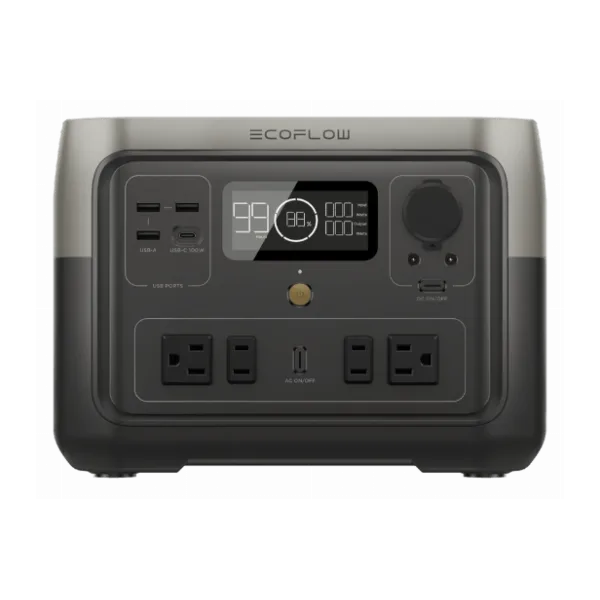 EcoFlow RIVER 2 Max 500 Portable Power Station | 499 Wh | about 11 hours, one night | about 5 hours, short of a night |
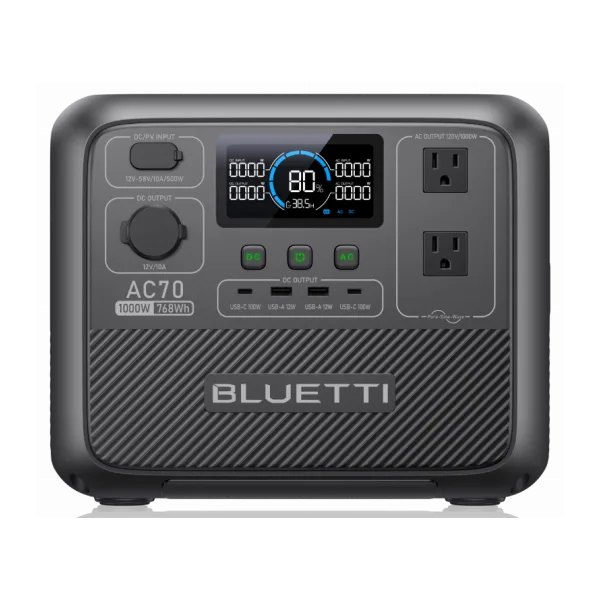 BLUETTI AC70 Portable Power Station | 768 Wh | about 17 hours, two nights | about 8 hours, one night with no margin |
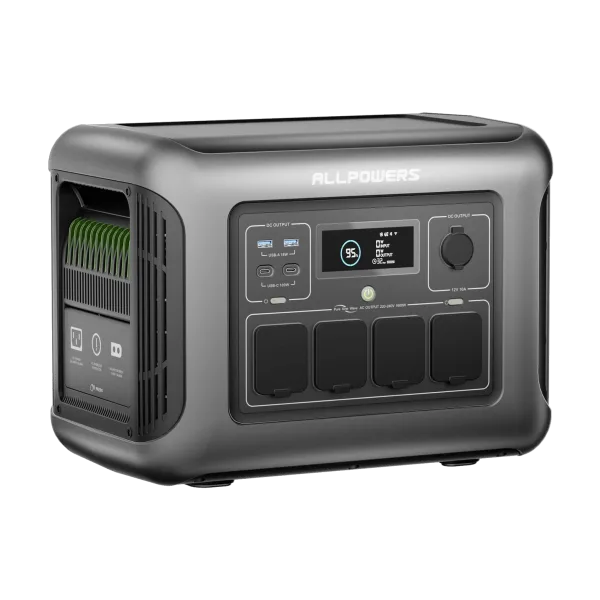 ALLPOWERS R1500 LITE Portable Power Station | 1,056 Wh | about 23 hours, two nights | about 11 hours, one night |
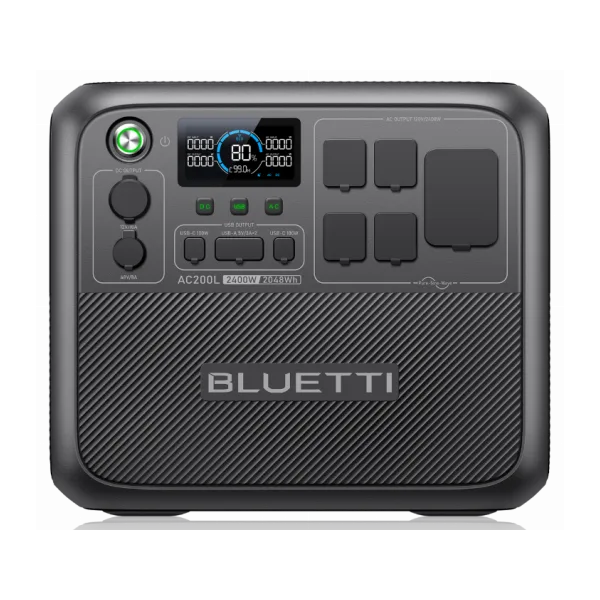 BLUETTI AC200L Portable Power Station | 2,048 Wh | about 45 hours, five nights | about 22 hours, two nights |
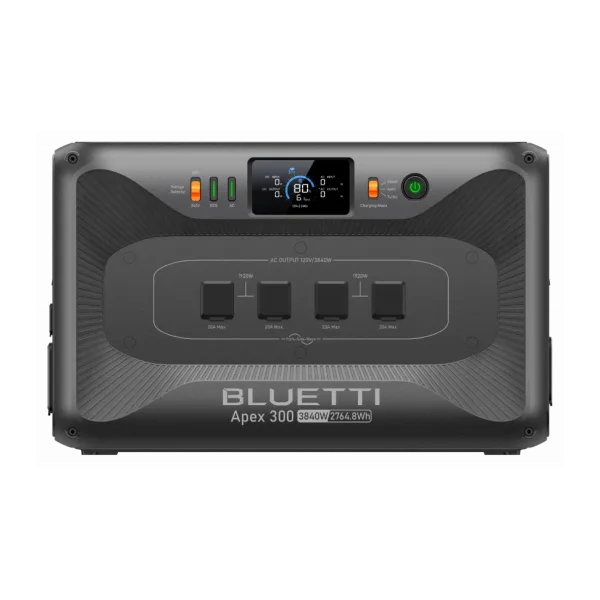 Apex 300 Versatile Power Station | 2,765 Wh | about 62 hours, seven nights | about 30 hours, three nights |
These are published capacities run through the arithmetic above, not observations of any unit overnight. Read them against the sizing earlier on this page. The 499Wh row covers one humidifier-off night but not a humidifier-on one. The AC70 covers either, with under half an hour to spare on the humidifier-on night (8.4 hours against an 8-hour night). The 1,056Wh row is the first with a real margin on both settings, which fits the 1,000Wh floor suggested for a second night or for keeping the humidifier on. The two largest rows only make sense when other loads, such as a refrigerator, share the battery.
How this page makes money. The links on the five units in the table above are affiliate links, and we earn a commission if you buy through them: the BLUETTI and ALLPOWERS links go through the Awin affiliate network, and the EcoFlow link goes to Amazon. As an Amazon Associate we earn from qualifying purchases.
Keep it running through an outage: UPS mode
A charged battery on the floor does nothing until someone moves the plug, and at three in the morning that may not happen. A power station with a UPS (uninterruptible power supply) function closes that gap. Plug the station into the wall and the CPAP into the station, and leave both there: while the grid is up the station passes wall power through, and when it fails the station switches to its own battery. Makers list how long that switch takes:
| Unit | Maker’s listed switchover |
|---|---|
| EcoFlow RIVER 2 Max 500 | not listed |
| BLUETTI AC70 | 20ms |
| ALLPOWERS R1500 LITE | 15ms or less |
| BLUETTI AC200L | within 20ms |
| BLUETTI Apex 300 | 0ms or 20ms |
These are the makers’ claims for consumer power stations, not ratings tested against a medical device. EcoFlow lists under 30ms for the 512Wh RIVER 2 Max and calls it EPS rather than UPS, but its page for the 499Wh RIVER 2 Max 500 gives no figure. BLUETTI ties the Apex 300’s 0ms figure to one setup (grid power through its 15A charging cable, output set to 240V, devices in the left two AC outlets) and says its switching keeps CPAP machines running, but none of these product pages says which CPAP models ride through the gap. If yours does not, ResMed’s guides say therapy restarts automatically once power is back, so the likely cost is a brief pause. Test it once while you are awake: run the CPAP through the station, unplug the station from the wall, and watch whether the machine carries on.
UPS mode also changes which runtime column applies. If the power fails while you sleep, the humidifier stays on, so plan the first night on the humidifier-on figures: by the arithmetic above the AC70 just covers it and the RIVER 2 Max 500 does not.
What a CPAP costs to run per year
At the US average residential rate of about 18 cents per kilowatt-hour (EIA, 2026):
- Humidifier off, 30W for eight hours a night: about 88 kWh, or $16 a year
- Humidifier and heated hose on, 70W: about 204 kWh, or $37 a year
- Left plugged in and idle during the day: about 29 kWh, or $5 a year
Even the worst case is under fifty dollars, which is the useful conclusion: running cost is not a reason to change anything about how you use the machine. Unplugging it during the day saves about five dollars a year and buys you a chance to forget to plug it back in. Turn the humidifier off when you are on battery and leave it alone the rest of the time.
For scale, the machine costs roughly a fifth of what the refrigerator beside it does. If the electricity bill is the real problem, the CPAP is not where the money is going.
Frequently asked questions
How many watts does a CPAP machine use per hour?
Watts are already a rate, so the figure you want is watt-hours. A CPAP uses 7–30 watt-hours per hour with the humidifier off and 20–70 with it on. Over a standard eight-hour night that is up to about 240Wh without humidification and up to about 560Wh with it, depending on your humidity setting and room temperature.
Will a 300Wh power station run a CPAP all night?
Usually not, despite being widely recommended for it. After inverter losses and the inverter’s own idle draw, 300Wh gives roughly six and a half hours at 30W, which is short of a full night, and about three hours with the humidifier on. Treat 500Wh as the minimum for one reliable night with humidification switched off.
What size inverter do I need for a CPAP machine?
Far less than you would expect. ResMed lists peaks of 73.2W for the AirSense 11 and 104W for the AirSense 10, and there is no motor surge, so 150W of continuous pure sine output is technically enough. In practice the inverter rating is never the limiting factor — buy for watt-hours of capacity and the output rating takes care of itself. Avoid modified sine wave inverters.
Does turning off the humidifier save much battery?
Yes, and it is the single most effective thing you can do. The heater plate draws 50–85W while it cycles, against 7–30W for the blower alone. Switching humidification off roughly doubles your runtime, and can more than triple it if you were running a heated hose on a high setting in a cold room.
Can I run a CPAP from a 12V battery?
Yes, using the regulated DC cable your machine’s manufacturer sells for it, which skips the inverter and gains you 25–30% more runtime. At 30W the draw is about 2.5 amps at 12V. Humidification generally will not run from DC on most machines. Do not substitute a generic car adapter for the proper cable.
How much does it cost to run a CPAP machine per night?
About 4 to 10 cents a night at about 18 cents per kilowatt-hour (EIA, 2026), depending on whether the humidifier is running and how high it is set. Across a year that is roughly $16 with humidification off and about $37 with it on. It is one of the cheapest continuously used appliances in a typical bedroom.
Is a power station or a generator better for CPAP backup?
A power station, clearly. The load is small enough that a battery covers several nights, and a battery runs silently indoors with no fuel and nothing to start at three in the morning. A generator only wins on multi-day outages with heavy loads. Our comparison of the two covers where that crossover sits.
Next step. Measure one night with the humidifier off, divide the watt-hours by 0.85, and you have your minimum capacity. Then take that number to the finder and ignore every unit whose headline spec is an output rating rather than a capacity.