
E-Bike Classes Explained
The class system controls where you can ride far more than how fast you can go, and that is the part most buyers discover afterwards.
What the classes actually are
Most US states use a three-class system, adopted from model legislation that now covers the large majority of the country. It exists to separate bikes that behave like bicycles from vehicles that behave like mopeds, so that the first group can use bike infrastructure and the second cannot.
- Class 1 — the motor assists only while you pedal, and stops assisting at 20mph. No throttle.
- Class 2 — a throttle can move the bike without pedalling, and assist stops at 20mph either way.
- Class 3 — pedal assist only, and it continues to 28mph. A speedometer is required. A throttle, where permitted at all, must still cut out at 20mph.
All three are capped at 750W of nominal motor power. That figure is why so many listings say “750W” — it is the legal ceiling, not an engineering choice.
The class decides where you can ride
This is the part that matters and the part that gets skipped. Speed is a difference of eight miles an hour. Access is a difference between being allowed on a trail and not.
- Class 1 is the class land managers permit. National forest trails, state park systems, rail trails and shared paths that allow e-bikes at all generally allow Class 1.
- Class 2 is excluded from a surprising number of those same systems, purely because of the throttle. A throttle turns a bicycle into something that can be ridden without any physical input, and that is the line many agencies draw.
- Class 3 is usually confined to roads and on-road bike lanes, and is commonly banned from shared-use paths entirely.
So the fastest bike is often the one you are allowed to ride in the fewest places. If most of your riding is on paths, a Class 1 bike is not a downgrade — it is the only one that works.
Class 3 costs you more than you think
Beyond access, speed is expensive in watt-hours. Aerodynamic drag rises with the square of speed, so the power needed to hold it rises roughly with the cube. Riding at 28mph rather than 18mph can double your consumption per mile.
A 672 Wh pack on a Lectric XPress2 Commuter that would carry you 40 miles at a relaxed 15mph will do perhaps 20 at a sustained 28mph. If you buy Class 3 for the speed, buy more battery to go with it.
Class 3 also frequently carries extra rules: a helmet requirement regardless of age, a minimum rider age of 16, and exclusion from bike paths. Those vary by state, and they are worth checking before rather than after.
Switchable bikes
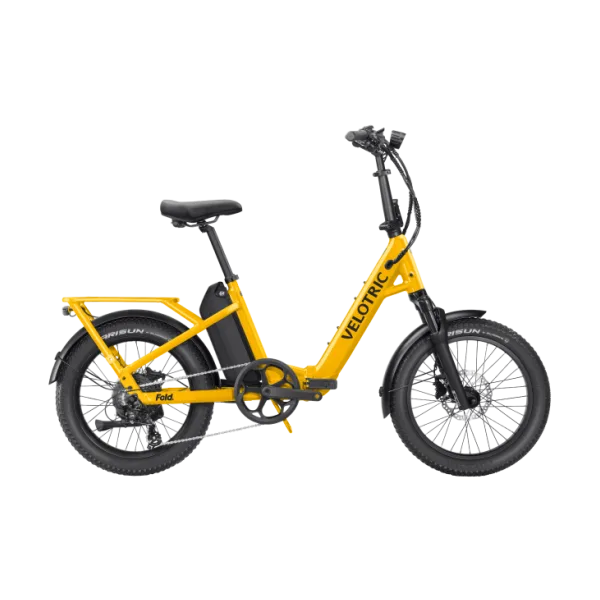
Some bikes let you change class in the display settings. The Velotric Fold 1 Plus is switchable across Class 1, 2 and 3, and so is the Himiway A7 Commuter.
On a bike whose route crosses a boundary this is genuinely useful rather than a marketing feature: ride Class 3 on the road, drop to Class 1 before the park entrance. It is not a loophole — the bike is legitimately in whichever class it is currently configured for — but it does put the responsibility on you to actually change it.
Above Class 3 you are not on a bicycle
Plenty of machines are sold as e-bikes that exceed 750W or assist past 28mph. Legally, in most states, those are not bicycles. Depending on where you are they may be mopeds or motor-driven cycles, which brings registration, a licence, insurance and a prohibition on bike lanes.
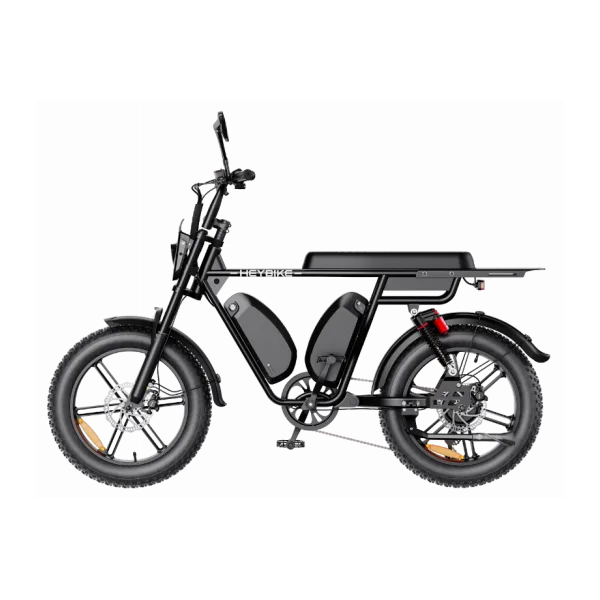
Manufacturers navigate this by rating the motor conservatively — a “1000W” bike such as the Heybike Saturn is typically 750W nominal with a 1000W peak, which keeps it inside the definition. The number in the marketing is peak; the number in the law is nominal. When a listing quotes only the larger figure, that is worth a question.
Removing a speed limiter has the same effect. A bike modified past its class is no longer the vehicle it was certified as, which matters for insurance and liability far more than for any likely traffic stop.
How to tell what class a bike is
Since 2016 the standard has been a label on the frame stating the class, top assisted speed and motor wattage. If a bike has no label, it was probably not built with the class system in mind, and getting a straight answer about it afterwards is often difficult.
- No throttle, cuts out at 20mph — Class 1.
- Throttle, cuts out at 20mph — Class 2.
- No throttle or a 20mph-limited one, assists to 28mph, has a speedometer — Class 3.
Common questions
Do I need a licence for a Class 1, 2 or 3 e-bike? In most states, no. All three are treated as bicycles. Above Class 3 the answer changes.
Can I ride a Class 2 on a bike path? Sometimes. It is the class most often excluded, so check the specific path rather than the state law.
Is a Class 3 bike faster uphill? Not necessarily. The 28mph figure is a cut-off, not a capability. Climbing is decided by motor torque and gearing, and a Class 1 mid-drive will frequently out-climb a Class 3 hub motor.
Does the class affect insurance? Home insurance often covers a bicycle and rarely covers a motor vehicle. A machine that exceeds Class 3 may fall into the gap between the two.
How this page makes money. Some links here are affiliate links and we earn a commission if you buy through them — currently BLUETTI, ALLPOWERS, Mango Power, Renogy and MoonCool. Every other brand on this page is here because leaving it out would make the comparison useless to you, and we are paid nothing either way. Prices are each maker’s own list price at the time of writing and change often.