
Home › Electric Bikes › Charging off-grid
Charging an E-Bike From a Power Station
What size station you need to put a full charge back into an e-bike, and how to work it out for your own pack.

How this page makes money. Some links on this page are affiliate links: if you buy through them we may earn a commission (on this page: BLUETTI). Brands that pay us nothing are included wherever leaving them out would make a comparison less useful.
The short version
Take your bike’s battery in watt-hours, add about 20% for charging losses, and buy a power station with at least that much usable capacity. A 672Wh e-bike pack needs roughly 800Wh of usable output to go from empty to full in one go, which is about 950Wh of rated station capacity once the station’s own inverter loss is counted (672 × 1.2 ÷ 0.85), so a 1,000Wh-class station.
Working out the number
E-bike chargers are not perfectly efficient, and neither is a power station’s inverter. Between them you lose somewhere between 10 and 25% of what leaves the station.
| E-bike pack | Energy needed at the wall | Sensible station |
|---|---|---|
| 360Wh (36V 10Ah) | ~430Wh | 500Wh+ |
| 500Wh | ~600Wh | 700Wh+ |
| 672Wh (48V 14Ah) | ~810Wh | 1,000Wh+ |
| 720Wh (48V 15Ah) | ~865Wh | 1,000Wh+ |
| 960Wh (48V 20Ah) | ~1,150Wh | 1,500Wh+ |
Buying a station the same size as the pack will not do it. A 700Wh station will not fully charge a 700Wh bike, because some of that energy is lost on the way through.
Output matters less than you think
E-bike chargers are modest loads — typically 100 to 200W, occasionally 300W on a fast charger. Almost any power station with a pure sine wave AC outlet will run one. Capacity is the constraint, not output.
Do check for pure sine wave rather than modified sine. Switching power supplies generally tolerate modified sine, but running one warm and unhappy for four hours is not worth the saving. Every station we track uses pure sine.
How many charges a station gives you
The sizing table earlier sizes a station for a single charge. For a trip, the more useful number is how many charges a station delivers. Two allowances turn rated capacity into charges: the pack draws about 20% more than its rating from the wall, as above, and a station delivers about 85% of its rated watt-hours through its inverter. Each full charge therefore costs the station about 1.4 times the pack’s rating (1.2 ÷ 0.85), against 1.2 times straight from a socket.
| Station | Capacity | 500Wh pack | 672Wh pack | 960Wh pack |
|---|---|---|---|---|
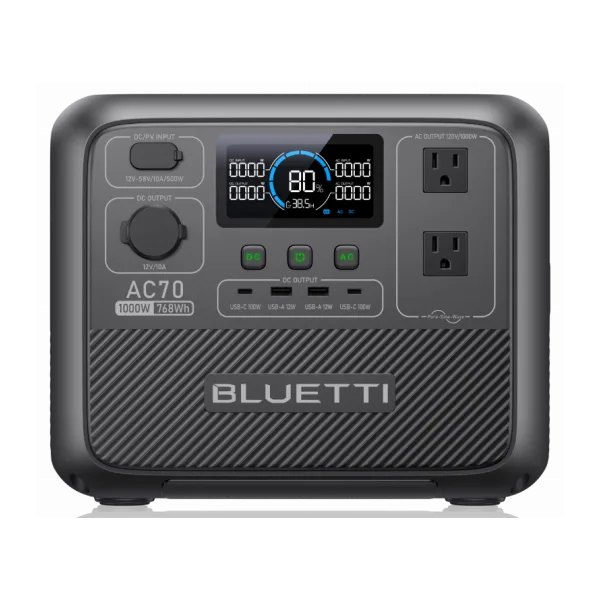 BLUETTI AC70 Portable Power Station | 768 Wh | 1.1 | 0.8 | 0.6 |
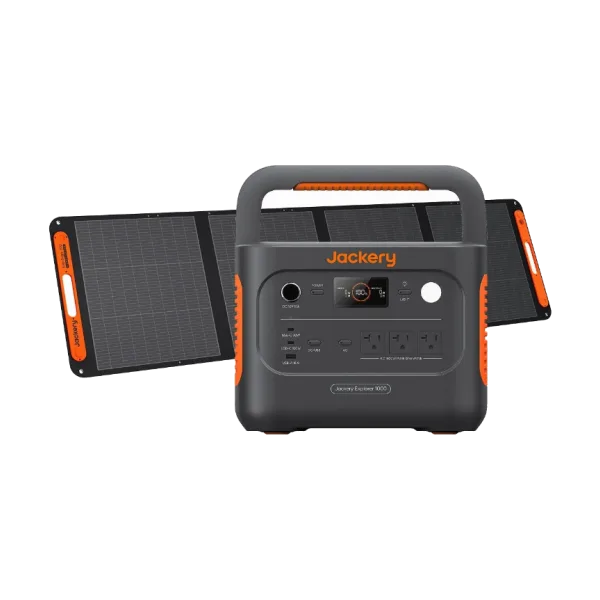 Jackery Portable Power Station Explorer 1000 | 1,070 Wh | 1.5 | 1.1 | 0.8 |
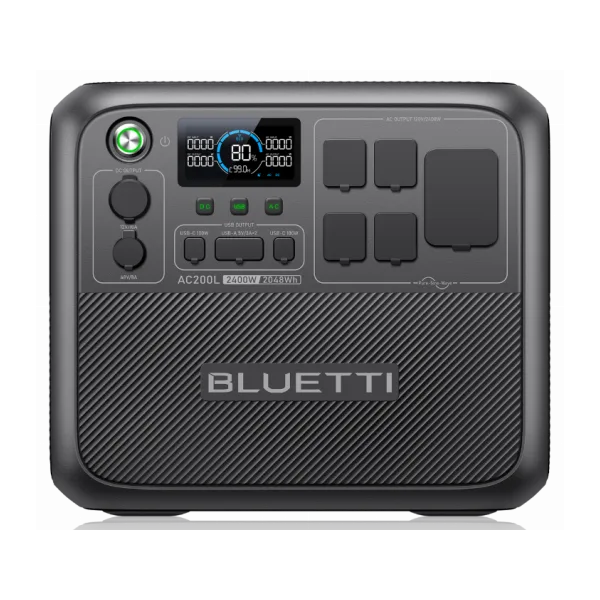 BLUETTI AC200L Portable Power Station | 2,048 Wh | 2.9 | 2.2 | 1.5 |
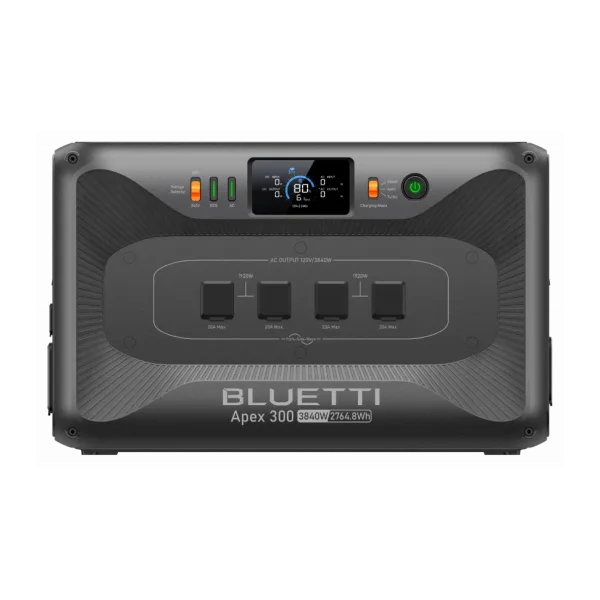 Apex 300 Versatile Power Station | 2,765 Wh | 3.9 | 2.9 | 2.0 |
These are full charges from an empty pack. A figure under 1.0 means the station cannot fill that pack from empty, and because most charges start part-way up, real counts run higher.
Output is shared with whatever else is plugged in. A 300W fast charger, a 65W laptop and 20W of lights come to 385W, well inside the smallest output in the table (1,000W), so charging the bike while you work is a question of watt-hours, not watts. Charging through a station never beats the wall for efficiency, since the station’s conversion losses sit on top of the charger’s; it earns its place where there is no socket.
How long it takes
Charging time is set by the bike’s charger, not the station. A 2A charger on a 48V pack delivers about 96W, so a 720Wh battery takes roughly seven to eight hours. A 4A fast charger halves that. The station simply supplies the wall power.
Two-day trips need solar. Charging a bike once will empty a mid-size station. If you are out for more than a night, pair it with panels — see solar generators.
Charging safely away from home
The same rules apply as at home, and they matter more when you are in a van or a tent.
Never charge a pack that is below freezing or still hot from a ride — let it settle to something like room temperature first. Charge outside the tent or vehicle where you reasonably can, and never leave a charge unattended overnight in an enclosed space. Use the charger the bike came with; a generic one running off an inverter is exactly the combination that causes trouble.
What about charging straight from solar?
Not directly. An e-bike charger expects household AC, and a solar panel produces variable DC. You need something in between, which is what a power station is: the panel charges the station, the station runs the charger.
For a full e-bike charge from sunlight in a day, plan on 200W of panel or more, and accept that a cloudy day will not do it.
Sizing a station generally? Our what size power station do I need guide covers the same arithmetic for fridges, CPAP machines and tools.