
How Many Watts Does a Gas Furnace Use?
A gas furnace’s blower and controls draw 300-800W running at 120V, with a startup surge (roughly 1,800-2,400W for a 600-800W PSC blower, far less for an ECM) that decides what breaker, generator or battery can actually run it.

How this page makes money. Some links on this page are affiliate links: if you buy through them we may earn a commission (on this page: BLUETTI and Amazon). As an Amazon Associate we earn from qualifying purchases. Brands that pay us nothing are included wherever leaving them out would make a comparison less useful.
A typical gas furnace draws 300–800W to run its blower motor on a permanent-split-capacitor (PSC) design, or 100–300W on a newer variable-speed ECM blower, plus 80–150W for the draft inducer — all on a standard 120V circuit. A furnace running its blower at 600W is drawing 5.0A (600W ÷ 120V). The number that actually matters, though, is the startup surge: on a PSC blower running at 600–800W, roughly 1,800–2,400W for a moment as the motor first spins up (an ECM blower ramps up with little surge). That surge, not the running wattage, is what trips a breaker or stalls an undersized battery.
What’s actually drawing power
The gas supplies the heat, but everything that moves the furnace through its cycle is electric. A call for heat starts the draft inducer, a small motor that pulls exhaust gases through the heat exchanger and out the flue before any gas is allowed to flow — this is a safety interlock, not an optional step. Once the inducer proves airflow, the igniter fires: either a hot surface igniter that glows for 15–40 seconds, or a spark igniter that fires repeatedly for a fraction of a second. Only then does the gas valve open. The blower motor, which moves the actual heated air through the ducts, typically doesn’t start until the heat exchanger has warmed for 30–45 seconds, and a small control board coordinates the whole sequence.
| Component | Running watts | Amps at 120V |
|---|---|---|
| PSC blower motor | 600 W | 5.0 A |
| ECM blower motor | 200 W | 1.7 A |
| Draft inducer motor | 100 W | 0.8 A |
| Hot surface igniter (120V type, 15–40 seconds per cycle) | 300–600 W | 2.5–5 A |
| Control board / thermostat | 5 W | <0.1 A |
The wattage figures above are typical values from manufacturer spec sheets, not something we’ve measured, and they vary by furnace size and blower speed setting — a furnace sized for a large house draws more than one sized for a small apartment, and a blower running on its highest fan-only setting draws more than the same motor on low heat. For a precise figure, use the amps or watts stamped on your furnace’s rating plate and run it through our watts-to-amps calculator rather than assuming the numbers here apply exactly to your unit.
The igniter row covers 120V hot surface igniters, which draw hundreds of watts while they glow: White-Rodgers rates its 21D64-2 nitride igniter at 3.0A maximum at 132V, and Supco lists its IG4000 silicon carbide igniter at 2.9–5.0A maximum at 115V. Furnaces with 80V nitride igniters or spark ignition fall outside this row. The igniter does not add to the blower’s start-up surge: on White-Rodgers’ 50T35 control board, for example, it switches off 5 seconds after the gas valve opens, and the blower waits 30 seconds for heat to build.
PSC versus ECM: why the range is so wide
PSC (permanent split capacitor) motors are the older, simpler, cheaper design. They run at a fixed speed and pull 300–800W continuously whenever the blower is on, regardless of how much airflow the system actually needs at that moment. ECM (electronically commutated) motors are the variable-speed alternative fitted to most newer, higher-efficiency furnaces. They ramp their draw to match demand, which is why they can idle at 100–300W for routine circulation and only climb toward the top of that range during a full heating cycle. If your furnace was built before mid-2019, when the Department of Energy’s furnace-fan efficiency standard took effect (it covers fans made from July 3, 2019), assume a PSC blower unless its spec sheet says ECM; for a furnace built since then, assume an ECM, often a constant-torque type, and use the ECM figures.
The startup surge
An ECM blower’s electronics ramp the motor up gradually, so it adds little start surge. A PSC blower and most draft inducers are different: they are induction motors, and induction motors draw far more current the instant they start than they do once spinning — for a PSC blower, roughly three times its running watts for a fraction of a second, because the motor has to overcome the inertia of a stationary rotor before it can settle into its running speed. For a furnace whose PSC blower runs at 600–800W, that multiplier puts the startup spike at roughly 1,800–2,400W; the motor’s label (its full-load amps, FLA, and, where listed, its locked-rotor amps, LRA) gives a better figure for your unit. This is the single most common reason a furnace trips a breaker it otherwise has headroom on, and it’s the number that actually determines whether a battery or generator can run the unit at all — a power source that clears the running wattage with room to spare can still stall or shut down on the surge if its surge rating isn’t high enough. Generator sizing charts put the spike on the same scale: Eugene Water & Electric Board’s chart lists a 1/3 HP furnace fan blower at 700 running watts plus 1,400 additional starting watts, or 2,100W at the moment of start.
Why the circuit is sized the way it is
Furnaces are wired to their own dedicated circuit, usually 15A at 120V, rather than sharing one with other household loads. Under NEC 210.20, a circuit is only loaded to 80% for a continuous load, so a 15A circuit is rated for 12A continuous — 12A × 120V = 1,440W. Even a furnace running at the top of the PSC range, 800W (6.7A), sits well inside that ceiling with the inducer added (the igniter normally switches off before the blower starts). That headroom helps the circuit ride through the startup surge, but it is not the reason furnaces get a circuit of their own: the National Electrical Code (NEC 422.12) requires central heating equipment, gas furnaces included, to be on an individual branch circuit, which only the furnace’s own accessories (such as a humidifier, condensate pump or electronic air cleaner) and permanently connected air-conditioning equipment may share. Which code edition applies depends on what your area has adopted, so have a licensed electrician do any work on the furnace circuit.
Running a furnace during an outage
This is where the gas-versus-electric distinction actually bites. The furnace burns gas for heat, but every part that moves gas and air through the system — the draft inducer, the igniter, the blower, the control board — is electric, so a furnace with a full tank or an uninterrupted gas line still does nothing at all if the power is out. We cover sizing a specific unit in detail in powering a gas furnace from a portable power station; the short version is that you need a source that clears both the running wattage above and the startup surge, not just one or the other.
How you connect it depends on how the furnace is installed. Some gas furnaces plug into a standard 120V outlet on their dedicated circuit near the unit — if yours does, you can unplug it from the wall once you’ve confirmed utility power is actually off, and plug it straight into the power station. A furnace hardwired directly into the panel with no accessible plug needs either a manual transfer switch or interlock kit installed on the breaker panel, or a licensed electrician to add a disconnect. Don’t improvise a connection into a hardwired circuit or attempt to backfeed a panel from a power station or generator; that’s how you energize a line a utility crew assumes is dead.
Two more checks belong in any outage plan. First, flame proving. The control board keeps the gas valve open only while it reads a tiny current through the flame: White-Rodgers’ 50T35 board needs at least 1 microamp, retries twice after a failed ignition, then locks out, and its instructions call for proper earth grounding and correct hot and neutral wiring. A power station feeding the furnace has to provide that ground and neutral reference too, so if the burner lights on battery power and drops out within seconds, read our floating-neutral section before blaming the battery size.
Second, carbon monoxide. The furnace still burns gas in an outage, and a generator adds a second CO source. The CPSC advises battery-operated CO alarms, or alarms with battery backup, on each level and outside separate sleeping areas, tested monthly; an alarm that runs only on house power goes quiet in a power cut. A generator belongs outside only, at least 20 feet from the house, with its exhaust directed away from the home and windows and other openings in the exhaust path closed. Never run one in the home, a garage, basement, crawlspace or shed, or on a porch; CPSC says opening doors or windows will not provide enough ventilation.
Sizing a power station to the surge, not just the running load
Most portable power stations publish two figures: a continuous AC output rating and a separate, higher surge or peak rating, 1.5 to 2 times the continuous figure on the four units below. The continuous rating needs to clear your furnace’s running watts with margin; the surge rating needs to clear the startup spike (roughly 1,800–2,400W for a PSC blower, much less for an ECM) on its own, since that spike arrives on top of whatever else the unit is already running.
| Power station | Capacity | Continuous AC output | Maker surge or peak rating |
|---|---|---|---|
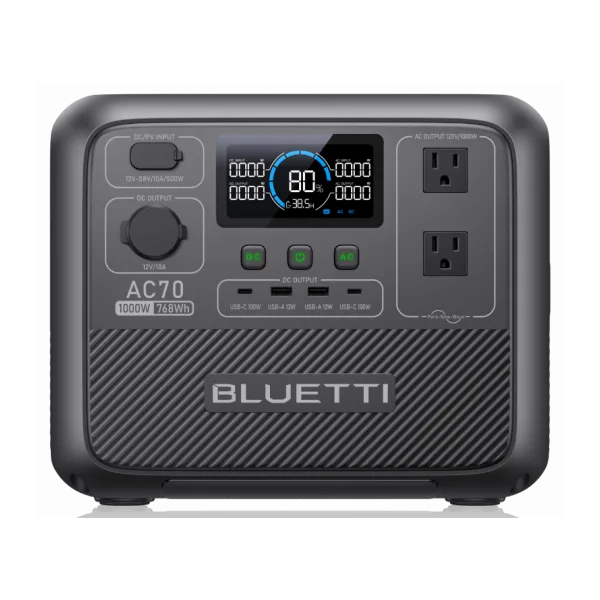 BLUETTI AC70 Portable Power Station BLUETTI AC70 Portable Power Station | 768 Wh | about 1,000W | 1,500W surge |
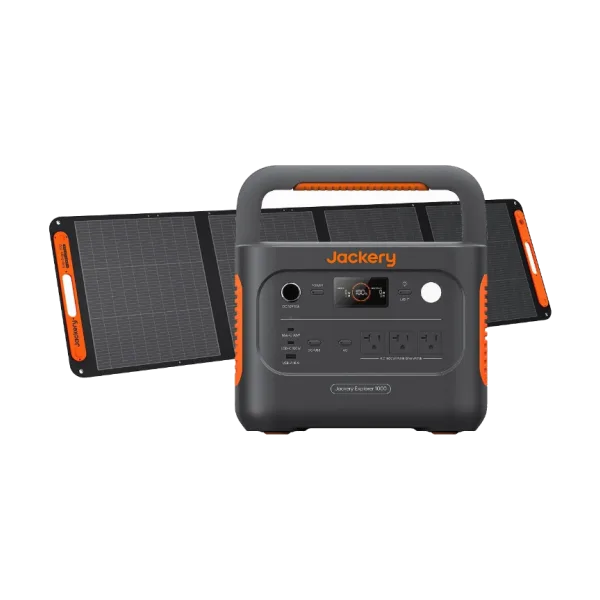 Jackery Portable Power Station Explorer 1000 v2 Jackery Portable Power Station Explorer 1000 v2 | 1,070 Wh | about 1,500W | 3,000W surge peak |
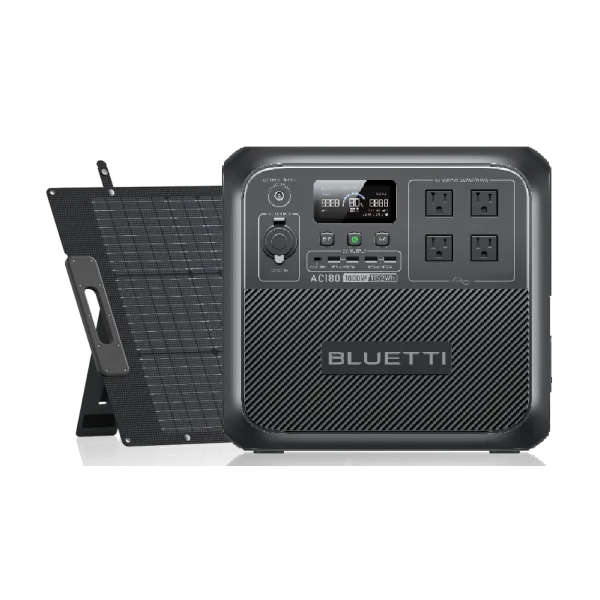 BLUETTI AC180 Portable Power Station BLUETTI AC180 Portable Power Station | 1,152 Wh | about 1,800W | 2,700W surge |
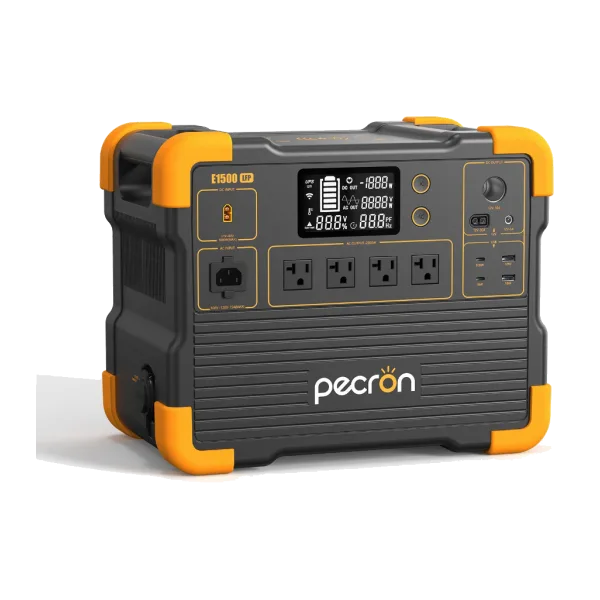 PECRON E1500LFP Expandable Portable Power Station 2200W 1536Wh V3 Version PECRON E1500LFP Expandable Portable Power Station 2200W 1536Wh V3 Version | 1,536 Wh | about 2,200W | 4,400W peak (10 ms) |
These are each maker’s own figures, and they are not stated on the same basis: PECRON gives its 4,400W peak for 10 milliseconds, while Jackery and BLUETTI give no duration. A PSC furnace needs a surge rating of about 2,500W or more (the top of the blower estimate plus the inducer, which is already running when the blower starts) and about 1,000W continuous. The AC180’s 2,700W clears that with little to spare, so check your blower’s label before relying on it. An ECM furnace’s heaviest moment is ignition, when the inducer and a 300–600W igniter run together for under a minute, so about 1,000W continuous covers it.
Take the BLUETTI AC70 Portable Power Station as a worked example. BLUETTI lists it at 1,000W rated and 1,500W surge, below the 1,800–2,400W a 600–800W PSC blower pulls at start-up, so it suits an ECM furnace, not a PSC one in that range. Its 2,000W Power Lifting mode does not help: BLUETTI says the mode only works for resistive loads such as space heaters and kettles, and warns that motors and compressors may surge to 2–4 times their rated power. On an ECM furnace its 768 Wh lasts roughly 4–5 hours (see the runtime section below). Anyone sizing for a longer outage, or planning to recharge the station from panels between cycles, should start with our guide to sizing a solar system rather than assuming a bigger battery alone solves it. The PECRON E1500LFP Expandable Portable Power Station 2200W 1536Wh V3 Version and units like it earn their higher price mainly through output headroom (PECRON lists 2,200W continuous and a 4,400W peak for the E1500LFP), which matters more here than raw capacity; check the cost of that headroom against the other power stations we track on our power station price index before assuming bigger is always the right call. Our power station finder lets you filter by continuous and surge output directly if you’d rather start from the furnace’s numbers than from a product list.
Energy per day and runtime through an outage
Surge decides whether the furnace starts; stored energy decides how long it runs. A furnace cycles, so runtime depends on its duty cycle, the share of each hour the burner and blower actually run. The figures below assume 40%; colder weather raises that share and shortens every number here.
| Load | Watts while on | Energy per day at 40% |
|---|---|---|
| PSC blower (middle of its range) | 500–600 W | 4.8–5.8 kWh |
| ECM blower | 200–300 W | 1.9–2.9 kWh |
| Draft inducer | 100 W | 1.0 kWh |
| Control board (on all day) | 5 W | 0.1 kWh |
| Hot surface igniter | 300–600 W for 15–40 seconds | under 7 Wh per ignition |
Leaving out the igniter, which adds up to 7 Wh each time the burner lights, that comes to about 5.9–6.8 kWh a day for a PSC furnace and 3.0–4.0 kWh for an ECM one. Inverters lose some of the stored energy: Jackery’s runtime formula for its Explorer 550 multiplies capacity by 0.85, and BLUETTI’s formula for the AC180 assumes 85% inverter efficiency. So a full day takes roughly 6.9–8.0 kWh of battery for a PSC furnace and 3.5–4.7 kWh for an ECM one, more than any of the four stations listed above holds. The runtimes below are capacity × 0.85 ÷ the furnace’s average draw (245–285W for PSC, 125–165W for ECM):
| Power station | PSC furnace | ECM furnace |
|---|---|---|
| BLUETTI AC70 (768 Wh) | surge rating too low | 4.0–5.2 hours |
| Jackery Explorer 1000 v2 (1,070 Wh) | 3.2–3.7 hours | 5.5–7.3 hours |
| BLUETTI AC180 (1,152 Wh) | 3.4–4.0 hours | 5.9–7.8 hours |
| PECRON E1500LFP (1,536 Wh) | 4.6–5.3 hours | 7.9–10.4 hours |
| Any 2,000 Wh station | 6.0–6.9 hours | 10.3–13.6 hours |
Treat these as upper bounds: they leave out the igniter, the station’s idle draw and any capacity the maker holds back. BLUETTI’s AC180 formula also assumes a 90% depth of discharge and about 15W of self-consumption, which cuts that unit’s figures by 15–20%. For a longer outage, size up with our guide to a power station for a gas furnace.
How a furnace compares to other outage loads
A furnace’s running wattage is modest next to some of the other appliances people size a power station around — a refrigerator’s compressor, for instance, carries its own surge problem that we break down in watts to run a refrigerator, our most detailed appliance page. If you’re building an outage plan that covers more than the furnace, our appliance wattage chart lays out running and surge figures for the rest of the house in the same format used here, so you can add up a real total instead of guessing at it.
The arithmetic throughout comes down to the same three numbers every time: the blower’s running watts, the roughly 3x surge multiplier on top of it, and 120V as the voltage doing the dividing. Get those three right and sizing a breaker, a generator, or a battery for a gas furnace stops being a guess.