
How this page makes money. Some links on this page are affiliate links: if you buy through them we may earn a commission (on this page: BLUETTI). Brands that pay us nothing are included wherever leaving them out would make a comparison less useful.
The honest answer: some of it
A solar generator will comfortably run the things that matter in an outage — fridge, internet, lighting, phone charging, a gas furnace blower. It will not run a whole house the way the grid does, and any seller implying otherwise is overselling.
The useful question is not “can it power my house” but “which circuits do I actually need during an outage”. For most households that list is much shorter than expected.
How much a whole house actually uses
The average US residential customer bought 10,791kWh of electricity in 2022, about 899kWh a month, according to the U.S. Energy Information Administration. That is roughly 30kWh a day. State averages run from about 17kWh a day in Hawaii (6,178kWh a year) to about 40kWh a day in Louisiana (14,774kWh a year). EIA counts only power bought from the utility, so homes with rooftop solar use more than these figures show.
Set that against the essentials figures further down this page: about 1,000Wh to keep a fridge and devices going for ten hours, about 2,000Wh for a fridge, furnace and lights overnight, and 3,000–5,000Wh for a full heating-season day with an efficient furnace blower. A 2,000Wh station holds about a fifteenth of an average home’s daily use. That covers the essentials. It does not cover the house.
What it will run
| Appliance | Draw | Realistic? |
|---|---|---|
| Fridge / freezer | 100–250W running; about 40–80W averaged over 24 hours | Yes |
| Internet + phones | 20–40W | Easily |
| LED lighting | 20–60W | Easily |
| Gas furnace blower | 300–600W | Yes |
| CPAP | 30W; 70W with heated humidifier | Yes |
| Microwave (bursts, draw from the outlet) | 1,000–1,700W | With enough output |
| Electric heat | 1,500W+ | No |
| Central air conditioning | 3,000W+ | Not on a 1–3kWh station; needs a system rated for its start (see below) |
| Electric water heater | 4,500W | No |
| Well pump | Start surge 4–8× running current | Generator, or a battery system rated for its start (see below) |
The pattern is simple. Anything that makes heat or moves large volumes of air or water is out of reach for a 1,000–3,000Wh station. Everything else is usually fine.
What it costs to cover the essentials
- Fridge and devices for an outage of up to about ten hours: around 1,000Wh — EcoFlow DELTA 3 Classic Solar Generator.
- Fridge, furnace and lights through an overnight outage: around 2,000Wh — Bluetti AC200L. A full heating-season day takes roughly 3,000–5,000Wh with an efficient (ECM) furnace blower and up to about 7,500Wh with an older PSC blower.
- Several circuits, multi-day, expandable: Bluetti Apex 300Check price at BLUETTI with extra batteries.
Store prices for those units, with the cost per kWh of battery for comparison:
| Unit | Battery | Price (maker list price, October 2026) | Per kWh |
|---|---|---|---|
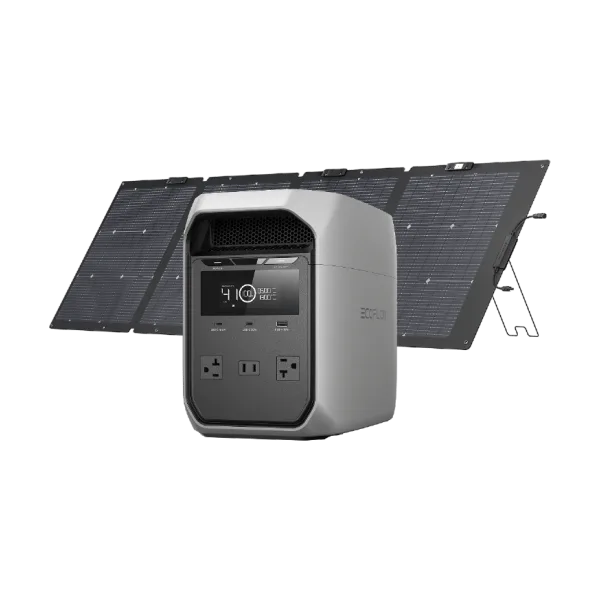 EcoFlow DELTA 3 Classic Solar Generator, 160W panel included | 1,024Wh | $619 | about $605 |
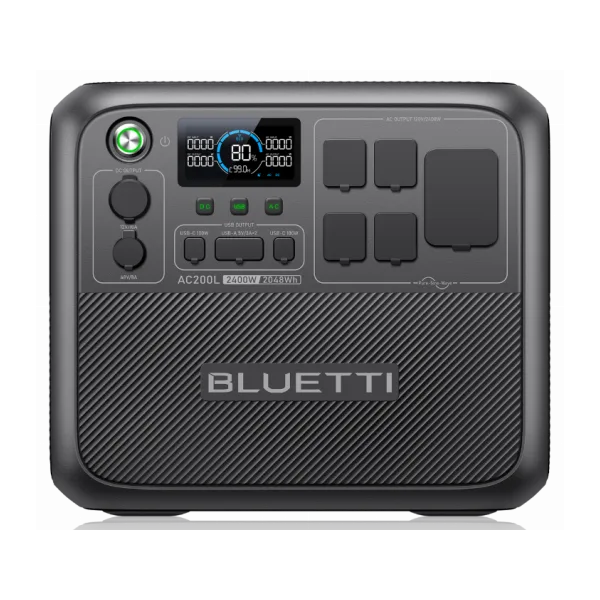 Bluetti AC200L | 2,048Wh | $899, marked discontinued | about $440 |
| Bluetti Apex 300 | 2,764.8Wh | $1,599 | about $580 |
| Bluetti Apex 300 + one B300K battery (Bluetti bundle) | 5,529.6Wh | $2,599 | about $470 |
With the AC200L now listed as discontinued on Bluetti’s US store, check stock before planning around it. Sales move every figure here.
Costs and the three routes to home backup are laid out in home battery backup.
Whole-home batteries that can start central AC and a well pump
Whether a battery can run central air or a well pump usually comes down to the start, not the running load. Enphase’s technical brief on running pumps and HVAC from batteries (March 2021) notes that most HVAC units, motors and pumps draw 4–8 times their normal operating current for a moment at start-up. The figure to check is the locked-rotor amps (LRA) on the compressor or pump nameplate. Variable-speed (inverter) air conditioners typically have no start surge.
The brief’s typical LRA figures for central AC compressors, before any soft starter, are 70–80A for a 3-ton unit, 100–120A for a 4-ton and 125–135A for a 5-ton. Drawing on the National Electrical Code’s motor tables, it lists a 1 HP single-phase motor at 8A running and 48A locked-rotor on 240V, or 16A and 96A on 120V. A soft starter brings the start down: in the same brief, a 4-ton compressor drops to 38–46A. The battery has to cover the LRA plus whatever else is running at that moment.
Most power stations are rated only in watts, with a surge figure at most, so a motor start cannot be checked against them on paper. Tesla and Generac publish a locked-rotor rating for their installed batteries, and EcoFlow gives one for the DELTA Pro Ultra. Four whole-home systems on their makers’ own figures:
| System | Storage | Continuous output | Motor start | Price (maker list price, October 2026) |
|---|---|---|---|---|
| Tesla Powerwall 3 | 13.5kWh per unit; up to 4 units | 11.5kW, 120/240V | 185 LRA | Installer quote |
| Generac PWRcell 2 | 9–18kWh per cabinet; 36kWh with two | Up to 11.5kW (two cabinets) | 130 LRA with an 18kWh cabinet; 65 LRA with 9kWh | Installer quote |
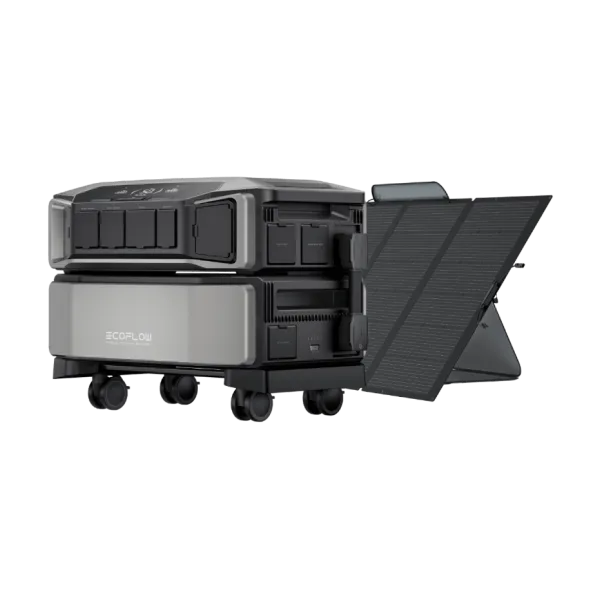 EcoFlow DELTA Pro Ultra | 6,144Wh per battery; 30kWh per inverter, 90kWh with three | 7,200W per inverter (10.8kW surge), 120/240V | 120 LRA per inverter | $4,199 (one inverter, one battery) |
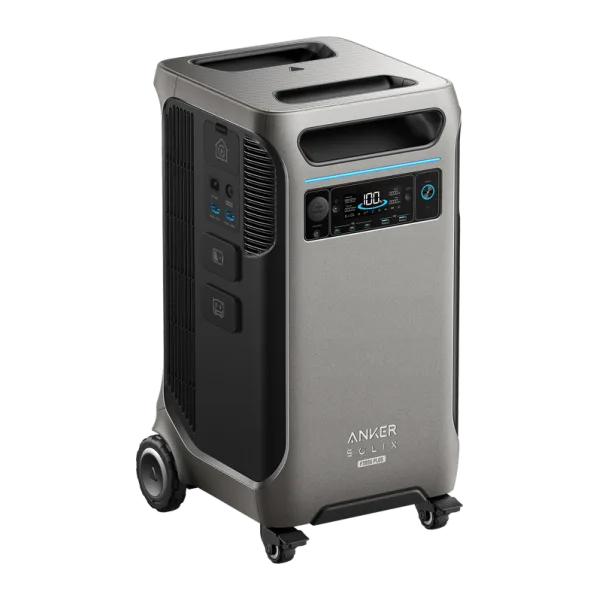 Anker SOLIX F3800 Plus | 3,840Wh; up to 53.8kWh with two units and expansion batteries | 6,000W, 120/240V | Not published | $2,699.99 |
On paper, Powerwall 3’s 185 LRA reaches the top of every range in Enphase’s table, which runs to 6-ton units at 140–185A. An 18kWh PWRcell 2 cabinet’s 130 LRA clears a typical 4-ton unit; Generac rates that start with 2kW of other load already running, the battery at 12–100% charge and the air below 95°F. EcoFlow says one DELTA Pro Ultra runs a 3-ton central air conditioner, and two run a 4-ton unit if its LRA is within 120A. Anker says the F3800 Plus powers central AC but publishes no locked-rotor figure. Before buying any of them for a compressor or a pump, have the installer check the nameplate LRA against the system’s rating and put it in the quote.
Storage still sets the clock. One Powerwall 3 holds 13.5kWh, under half of the 30kWh an average home uses in a day, and four hold 54kWh. Powerwall 3 accepts up to 20kW of solar panels directly, so panels can refill it during a long outage. Per kWh of battery, the DELTA Pro Ultra works out to about $685 with one battery and about $490 with two ($5,999 for 12,288Wh, maker list price, October 2026); the F3800 Plus is about $705. For an installed system, divide the installer’s written quote by the usable kWh to compare on the same basis.
Connecting a battery to the house safely
There are two safe ways to use a battery in an outage. The simple one is to plug appliances into the unit’s own outlets, using heavy-duty extension cords rated for the load. The other is to power house circuits through a transfer switch or the maker’s own backup panel, installed by a qualified electrician to local electrical code. FEMA gives the same advice for generators. Your local building department can tell you whether the job needs a permit and inspection.
Never feed house wiring by plugging a station or generator into a wall or dryer outlet. CPSC calls this backfeeding and warns that it is extremely dangerous: it puts utility workers and neighbors on the same transformer at risk of electrocution, and it bypasses some of the home’s circuit protection. OSHA’s portable generator fact sheet adds that a source tied into a building without a properly installed transfer switch can energize wiring for great distances. Those warnings are written for generators, but a power station’s AC outlets put the same household voltage onto whatever they are connected to.
The whole-home systems above connect through their makers’ transfer hardware. Powerwall 3 works with Tesla’s Backup Gateway 2, Gateway 3 or Backup Switch. PWRcell 2 uses Generac’s Smart Disconnect Switch, rated for whole- or partial-home backup up to 200A. EcoFlow sells the DELTA Pro Ultra with its Smart Home Panel 2, which switches over automatically and must be installed before use; the bundle with the panel is $5,599 (maker list price, October 2026), $1,400 more than the unit alone, before installation. Anker says the F3800 Plus can connect to a transfer switch, an inlet box or its own Home Power Panel. Count that hardware and the electrician in the price of any whole-home setup.
Where solar changes the math
Battery alone is a fixed budget. Add panels and it refills each day, which turns a one-day solution into an indefinite one — weather permitting. That is the real argument for a solar generator over a plain battery.
Expect a realistic panel output well below the rated figure when you plan it.
When you should buy a generator instead
If you have electric heat, a well pump and no whole-home battery to start it, or outages measured in days rather than hours, a gas generator is still the right tool — or both. The honest comparison is in power station vs generator.
Run a generator outdoors only. CPSC says to keep it at least 20 feet from the house with the exhaust pointed away from windows, doors and vents, never to run it in a garage or basement even with the doors open, and to fit battery-operated or battery-backup CO alarms on every level of the home and outside sleeping areas.