
Home › Power Stations › Bluetti Apex 300
Bluetti Apex 300 Review
Bluetti’s flagship portable: high output, genuinely expandable, and aimed at backing up a house rather than lighting a campsite.
The short version
The Apex 300 is the unit to look at if you want one purchase that can grow. It pairs a large LiFePO4 pack with an inverter big enough for real household loads, and it accepts expansion batteries, so the ceiling is far higher than the box you start with.
It is not the right choice if you want something to throw in a car for weekends. It is heavy, it is expensive, and most of what makes it good is wasted on a camping trip.
Buy it if you are backing up a home, you want expandability, or you want maximum stored energy per dollar. Skip it if portability matters or your loads are small — the AC200L is better value for most people.
Specifications
| Specification | Figure |
|---|---|
| Capacity | 2,764Wh |
| Continuous output | 3,840W |
| Cell chemistry | LiFePO4 |
| Expandable | Yes |
Those are manufacturer figures. Two things worth knowing about how they translate: usable capacity after inverter losses is typically 80–90% of the rating, and continuous output is the number that decides whether something starts, not capacity.
What it will actually run
| Load | Draw | Rough runtime |
|---|---|---|
| Full-size fridge | 100–200W avg | 14–25 hours |
| CPAP | 30–60W | Several nights |
| Gas furnace blower | 300–600W | 5–9 hours |
| Starlink Mini | ~40W | 2–3 days |
| Microwave (bursts) | 1,000–1,500W | Handles it |
Runtimes assume roughly 85% usable capacity. Real figures move with temperature and how hard the inverter is working.
Where it beats EcoFlow
Capacity per dollar, and expandability. Compare it against EcoFlow’s equivalent and you generally get more stored energy for the money, plus the option to bolt on more later rather than replacing the unit.
Where it loses
Recharge speed. EcoFlow refills faster from a wall socket, and if your outages come with short windows of restored power, that gap matters more than the capacity advantage.
The full comparison is in Bluetti vs EcoFlow.
What you actually get in the box
Worth checking before you buy, because the accessory list changes what it costs to make the thing useful. A station on its own is a battery with sockets. To charge it from the sun you need panels and the right cable; to feed household circuits you need either extension leads or an electrician.
Budget for the whole system rather than the headline unit. Panels typically add 30–60% to the total, and a transfer switch install is a few hundred dollars on top. Our home battery backup guide breaks down all three routes.
Charging: the three ways in
From the wall
The default. Bluetti trades charge speed for capacity across the range, so expect this to be slower than an equivalent EcoFlow. For a unit that sits full waiting for an outage, that is a non-issue.
From solar
Check the maximum solar input in both watts and volts before buying panels. Exceeding the wattage wastes the surplus; exceeding the voltage can damage the unit. See how to size a solar system for the arithmetic, and solar panels and kits for what to pair it with.
From a vehicle
Slow but useful on the road. A 12V socket delivers very little; a dedicated alternator charger is far quicker if you are living in a van or RV.
Expansion: the reason to buy this one
The Apex 300 accepts additional battery modules, which is the single feature that separates it from cheaper units. A sealed station is a ceiling — when you outgrow it you buy a second one and own two half-solutions. An expandable system grows with you.
The rule of thumb. If your requirement is anywhere near the edge of a unit’s capacity, buy expandable. Batteries also lose capacity as they age, so sizing exactly to today’s need means being short inside two years.
Three scenarios, worked through
A 24-hour outage, gas heat
Fridge at roughly 150W average, furnace blower at 400W intermittently, router, phones and a few lights. That lands around 2,200–2,800Wh over a full day — right at this unit’s capacity, and comfortably inside it if you are sensible about the fridge door. See how many watts a refrigerator uses.
A weekend off-grid with Starlink
Starlink Mini at 40W continuous is roughly 960Wh a day if you leave it up, which is more than most people budget for. Add a 12V fridge and lighting and you are near 1,500Wh daily — so this unit gives you close to two days. Detail in best power station for Starlink.
A job site
Output matters more than capacity here. The high continuous rating handles most corded tools, but sustained heavy draw drains any battery fast. If you are running a compressor all day, a generator is still the right tool — see power station vs generator.
Alternatives worth comparing
| If you want… | Look at | Why |
|---|---|---|
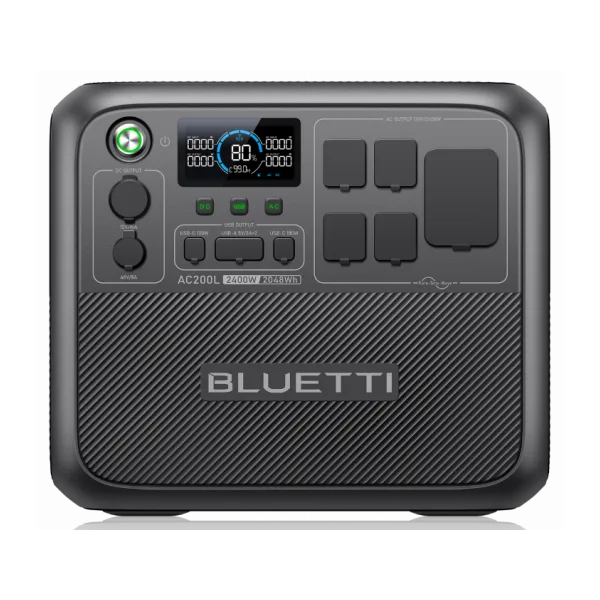 The same job, less money The same job, less money | Bluetti AC200L | Enough for a fridge overnight at a lower price |
| Faster recharge | EcoFlow Delta 2 | Refills in a fraction of the time, smaller battery |
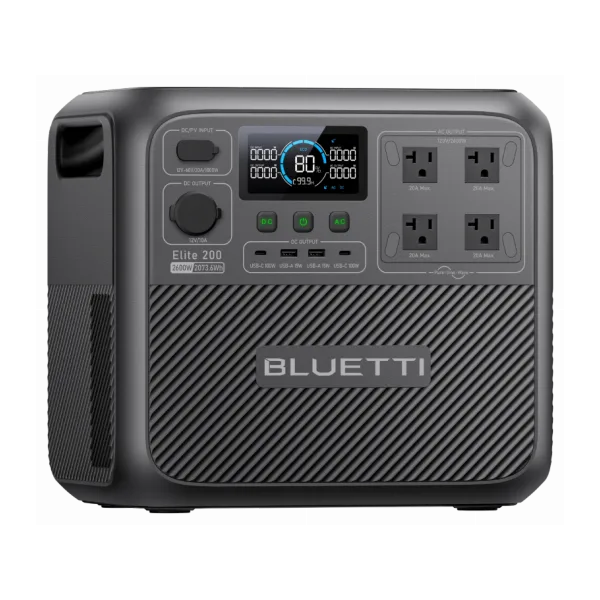 Lighter to carry Lighter to carry | Bluetti Elite 200 V2 | Similar capacity, meaningfully less weight |
| More capacity per dollar | OUPES | Challenger brand competing directly on watt-hours |
| Home backup, expandable | Mango Power | Built for household circuits rather than camping |
Still undecided between the two big names? Bluetti vs EcoFlow reduces it to a single question.