

How this page makes money. Some links on this page are affiliate links: if you buy through them we may earn a commission (on this page: Amazon). As an Amazon Associate we earn from qualifying purchases. Brands that pay us nothing are included wherever leaving them out would make a comparison less useful.
Of the current power stations we track, the portable units rated for 4,500W or more of continuous output are two Anker SOLIX F3800 versions, the Jackery 5000 Plus and, from its 240V side, the OUPES Guardian 6000 V2. The ones that store 4,500Wh or more are the Jackery, the Pecron F5000LFP and the Guardian, though Pecron gives the F5000LFP’s 240V output only as 7,200W max, with no separate continuous rating. One box that delivers 5,000W and stores 5,000Wh is rarer than the search suggests.
Watts or watt-hours: which 5,000 do you need?
5,000W is a rate: what the inverter can deliver at once, which decides what you can plug in. 5,000Wh is a quantity: how much energy is stored, which decides how long it runs. They pull against each other. A 5,040Wh unit run flat out at 5,000W is empty in about 51 minutes (5,040 × 0.85 for inverter losses, divided by 5,000), and a 3,840Wh unit in about 39. Buy on output to start heavy 240V loads such as a well pump or an air-conditioner compressor; buy on capacity for hours or days of ordinary use.
Units with 4,500W or more of continuous output
| Model | Continuous AC | Surge | Capacity | Max solar in | AC charge in | Weight |
|---|---|---|---|---|---|---|
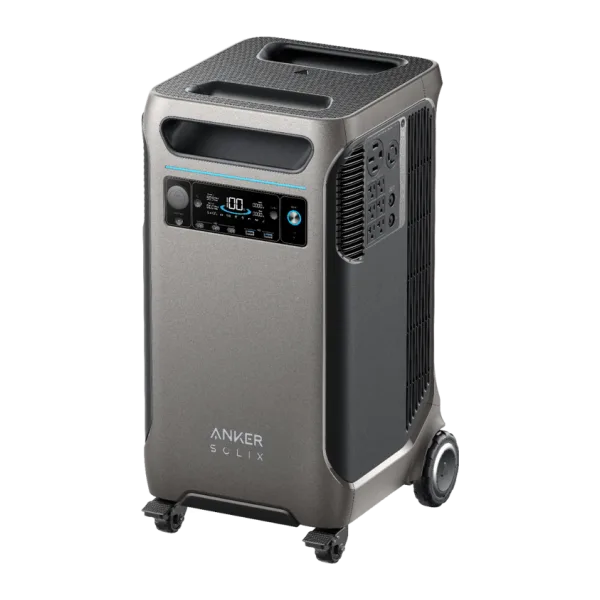 Anker SOLIX F3800 Anker SOLIX F3800 | 6,000W | 9,000W | 3,840Wh | 2,400W | 1,800W | 132.3 lb |
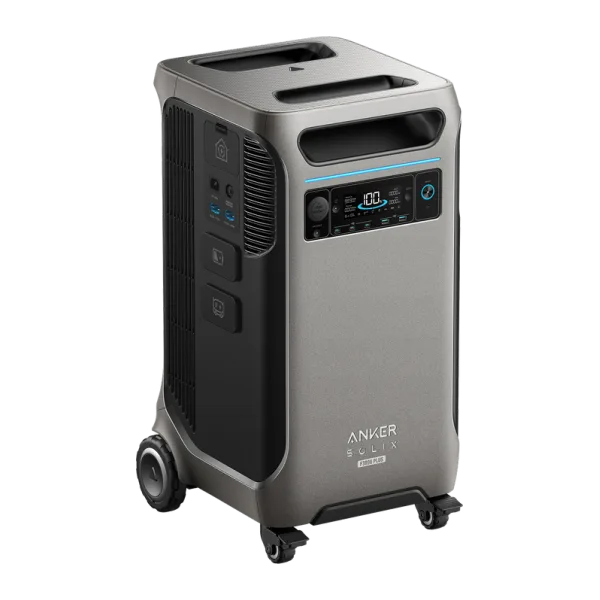 Anker SOLIX F3800 Plus Anker SOLIX F3800 Plus | 6,000W | 9,000W | 3,840Wh | 3,200W | 1,800W | 136.7 lb |
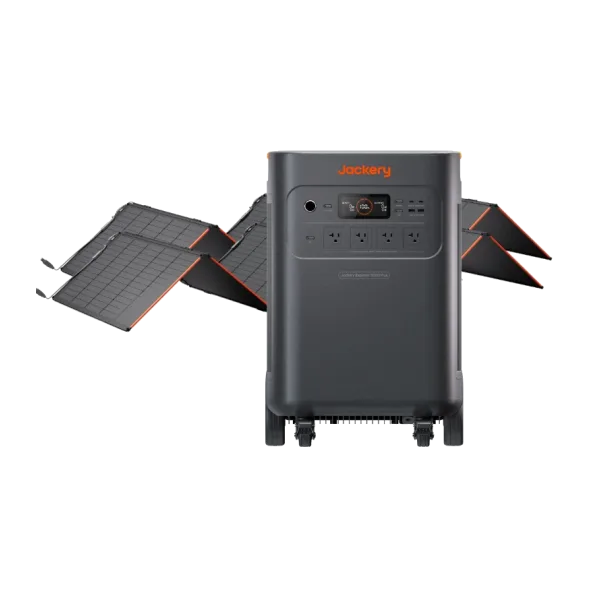 Jackery Solar Generator 5000 Plus Jackery Solar Generator 5000 Plus | 7,200W | 14,400W | 5,040Wh | 4,000W | 1,800W (120V, 15A) | 134.5 lb |
All three use LiFePO4 cells and a 5-year warranty; the Anker pair is rated for 3,000 cycles, the Jackery for 4,000. Anker rates both F3800 versions at 9,000W surge. Jackery rates the 5000 Plus at 14,400W surge, with up to 4,000W of solar input and 1,800W of AC charging (120V, 15A), on its spec page (checked October 2026); our Explorer 5000 Plus page has more on the unit. The Plus takes more solar than the F3800: Anker lists 3,200W for it (two 1,600W inputs, 11-165V) against 2,400W, and a net weight of 136.7 lb. All three take add-on batteries, and for the Anker pair, reaching 5,000Wh means adding one.
Near-misses: the EcoFlow DELTA Pro is 3,600W and 3,600Wh, and the DELTA Pro 3 is 4,000W and 4,096Wh. Neither clears 4,500W of output or 4,500Wh of storage.
The OUPES Guardian 6000 V2 clears both bars, the output bar only from its 240V side. OUPES rates it at 6,000W at 240V, with a 9,000W surge, and at 3,600W from its 120V outlets, and lists 4,608Wh, 3,600W of solar input and a net weight of 111.8 lb (spec page checked October 2026). Because its 120V outlets are rated 3,600W, our 3000 watt page covers it too; check which outlets your loads need before counting on the 6,000W figure.
A 5,000W rating is not one 5,000W outlet
A standard 120V outlet on a 20A circuit carries 2,400W (120V × 20A), or 1,920W continuously at the usual 80% limit, so anything above that must leave the unit through 240V outlets or several outlets at once. Jackery’s manual, for example, splits its 120V sockets into two 3,600W banks, so the 7,200W total needs the 240V ports or both banks, and output falls to 3,600W between 5°F and 14°F. Pecron lists both 120V and 240V output for the F5000LFP; for any unit, confirm outlet types and amp ratings on the maker’s spec sheet before planning around a 240V load.
Units that store 4,500Wh or more
| Model | Capacity | Continuous AC | AC charge in | Cycle life | Warranty | Weight |
|---|---|---|---|---|---|---|
| Jackery Solar Generator 5000 Plus | 5,040Wh | 7,200W | 1,800W (120V, 15A) | 4,000 cycles | 5 years | 134.5 lb |
| Pecron F5000LFP | 5,120Wh | 7,200W max at 240V | 3,600W | 4,000 cycles | 3+2 years | 123.9 lb |
Both units take add-on batteries (5,040Wh for the Jackery, 5,120Wh for the Pecron), but those add storage and no inverter, so they are left out. The Pecron was still sold as a pre-order when we checked in October 2026, and Pecron’s spec page gives its 240V output only as 7,200W max, with no separate continuous or surge rating, and its warranty as 3+2 years, so the Jackery is the better documented of the two.
Apart from the Guardian, the other products we track that store more than 4,500Wh are not stand-alone 5,000W power stations. EcoFlow’s two 5kWh LFP batteries are storage modules with no output rating of their own, and Goal Zero’s 16,000Wh Haven kit pairs a Yeti PRO 4000, which Goal Zero lists at 3,600W, with three add-on batteries. EcoFlow’s DELTA Pro Ultra whole-home kit does clear both bars, as a modular home-backup system rather than one portable box: EcoFlow lists 7,200W continuous at 120/240V from its inverter and 6,144Wh per battery module.
What 5,000W runs, and for how long on 5,000Wh
Runtime is capacity × 0.85 for inverter losses, divided by the load, so 5,000Wh gives 4,250Wh usable.
| Load | Running draw | Starting surge | Runtime on 5,000Wh |
|---|---|---|---|
| Fridge, freezer, LED lights, Wi-Fi | 165W | Low | 26 hr |
| Same, plus a gas furnace blower (ECM) | 365W | Low | 11.6 hr |
| Well pump, 1/2 hp | about 1,000W | about 3,000W (5,300W to 7,400W locked-rotor) | 4.3 hr if nonstop |
| Well pump, 1 hp | about 1,600W | about 6,000W (9,600W to 11,200W locked-rotor) | 2 hr 39 min if nonstop |
| Central air conditioning, 3-ton | 3,000W to 4,000W | 8,000W to 20,000W | 1.1 to 1.4 hr |
| Electric water heater | 4,500W | None (resistive) | 57 min |
| EV charger set to 16A at 240V | 3,840W | Low | 66 min |
| Whole house at the US average | about 1,250W | Varies | 3.4 hr |
Well pump
On running watts a 240V pump is within reach of every unit in the output table, as long as the unit has a 240V outlet, so the question is starting surge. A generator needs about 3,000W to start a 1/2 hp pump and about 6,000W for a 1 hp pump, but a power station’s inverter has to survive the pump’s locked-rotor draw (the LRA on its label times its rated voltage): about 5,300W to 7,400W for 1/2 hp and 9,600W to 11,200W for 1 hp. The F3800’s 9,000W surge covers a 1/2 hp pump but not a 1 hp one; the 14,400W in Jackery’s manual covers both.
Central air conditioning
A 3-ton system runs at 3,000W to 4,000W but can start at 8,000W to 20,000W. A 5,000W unit holds the running load only with little else on, the F3800’s 9,000W surge clears only the bottom of the starting range and the 14,400W in Jackery’s manual a little over half of it, and a soft starter, which roughly halves the spike, is what makes it plausible. Even then 5,000Wh runs it for about an hour. For a long outage the realistic battery load is one room unit or a mini-split (see how many watts an air conditioner uses); whole-system cooling is gas generator territory (see power station vs gas generator).
Charging an electric car
A portable charging cable on a 14-50 outlet typically draws 32A × 240V = 7,680W, more than any unit here supplies, so you need a charger whose current can be lowered, such as 16A for 3,840W. At that rate 4,250Wh lasts about 66 minutes and adds roughly 13 to 17 miles at 3 to 4 miles per kWh, the figure used in our NEMA 14-50 guide. It is an emergency top-up, not a daily charge.
Connecting it to the house
Never feed a panel by plugging a generator or battery into an outlet or dryer receptacle: backfeeding can energize the utility line, and the National Electrical Code requires transfer equipment for this, and fitting it is a job for a licensed electrician. Our manual transfer switch guide covers how the switches work and what they cost.
The inlet sets a ceiling as well. A 30A L14-30 inlet carries at most 30A × 240V = 7,200W, or 5,760W at the 80% continuous margin; a 50A inlet carries 12,000W, or 9,600W at 80%. A 5,000W load (20.8A at 240V) fits a 30A inlet. A 6,000W Anker (25A) or a 7,200W Jackery (30A) run near full output for hours goes past that margin, so keep sustained loads under 5,760W or use a 50A inlet; Jackery’s manual rates its own 240V outlets at 30A, so the larger inlet adds headroom, not output. Switches are brand-specific too: Jackery sells a 240V 50A manual transfer switch as an add-on for the Explorer 5000 Plus, while Anker’s 6-circuit manual switch is 120V, 30A and names the F3000, F2600 and F2000, not the F3800, so check compatibility before buying both pieces.
Solar math
A 5,000Wh battery does not need 5,000W of panels. Daily harvest is panel watts × 0.7 (a realistic share of the rating) × usable sun hours, which our panel output guide puts at 4 to 5 in summer and 2 to 3 in winter at mid-northern latitudes. The array needed to harvest 5,000Wh in a day is 5,000 ÷ (0.7 × sun hours):
| Day | Sun hours | Panel watts needed | 400W panels |
|---|---|---|---|
| Good summer day | 5 | 1,430W | about 4 |
| Winter day | 2.5 | 2,860W | about 7 |
Input limits cap this. Jackery’s manual gives 4,000W in total through the 5000 Plus’s high-voltage input, and Anker lists 2,400W for the F3800. At 70% of the manual’s 4,000W the Jackery refills from empty in 5,040 ÷ (4,000 × 0.7) = 1.8 sun hours; with a 2,000W array it takes 5,040 ÷ (2,000 × 0.7) = 3.6. The F3800 needs 3,840 ÷ (2,400 × 0.7) = 2.3. On a 2.5-hour winter day a 2,000W array harvests about 3,500Wh, roughly 70% of the Jackery’s capacity. A wall outlet is the fallback: the F3800 takes 1,800W and the Pecron 3,600W. Our solar sizing guide covers string voltage.
Picks by need
- Both numbers in one box: Jackery Solar Generator 5000 Plus, with 7,200W, 5,040Wh, a 5-year warranty and 4,000-cycle cells.
- Over 5,000W from a smaller pack: Anker SOLIX F3800 or the Anker SOLIX F3800 Plus, both rated 6,000W continuous and 9,000W surge from 3,840Wh with 3,000-cycle cells. Choose between them on solar input (2,400W for the F3800 against 3,200W for the Plus) and current price.
- Most stored energy on paper: Pecron F5000LFP at 5,120Wh, with the pre-order and output-rating caveats above.
- Fridge, furnace blower and lights only: this bracket is overbuilt, since loads of 165W to 365W need capacity, not a 5,000W inverter. Start with the 3000 watt bracket or what size power station you need.
Questions
Is a 5000 watt solar generator enough to run a house?
It can power chosen circuits, not the whole house for long. Output is rarely the limit, but energy is: an average US household draws about 1,250W, which 4,250Wh usable covers for about 3.4 hours, against about 11.6 hours for a fridge, freezer, lights, Wi-Fi and furnace blower. See can a solar generator power a house for the circuit-by-circuit view, or whole house battery cost for permanently installed options.
How these figures were built
Specs are the manufacturers’ own published figures for the 112 power stations we track; we have not tested any of these units. Where a figure was missing, we took it from the maker’s spec page and say when we checked. Runtimes and solar figures are arithmetic from those specs. Prices are left off this page; check the retailer for the current figure.