

How this page makes money. Some links on this page are affiliate links: if you buy through them we may earn a commission (on this page: BLUETTI and Amazon). As an Amazon Associate we earn from qualifying purchases. Brands that pay us nothing are included wherever leaving them out would make a comparison less useful.
The short answer
BLUETTI is the cheaper line. Across the BLUETTI and Jackery power stations we compare, the median list price is $0.515 per Wh for BLUETTI and $0.570 for Jackery. Warranties are closer than the base terms suggest: BLUETTI gives five years on 13 of the 16 models we have warranty terms for, and Jackery’s three-year Plus, v2, Pro and HomePower models get two more free years when registered with Jackery or bought direct. Jackery is the lighter line, and bigger at the top end: 45.0 Wh per lb at the median against 32.8, a 5,040 Wh largest unit against 3,840 Wh, and 4,000 median rated cycles against 3,500. Pick BLUETTI for price and for output in the three smaller size brackets, Jackery for weight and for output above 3,000 Wh, and between 1,600 and 3,000 Wh check both, because Jackery’s median there ($0.44) is the lower.
How to read the numbers. This compares published figures; nothing here is measured. Every figure is a maker’s published specification or a list price, and each median leaves out any model we have no figure for.
The two line-ups in numbers
These are the current BLUETTI and Jackery power stations we track; discontinued and refurbished units are excluded.
| Measure | BLUETTI | Jackery |
|---|---|---|
| Current power stations | 17 | 25 |
| Median list price per Wh | $0.515 | $0.570 |
| Median capacity | 1,152 Wh | 1,536 Wh |
| Largest single unit | 3,840 Wh | 5,040 Wh |
| LiFePO4 share | 94% (16 of 17) | 92% (23 of 25) |
| Median rated cycles | 3,500 | 4,000 |
| Median base warranty | 5 years | 3 years, plus 2 free years on most models when registered or bought direct |
| Models with a base warranty of 5 years or more | 13 of 16 | 1 of 22 |
| Median Wh per lb | 32.8 | 45.0 |
| Expandable models | 2 of 17 | 5 of 25 |
| Current expansion batteries | 7 | 4 |
Wh per lb is capacity divided by weight, per unit, then the median. Medians include a few solar-generator bundles on both sides. We count two BLUETTI stations (AC200L, Apex 300) and five Jackery ones (2000 Plus Solar Generator, Explorer 2000 Plus, HomePower 2000 Plus v2, HomePower 3600 Plus, 5000 Plus Solar Generator) as expandable; the last line of the table counts the add-on batteries themselves. BLUETTI’s seven come in two sizes (2,765 and 5,120 Wh); Jackery’s four in three (about 2,048, 3,584 and 5,040 Wh).
Surge versus BLUETTI’s Lifting Power
A surge rating matters for anything with a motor or compressor, such as a refrigerator, well pump or air conditioner. The motor draws several times its running watts for a moment as it starts, and the inverter has to deliver that spike without shutting down. Jackery publishes a surge figure for each of its four picks below.
BLUETTI’s second headline number is usually Lifting Power, which is a different rating. BLUETTI describes it as a mode for pure resistive loads: kettles, electric blankets and hair dryers on the Elite 200 V2 page, and heaters, hair dryers, electric stoves and ovens in the Elite 300 FAQ. The Apex 300 page describes its 7,680 W the same way. A Lifting Power figure says nothing about starting a motor.
Two of the four BLUETTI picks also list a surge figure. The Elite 100 V2 gives 3,600 W of surge alongside 2,700 W of Lifting Power, and the Elite 300’s spec table gives a 4,800 W surge, the same number as its Lifting Power. The Elite 30 V2 and Elite 200 V2 spec tables give Lifting Power only, so for a motor load count on their continuous ratings, 600 W and 2,600 W. The tables below give each figure under its own name (BLUETTI product pages checked October 2026).
Size-by-size match-ups
For each bracket we took the closest current model from each brand by capacity. Jackery’s solar-input and AC-charging figures below come from its own spec pages, which give AC charging as hours to full rather than watts. Check panel limits on the maker’s page, and see how to size a solar system.
Small: under 700 Wh
| Spec | BLUETTI | Jackery |
|---|---|---|
| Model | BLUETTI Elite 30 V2 | Jackery Explorer 300 Plus |
| Capacity | 288 Wh | 288 Wh |
| AC output | 600 W | 300 W |
| Surge | Not in spec table (1,500 W Lifting Power, resistive loads only) | 600 W |
| Rated cycles | 3,000 | 3,000 |
| Warranty | 5 years | 3 years (5 if registered or bought direct) |
| Max solar input | 200 W | 100 W |
| Weight | 9.5 lb | 8.3 lb |
At the same capacity, the Elite 30 V2 has twice the AC output, and the Explorer 300 Plus is 1.2 lb lighter; both reach five years of warranty, Jackery’s when the unit is registered or bought direct. BLUETTI lists 380 W of AC charging for the Elite 30 V2 (spec page checked October 2026). Two other Jackery models in this bracket, the Explorer 500 and the Solar Generator 300, are Li-ion rated for 800 cycles; Jackery rates the 300 Plus at about 3,000 cycles, and its other LiFePO4 models with a cycle rating list 4,000 or 6,000.
Mid: 700 to 1,600 Wh
| Spec | BLUETTI | Jackery |
|---|---|---|
| Model | BLUETTI Elite 100 V2 | Jackery Explorer 1000 v2 |
| Capacity | 1,024 Wh | 1,070 Wh |
| AC output | 1,800 W | 1,500 W |
| Surge | 3,600 W (2,700 W Lifting Power) | 3,000 W |
| Rated cycles | 4,000 | 4,000 |
| Warranty | 5 years | 3 years (5 if registered or bought direct) |
| Max solar input | 1,000 W | 400 W |
| AC charge | 1,200 W | 1.58 hours to full; no wattage stated |
| Weight | 25 lb | 23.8 lb |
The Elite 100 V2 offers 300 W more output from 46 Wh less capacity; the Explorer 1000 v2 saves 1.2 lb. BLUETTI lists the higher surge, 3,600 W against 3,000 W (its 2,700 W figure is Lifting Power, not surge). Both reach five years of warranty, Jackery’s when registered or bought direct. For AC charging, BLUETTI lists 1,200 W, while Jackery quotes 1.58 hours to full on its spec page (checked October 2026). BLUETTI’s AC180 (1,152 Wh, 3,500 cycles) is in the AC180 variants guide; Jackery’s closest pair is 1000 v2 vs 1000 Plus.
Large: 1,600 to 3,000 Wh
| Spec | BLUETTI | Jackery |
|---|---|---|
| Model | BLUETTI Elite 200 V2 | Jackery Explorer 2000 v2 |
| Capacity | 2,074 Wh | 2,042 Wh |
| AC output | 2,600 W | 2,200 W |
| Surge | None published (3,900 W Lifting Power, resistive loads only) | 4,400 W |
| Rated cycles | 6,000 | 4,000 |
| Warranty | 5 years | 3 years (5 if registered or bought direct) |
| Max solar input | 1,000 W | 400 W |
| AC charge | 1,800 W | 1.75 hours to full; no wattage stated |
| Weight | 53.4 lb | 39.5 lb |
BLUETTI takes continuous output, cycles and solar input; Jackery is 13.9 lb lighter and is the only one of the two to publish a surge rating (BLUETTI’s 3,900 W is Lifting Power, for resistive loads such as kettles and hair dryers). The Explorer 2000 v2’s spec page (checked October 2026) gives a 4,400 W surge peak in its spec table (4,000 W in the product copy), 400 W of solar input and 1.75 hours to full on AC. Jackery’s HomePower 2000 Plus v2 matches the 6,000 cycles (2,048 Wh, 41.4 lb) at 2,400 W. The Apex 300Check price at BLUETTI adds 3,840 W continuous at 2,765 Wh; its 7,680 W figure is Lifting Power for resistive loads, not a surge rating.
Home backup: over 3,000 Wh
| Spec | BLUETTI | Jackery |
|---|---|---|
| Model | BLUETTI Elite 300 | Jackery HomePower 3000 |
| Capacity | 3,014 Wh | 3,072 Wh |
| AC output | 2,400 W | 3,600 W |
| Surge | 4,800 W | 7,200 W |
| Rated cycles | 6,000 | 4,000 |
| Warranty | 5 years | 3 years (5 if registered or bought direct) |
| Max solar input | 1,200 W | 1,000 W |
| AC charge | 1,800 W | 2.2 hours to full; no wattage stated |
| Weight | 58 lb | 59.5 lb |
Near-identical on size and weight, but not on output: Jackery lists the HomePower 3000 at 3,600 W continuous and 7,200 W surge, against 2,400 W and 4,800 W for the Elite 300 (the full 3,600 W is available from its 30 A outlet; each 20 A outlet is limited to 2,400 W). BLUETTI lists 6,000 cycles against 4,000. On AC charging, BLUETTI lists 1,800 W for the Elite 300, and Jackery quotes 2.2 hours to full for the HomePower 3000 on its spec page (checked October 2026). The ceilings differ: BLUETTI’s largest unit is the Elite 400 at 3,840 Wh, which BLUETTI rates at 2,600 W (product page checked October 2026), while the Jackery Explorer 5000 PlusCheck price on Amazon lists 5,040 Wh and 7,200 W. Past 3,840 Wh, BLUETTI’s route is add-on batteries such as the 5,120 Wh B500K named for the Apex 300.
Median price per Wh by bracket
| Bracket | BLUETTI (units) | Jackery (units) |
|---|---|---|
| Under 700 Wh | $0.91 (4) | $1.04 (5) |
| 700 to 1,600 Wh | $0.48 (6) | $0.54 (6) |
| 1,600 to 3,000 Wh | $0.49 (4) | $0.44 (6) |
| Over 3,000 Wh | $0.35 (2) | $0.53 (4) |
Neither brand lacks a current model in any bracket. The thin spots are BLUETTI over 3,000 Wh (two units, so $0.35 is indicative) and Jackery under 700 Wh, where three of the five models (the original Explorer 300, the Explorer 500 and the Solar Generator 300) are Li-ion.
Backup features: switchover time and panel hookup
For backup above 3,000 Wh, three published specs matter as much as capacity: how fast the built-in UPS takes over when the grid drops, whether the unit can supply 240 V, and how it connects to the home’s wiring. These are the over-3,000 Wh picks and each brand’s expandable flagship.
| Model | UPS switchover | 240 V output | Home hookup | Largest system |
|---|---|---|---|---|
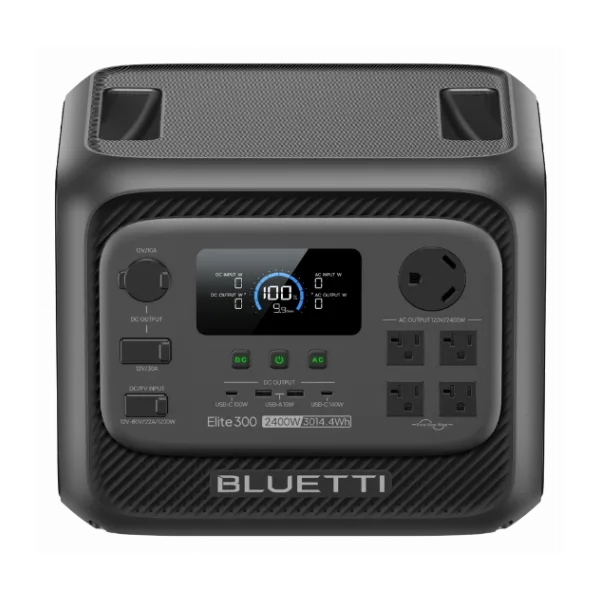 BLUETTI Elite 300 | 10 ms or less | No (120 V outlets plus a TT-30 RV outlet) | None listed | One unit, 3,014 Wh; no expansion port |
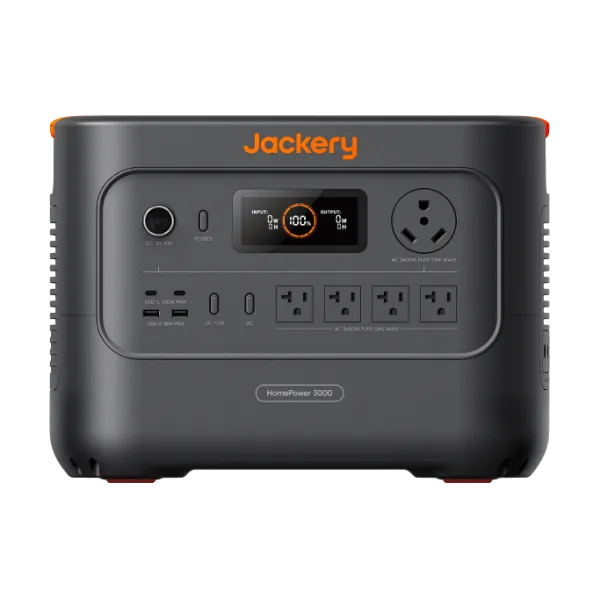 Jackery HomePower 3000 | Within 20 ms; no 0 ms mode | No (120 V outlets) | Manual transfer switch for up to six essential circuits (Jackery sells a 120 V 30 A one) | One unit, 3,072 Wh; not expandable |
| BLUETTI Apex 300 | 0 ms or 20 ms | Yes (NEMA 14-50, 120/240 V 50 A) | AT1 panel for essential circuits, or a 50 A transfer switch | 3 units and 18 batteries: 58 kWh, 11.52 kW |
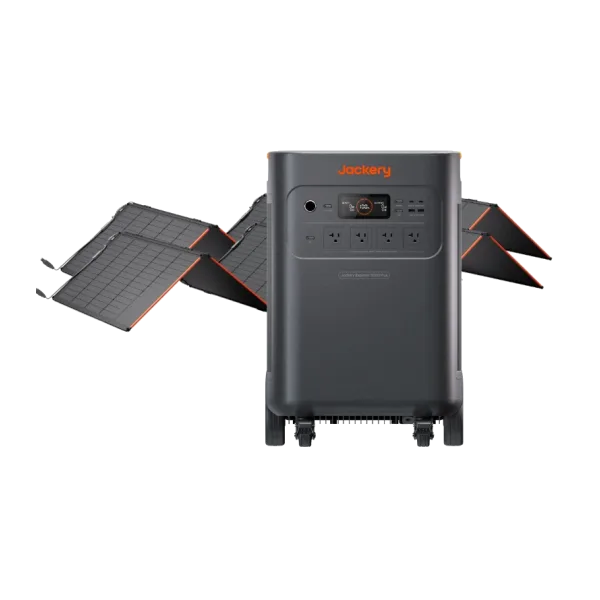 Jackery Explorer 5000 Plus | 20 ms; 0 ms in online mode (NEMA 5-20 outlets only, 3,600 W max) | Yes (L14-30 and 14-50, 120/240 V 30 A) | Smart Transfer Switch (JA-TS02A) or a 240 V 50 A manual transfer switch | 2 units and 10 battery packs: 60 kWh; Jackery’s two-unit kit lists 14,400 W |
Both 0 ms figures come with conditions. BLUETTI’s applies when the Apex 300 is on grid power through its 15 A charging cable, set to 240 V output, with the protected devices on the left two AC outlets (product page checked October 2026). Jackery’s online mode powers only the NEMA 5-20 outlets, up to 3,600 W, and the unit returns to 20 ms backup mode after a restart (Explorer 5000 Plus user manual).
Among the smaller picks, BLUETTI lists 10 ms or less for the Elite 30 V2 and Elite 100 V2 and within 15 ms for the Elite 200 V2; Jackery lists under 20 ms for the Explorer 2000 v2. Jackery pitches 20 ms as enough to keep a router, computer or NAS online, but says the HomePower 3000 is not recommended for sensitive devices such as data servers.
Panel hookup is wiring work. Jackery says a professional electrician must install its Smart Transfer Switch, which takes up to 12 circuits at 120 V or six at 240 V in a sub-panel. Read the manual transfer switch guide before choosing either brand’s panel kit.
Where each brand wins and loses
BLUETTI
- Wins on price per Wh ($0.515 against $0.570, ahead in three of four brackets), base warranty (13 of 16 models at five years, against Jackery’s three plus two on registration), output in the three smaller match-ups (600 against 300 W, 1,800 against 1,500 W, 2,600 against 2,200 W) and UPS switchover in the two larger match-ups (within 15 ms and 10 ms or less, against Jackery’s under 20 ms and 20 ms).
- Loses on output over 3,000 Wh (2,400 W against the HomePower 3000’s 3,600 W), weight (32.8 Wh per lb against 45.0; 53.4 lb against 39.5 lb in the 2,000 Wh pair), top-end capacity (3,840 against 5,040 Wh) and median cycles (3,500 against 4,000, with 7 of the 15 rated models at 3,000).
Jackery
- Wins on weight (lighter at near-equal capacity in three of four match-ups), single-unit ceiling (5,040 Wh, 7,200 W), output over 3,000 Wh (3,600 W against 2,400 W), a published surge rating for every pick (BLUETTI’s Elite 30 V2 and Elite 200 V2 spec tables give only Lifting Power), median cycles (4,000) and the 1,600 to 3,000 Wh bracket ($0.44 across six models).
- Loses on base warranty (18 of the 22 models with a known term carry three years and three carry two, before Jackery’s free extension of two years, or one on the two-year models, when registered or bought direct), price per Wh in three brackets and output in the three smaller match-ups. The Jackery spec pages we checked give AC charging as hours to full rather than watts, so check them before comparing recharge speed or panel limits.
Which to buy
- Phones, a laptop, a weekend away (under 700 Wh): BLUETTI’s Elite 30 V2 if anything draws more than 300 W; Jackery’s 300 Plus for the 1.2 lb. See Explorer 300 vs 300 Plus.
- A CPAP: the CPAP guide puts a night at about 240 Wh with the humidifier off and 560 Wh with it on (about 320 and 640 Wh through an inverter), so a 288 Wh unit covers a humidifier-off night only when the CPAP runs from its DC cable, and only just. For several nights, see what size power station you need.
- Van, RV or car camping (700 to 1,600 Wh): output favors BLUETTI, and both reach five years of warranty if you register the Jackery; weight is close (25 lb against 23.8 lb). See off-grid and RV power setups.
- A refrigerator through an outage (1,600 to 3,000 Wh): the refrigerator guide gives roughly 1,000 to 2,000 Wh a day and a 1,000 to 1,500 W start surge. Jackery lists a 4,400 W surge for the Explorer 2000 v2. BLUETTI publishes no surge figure for the Elite 200 V2, but its 2,600 W continuous rating alone is above the 1,000 W continuous and 2,000 W surge the guide asks for. At the 85% inverter efficiency the site uses for sizing, each holds about 1,740 Wh usable (2,042 Wh times 0.85), roughly a day for a modern full-size fridge. Take BLUETTI’s Elite 200 V2 for output and cycles, Jackery’s Explorer 2000 v2 if you will carry it.
- Essential circuits for over a day (over 3,000 Wh): BLUETTI on price per Wh; Jackery’s HomePower 3000 for output at matched size (3,600 W continuous and 7,200 W surge against the Elite 300’s 2,400 W and 4,800 W); Jackery also if you need more than 3,840 Wh or 3,840 W in one box. Across several units the capacity ceilings are close: three Apex 300s with 18 batteries reach 58 kWh and 11.52 kW, and two Explorer 5000 Plus units with 10 battery packs reach 60 kWh, with 14,400 W from Jackery’s two-unit kit. Read whether a solar generator can power a house and the manual transfer switch guide first.
- Neither fits: try BLUETTI vs EcoFlow, EcoFlow vs Jackery or the price index.
Frequently asked questions
Is BLUETTI or Jackery cheaper per watt-hour?
BLUETTI overall: a median list price of $0.515 per Wh against $0.570. It flips between 1,600 and 3,000 Wh, where Jackery’s median is $0.44 and BLUETTI’s $0.49.
Which lasts longer, BLUETTI or Jackery?
The published figures that bear on it are rated cycles and warranty length. Jackery’s median rating is higher (4,000 against 3,500), but BLUETTI’s 2,000 and 3,000 Wh picks list 6,000 cycles against 4,000. On warranty, BLUETTI lists five years and Jackery three, plus two free years when the Jackery is registered or bought direct. Cycle ratings are manufacturer figures. See LiFePO4 power stations.
Can I add extra batteries to either brand?
Both sell packs, and we count expandable units on each side: two BLUETTI stations (AC200L, Apex 300) and five Jackery ones (2000 Plus Solar Generator, Explorer 2000 Plus, HomePower 2000 Plus v2, HomePower 3600 Plus, 5000 Plus Solar Generator). BLUETTI’s seven current packs (B300K at 2,765 Wh, B500K at 5,120 Wh) include six that name the Apex 300, AC200L, AC300 or AC500 as host; Jackery’s four are about 2,048, 3,584 and 5,040 Wh. Packs are listed against specific hosts, so confirm yours on the maker’s page.