

How this page makes money. Some links on this page are affiliate links: if you buy through them we may earn a commission (on this page: Amazon). As an Amazon Associate we earn from qualifying purchases. Brands that pay us nothing are included wherever leaving them out would make a comparison less useful.
The short answer
Across the EcoFlow and Anker SOLIX power stations compared here, Anker is cheaper per watt-hour: a median of $0.47 at list price against $0.71 for EcoFlow ($0.68 if EcoFlow’s “Solar Generator” bundles are left out). Where the two brands publish them, typical cycle ratings and warranty terms match at 3,000 cycles and 5 years, though EcoFlow quotes an estimated 10-year battery life instead of a cycle count for its DELTA 3 Classic, DELTA 3 Max and DELTA 3 Ultra. EcoFlow reaches higher at the top: the DELTA Pro 3 holds 4,096 Wh in one box against Anker’s 3,840 Wh, and the DELTA Pro Ultra lists 7,200 W of output against the F3800’s 6,000 W. At 2 kWh the DELTA 3 Max and Anker’s C2000 Gen 2 are both rated 2,400 W. Buy Anker for watt-hours per dollar and a larger share of expandable models (6 of Anker’s 9 against 9 of EcoFlow’s 25 that we have confirmed); buy EcoFlow for the most output and solar input at the top end, or at 2 kWh, where the DELTA 3 Max lists lower per watt-hour than the C2000 Gen 2 and a higher surge. Both brands scale past 3,840 Wh with add-on batteries.
How to read the numbers. Everything here is the makers’ published specifications and list prices, not lab measurement. Five EcoFlow models (DELTA 3, DELTA Pro Ultra, DELTA Pro Ultra X, its whole-home variant and the TRAIL DC) are left out of every per-watt-hour figure and of the single-unit capacity row, and the DELTA Pro Ultra X and its whole-home variant are not used for any capacity, output or solar figure. Two Anker models, the C200 DC and C300 DC, are DC-only with no AC outlets: they count toward Anker’s capacity, price and cycle figures but have no AC output. Allow 10–15% of rated capacity for inverter losses.
The two line-ups in numbers
Medians cover current power stations only, and each one covers the models we have that figure for.
| Measure | EcoFlow | Anker SOLIX |
|---|---|---|
| Current models compared | 25 | 9 |
| Median capacity | 2,048 Wh | 2,048 Wh |
| Largest single-unit capacity | 4,096 Wh (DELTA Pro 3) | 3,840 Wh (F3800, F3800 Plus) |
| Median continuous AC output | 2,300 W | 2,400 W |
| Highest AC output | 7,200 W (DELTA Pro Ultra) | 6,000 W (F3800, F3800 Plus) |
| Median $/Wh, all models with a price | $0.71 | $0.47 |
| Median $/Wh, excluding bundles | $0.68 | $0.47 |
| Battery chemistry in our data | LiFePO4 on 15, NCM on 1 (RIVER mini), not in our data for 9 | LiFePO4 on all 9 |
| Median cycle rating | 3,000 | 3,000 |
| Median warranty | 5 years (two models at 3) | 5 years |
| Confirmed expandable (share of models) | 9 of 25 (36%) | 6 of 9 (67%) |
| Highest solar input | 5,600 W (DELTA Pro Ultra, per unit) | 3,200 W (F3800 Plus) |
“Bundles” are the six EcoFlow models sold as “Solar Generator” packages (DELTA 3 Classic, DELTA 3 Plus, DELTA, DELTA 2 Max, DELTA 3 Max Plus, DELTA Pro), whose price covers the package, not the station alone. The single-unit row leaves out the DELTA Pro Ultra, an inverter that takes separate battery packs: EcoFlow lists 6,144 Wh per battery, up to 30 kWh on one inverter and 90 kWh with three inverters on a Smart Home Panel 2 (DELTA Pro Ultra spec page, checked October 2026). Anker’s SOLIX E10 whole-home system, which is not among the nine Anker models here, also lists 6 to 90 kWh. In the chemistry row, the nine EcoFlow models without an entry are gaps in our data, not confirmed non-LFP models, so check the maker’s spec page; the one model our data lists with another chemistry is the RIVER mini, which EcoFlow lists with NCM cells that keep 80% or more of their capacity after 500 cycles.
Anker’s median is 34% lower than EcoFlow’s overall figure and 31% lower than EcoFlow’s figure without bundles. The gap is not just down to which sizes each brand sells: comparing stations sold on their own (no bundles, battery modules or generators), Anker’s median is about 21% lower under 700 Wh (three Anker models against six from EcoFlow, though two of Anker’s three are DC-only) and about 18% lower over 3,000 Wh (three against four), the two size brackets where both brands have at least three priced models. The exception is 2 kWh, where the DELTA 3 Max, the only EcoFlow station in that bracket priced on its own, lists about 16% lower per watt-hour than Anker’s C2000 Gen 2.
Size-bracket match-ups
For each bracket we paired the closest current model from each brand by capacity. A highlighted cell marks the better published figure.
Small: under 700 Wh
| Spec | EcoFlow | Anker SOLIX |
|---|---|---|
| Model | EcoFlow RIVER 2 | Anker 521 PowerHouse |
| Capacity | 256 Wh | 256 Wh |
| Continuous AC | 300 W | 200 W |
| Surge | 600 W | 600 W |
| Cycles | 3,000 | 3,000 |
| Warranty | 5 years | 5 years |
| Solar input | 110 W | 65 W |
| AC charging | 360 W | 125 W |
| Weight | 7.7 lb | 8.2 lb |
Same capacity, and the RIVER 2 leads on the figures that differ: EcoFlow rates it at 50% more AC output (300 W against 200 W), with more solar input (110 W against 65 W) and AC charging (360 W against 125 W), and it is half a pound lighter; surge, cycle rating and warranty match. Anker’s other two small models here, the C200 DC (192 Wh) and C300 DC (288 Wh), are DC-only with no AC outlets, so neither is an AC alternative to a RIVER; among Anker’s AC models under 700 Wh, the 521 sits beside the SOLIX C300 (288 Wh, 300 W) and the 535 PowerHouse (512 Wh, 500 W), neither of which is among the nine Anker models compared here, and the 521’s 200 W is the lowest AC rating of the nine. EcoFlow’s RIVER 3 Plus lists 286 Wh and 600 W, three times the 521’s output, and EcoFlow lists it at 10.4 lb with a 3,000-cycle rating (RIVER 3 Plus spec page checked October 2026) and a 5-year term in its warranty policy. The RIVER 2 Max 500 (499 Wh, 500 W, 13.4 lb) is closest to Anker’s 535 PowerHouse, and Anker’s 768 Wh SOLIX C800 and C800 Plus also sit between 288 and 1,056 Wh. See RIVER 2 vs RIVER 3.
Mid: 700 to 1,600 Wh
| Spec | EcoFlow | Anker SOLIX |
|---|---|---|
| Model | EcoFlow DELTA 3 Classic | Anker SOLIX C1000 |
| Capacity | 1,024 Wh | 1,056 Wh |
| Continuous AC | 1,800 W | 1,800 W |
| Surge | 2,600 W | 2,400 W |
| Cycles | Not stated (EcoFlow quotes a 10-year life) | 3,000 |
| Warranty | 3 years | 5 years |
| Solar input | 500 W | 600 W |
| AC charging | 1,400 W | 1,300 W |
| Weight | 26.7 lb | 28.44 lb |
Output is identical. Anker adds two years of listed warranty and 100 W more solar input; EcoFlow takes 100 W more AC charging and is 1.7 lb lighter. The EcoFlow price here is for a “Solar Generator” bundle, so compare the station alone on price. EcoFlow gives no cycle count for the DELTA 3 Classic, estimating a battery life of about 10 years instead (DELTA 3 Classic spec page checked October 2026). EcoFlow’s DELTA 3 Plus, also 1,024 Wh, is the stronger 1 kWh EcoFlow on headline figures (2,200 W, 3,000 cycles, 5 years, expandable), and EcoFlow lists 1,000 W of solar input across two ports, 1,500 W of AC charging and 27.6 lb for it (DELTA 3 Plus spec page checked October 2026); it is also sold as a bundle here. See DELTA 3 vs DELTA 3 Classic and DELTA 3 vs DELTA 3 Plus.
Large: 1,600 to 3,000 Wh
| Spec | EcoFlow | Anker SOLIX |
|---|---|---|
| Model | EcoFlow DELTA 3 Max | Anker SOLIX C2000 Gen 2 |
| Capacity | 2,048 Wh | 2,048 Wh |
| Continuous AC | 2,400 W | 2,400 W |
| Surge | 4,800 W | 4,000 W |
| Cycles | Not stated (EcoFlow quotes a 10-year life) | 4,000 |
| Warranty | 5 years | 5 years |
| Solar input | 500 W | 800 W |
| AC charging | 1,800 W | 1,800 W |
| Weight | 44.8 lb | 41.7 lb |
Same capacity and the same 2,400 W rating; the DELTA 3 Max lists the higher surge (4,800 W against 4,000 W), and both take 1,800 W from the wall. At list price the DELTA 3 Max is also about 16% cheaper per watt-hour; the C2000 Gen 2 answers with a 4,000-cycle rating (EcoFlow quotes an estimated 10-year life for the DELTA 3 Max rather than a cycle count on its product page, checked October 2026), more solar input (800 W against 500 W) and expansion support. The 3,000 W figure belongs to the DELTA 3 Max Plus, which is priced here as a bundle, and the DELTA 2 Max bundle (2,048 Wh, 2,400 W, 1,000 W of solar input, a 3,000-cycle rating and a 5-year warranty) matches the C2000 Gen 2’s output. Anker’s F2600 (2,560 Wh, 2,400 W) has no EcoFlow match between 2,048 and 3,072 Wh; at 69.7 lb it weighs 28 lb more than the C2000 Gen 2 for 512 Wh extra.
Home backup: over 3,000 Wh
| Spec | EcoFlow | Anker SOLIX |
|---|---|---|
| Model | EcoFlow DELTA 3 Ultra | Anker SOLIX F3000 |
| Capacity | 3,072 Wh | 3,072 Wh |
| Continuous AC | 3,600 W | 3,600 W |
| Surge | 7,200 W | 7,200 W |
| Cycles | Not stated (EcoFlow quotes a 10-year life) | 4,000 |
| Warranty | 5 years | 5 years |
| Solar input | 800 W | 2,400 W |
| AC charging | 1,800 W | 3,600 W |
| Weight | 72.1 lb | 91.5 lb |
The headline figures are identical. Beyond them, the F3000 takes more solar input (2,400 W against 800 W) and more from the wall (3,600 W against 1,800 W), while the DELTA 3 Ultra is lighter: EcoFlow lists it at 32.7 kg and gives an estimated 10-year life rather than a cycle count (DELTA 3 Ultra spec page checked October 2026). Anker’s single-unit ceiling is the F3800 and F3800 Plus (3,840 Wh, 6,000 W, 9,000 W surge; 132.3 lb and 136.7 lb), and either takes up to six BP3800 expansion batteries, about 26.9 kWh in all. EcoFlow brackets that ceiling: the DELTA Pro sits below it (3,600 Wh, 3,600 W, 1,600 W of solar input, 5-year warranty, expandable) and the DELTA Pro 3 above it (4,096 Wh, 4,000 W, 4,000 cycles, expandable). The DELTA Pro 3 lists 4,000 cycles, the same as the F3000 and C2000 Gen 2, and 2,600 W of solar input, but 2,000 W less output than the F3800. Above both sits the DELTA Pro Ultra, at 7,200 W of 120/240 V output and 5,600 W of solar input per unit.
Backup features side by side
Four features decide how a station fits into a house: how fast its UPS outlets take over, whether it gives 240 V, how far it expands and how it connects to your wiring. Figures are the makers’ own, checked October 2026.
| Model | UPS switchover | 240 V output | Most capacity (maker figure) | Home connection |
|---|---|---|---|---|
| EcoFlow DELTA 3 Max | Under 10 ms | No, 120 V only | 2,048 Wh; no expansion listed | None listed |
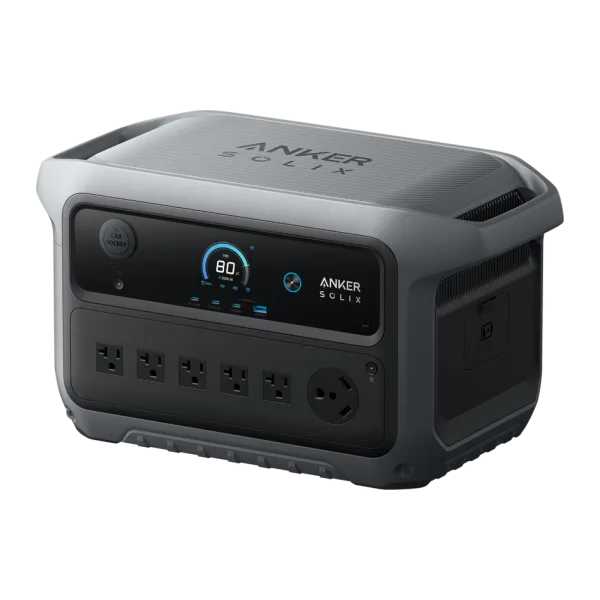 Anker SOLIX C2000 Gen 2 | 10 ms | No, 120 V only | 4,096 Wh with one BP2000 (Gen 2) | Bi-directional inlet box, 1,800 W at 120 V |
| EcoFlow DELTA 3 Ultra | Under 10 ms | No, 120 V only | 3,072 Wh; no expansion listed | Manual transfer switch or inlet box |
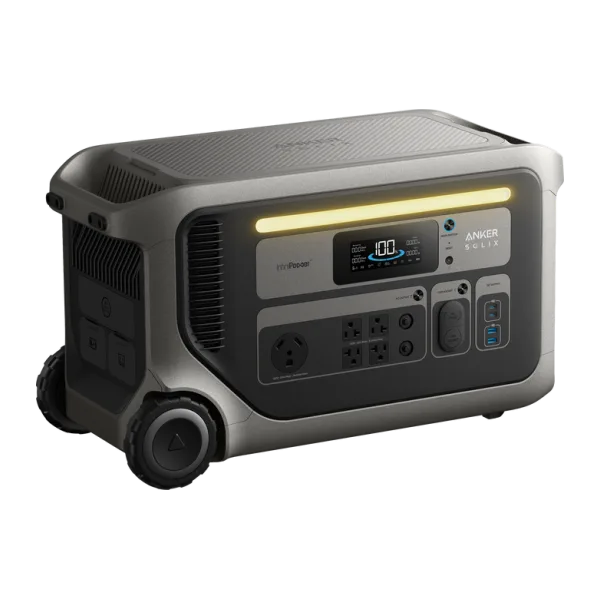 Anker SOLIX F3000 | 20 ms | Only with two units and Anker’s Double Voltage Hub | 12,288 Wh with three BP3000; 24 kWh as a system | Bi-directional inlet box, 1,800 W at 120 V |
| EcoFlow DELTA Pro 3 | 10 ms | Yes, up to 4,000 W (L14-30 and 6-20 outlets) | 12 kWh with two extra batteries; 36 kWh with three units | Smart Home Panel 2 (up to three units), transfer switch or inlet box |
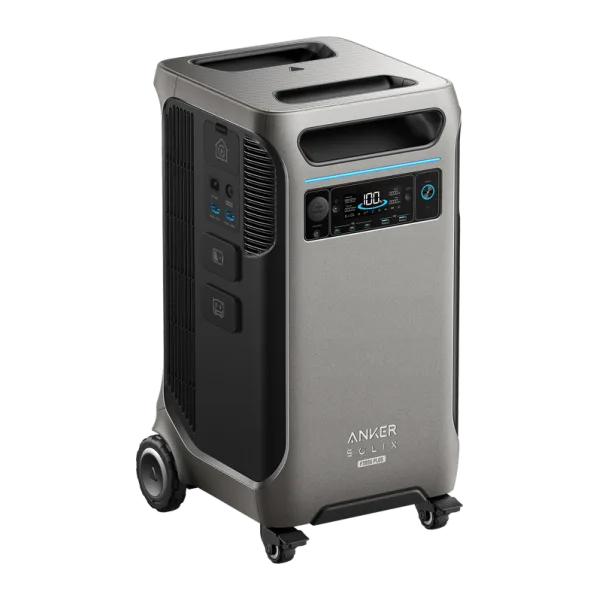 Anker SOLIX F3800 Plus | 20 ms on its three UPS outlets | Yes, up to 6,000 W on the L14-30 | About 26.9 kWh with six BP3800; 53.8 kWh as a system | Home Power Panel, transfer switch or inlet box |
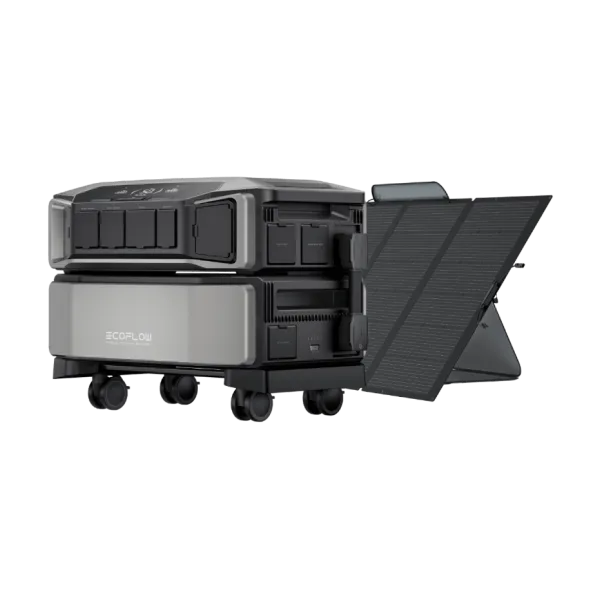 EcoFlow DELTA Pro Ultra | 0 ms on its online-UPS outlets, under 20 ms on the rest | Yes, up to 7,200 W | 30 kWh on one inverter; 90 kWh with three | Smart Home Panel 2, up to three inverters |
Switchover. A UPS outlet carries its load through a grid outage; the figure is the length of the gap. On 120 V wall power the F3800 Plus passes up to 1,440 W through its three UPS outlets and its TT-30, which has no UPS function, and its L14-30 is off (F3800 Plus spec page, checked October 2026). On the DELTA Pro Ultra, the 0 ms applies only to its three 120 V online-UPS outlets; its 120/240 V L14-30 is on the under-20 ms backup side.
240 V. You need it only for 240 V appliances; the nameplate says which. EcoFlow’s DELTA Pro 3 FAQ says it runs either its 120 V or its 240 V outlets, not both, though in 240 V mode its L14-30 is split-phase 120/240 V. The F3800 Plus drops 240 V while charging from a 120 V outlet, and the DELTA Pro Ultra shuts off all AC output while charging at 240 V. The F3000 is 120 V on its own.
Wiring it in. Feeding house circuits takes a transfer switch or a maker’s home panel that cuts those circuits off from the grid first, never a cord plugged into a wall outlet. CPSC warns that this “backfeeding” puts utility workers and neighbors on the same transformer at risk of electrocution and bypasses some household circuit protection (CPSC generator safety alert). The warning is written for generators; a power station wired the same way carries the same risk, and EcoFlow’s own FAQ says circuits should be disconnected from the grid before a power station supplies them. EcoFlow says the Smart Home Panel 2 must be installed by certified installers and electricians and sells an installation service, as Anker does for its Home Power Panel. Tying a DELTA Pro Ultra into rooftop solar circuits needs NEC rapid shutdown, and EcoFlow asks for a qualified electrician or installer to consult before purchase.
UL 9540. This is UL’s safety standard for energy storage systems. EcoFlow sells the DELTA Pro 3 and DELTA Pro Ultra as UL 9540 certified, and Anker the F3000; the F3800 Plus product page does not list it. If your installer or permit office asks for the listing, confirm it before you buy.
Where each brand wins and loses
Anker SOLIX
- Wins on value. $0.47 per Wh against $0.71, and cheaper in both size brackets where each brand has enough priced models to compare, though not at 2 kWh, where the DELTA 3 Max lists lower.
- Wins on charging input at 3 kWh. The F3000 lists 3,600 W AC and 2,400 W solar input, against 1,800 W and 800 W for the DELTA 3 Ultra. Lower down the gap closes: the DELTA 3 Classic takes 1,400 W from the wall against the C1000’s 1,300 W, and both 2 kWh models take 1,800 W. On solar, EcoFlow’s largest units go higher (2,600 W on the DELTA Pro 3, 5,600 W per DELTA Pro Ultra unit).
- Wins on consistency. All 9 Anker models list LiFePO4, at least 3,000 cycles (4,000 on the C2000 Gen 2 and F3000) and 5 years. On the DELTA 3 Classic and DELTA 3 Max Plus, EcoFlow’s standard term is 3 years, with 2 more on registration (EcoFlow warranty policy checked October 2026).
- Loses on single-unit size and output at the top. Anker’s largest single unit is 3,840 Wh and 6,000 W, where EcoFlow lists 4,096 Wh (DELTA Pro 3) and 7,200 W (DELTA Pro Ultra), though the F3800 grows to about 26.9 kWh with six BP3800 batteries. None of the nine Anker models compared here falls between 288 and 1,056 Wh, but Anker also sells the 512 Wh 535 PowerHouse and the 768 Wh SOLIX C800.
- Loses on surge at 2 kWh. 4,000 W against 4,800 W, at the same 2,400 W rating.
EcoFlow
- Wins on reach. 25 current models, six of them under 500 Wh, and at the top the DELTA Pro Ultra, which lists 7,200 W of output and 5,600 W of solar input per unit.
- Wins on surge at 2 kWh. 4,800 W against 4,000 W at the same 2,400 W rating, though the C2000 Gen 2 takes more solar (800 W against 500 W).
- Wins on UPS switchover at 3 kWh and up. The DELTA 3 Ultra lists under 10 ms and the DELTA Pro 3 10 ms, against 20 ms for the F3000 and F3800 Plus. Peak cycle ratings tie at 4,000: the DELTA Pro 3 on EcoFlow’s side, the C2000 Gen 2 and F3000 on Anker’s.
- Loses on value. $0.71 per Wh, or $0.68 without bundles, against $0.47.
- Fewer published cycle ratings. EcoFlow quotes an estimated 10-year battery life rather than a cycle count for the DELTA 3 Classic, DELTA 3 Max and DELTA 3 Ultra, so cycle life is harder to compare than with Anker. Where it does give one, it can be high: 4,000 cycles on the DELTA Pro 3.
Who should buy which
- A fridge and essentials through an outage. Our sizing guide puts this at 2,000 Wh with at least 1,000 W continuous and 2,000 W of surge, and a full-size fridge needs about 1,500 W for a moment when its compressor starts (watts to run a refrigerator). Both 2,048 Wh units clear that. The DELTA 3 Max lists lower per watt-hour and a higher surge at the same 2,400 W rating; pick the C2000 Gen 2 if you want a published cycle rating, more solar input and room to add a battery.
- A CPAP. A standard machine uses about 240 Wh a night with the humidifier off and up to about 560 Wh with the humidifier and heated hose on, or about 320 Wh and 640 Wh through a power station’s inverter (CPAP watts and runtimes). After a 15% loss allowance, the 499 Wh RIVER 2 Max 500 leaves about 420 Wh, enough with the humidifier off. With it on, you want around 1 kWh: the C1000 (about 900 Wh usable) or the DELTA 3 Classic (about 870 Wh). Between 288 and 1,056 Wh, Anker also sells the 512 Wh 535 PowerHouse and the 768 Wh SOLIX C800.
- Solar charging. Anker’s F3000 and F3800 list 2,400 W of solar input and the F3800 Plus 3,200 W; EcoFlow lists 1,600 W for the DELTA Pro, 2,600 W for the DELTA Pro 3 and 5,600 W per DELTA Pro Ultra unit. At 2 kWh the C2000 Gen 2 leads, 800 W to the DELTA 3 Max’s 500 W. For panel sizing, see how to size a solar system. Balcony-style plug-in solar is a separate category not covered here; start with what plug-in solar is.
- Home backup. Anker’s F3000 or F3800 for the lower price per watt-hour (the F3800 lists 6,000 W of output and takes up to six BP3800 batteries, about 26.9 kWh); EcoFlow’s DELTA Pro 3 for the most capacity in one box (4,096 Wh), or the DELTA Pro Ultra for 7,200 W of 120/240 V output and 5,600 W of solar input per unit. Both brands scale well past 3,840 Wh with add-on batteries. Read can a solar generator power a house and home battery backup first.
- Lowest cost per watt-hour overall. Neither. Among the brands we track, OUPES and Pecron have medians of $0.37 per watt-hour and ALLPOWERS $0.38, against $0.47 for Anker. See Bluetti vs Anker SOLIX, Bluetti vs EcoFlow and the price index.
FAQ
Does EcoFlow charge faster than Anker?
Not across the board. On AC charging power, EcoFlow lists 1,400 W for the DELTA 3 Classic against 1,300 W for the similar-size Anker C1000, and at 2 kWh EcoFlow lists 1,800 W for the DELTA 3 Max, the same as the C2000 Gen 2. At 3 kWh Anker’s F3000 takes 3,600 W against 1,800 W for the DELTA 3 Ultra. On solar, EcoFlow’s largest units take more than Anker’s (see above).
Can I add batteries later?
Six of Anker’s 9 models here take add-on batteries (C1000, C2000 Gen 2, F2600, F3000, F3800, F3800 Plus). For EcoFlow we have confirmed 9 of its 25 (DELTA Pro 3, DELTA Pro, DELTA 3 Plus, DELTA 3 Max Plus, DELTA 2 Max, DELTA Pro Ultra and its whole-home system, RIVER 3 Plus and RIVER), but others may take one too, so check the maker’s page before ruling expansion out, and confirm the exact battery your model accepts before buying.
Does EcoFlow publish cycle ratings?
For some models. EcoFlow lists 3,000 cycles for the RIVER 2 and RIVER 3 Plus and 4,000 for the DELTA Pro 3, but its DELTA 3 Classic, DELTA 3 Max and DELTA 3 Ultra pages give an estimated battery life of about 10 years instead of a cycle count (checked October 2026). Anker lists a cycle count for all nine models here: 4,000 for the C2000 Gen 2 and F3000 and 3,000 for the rest. The DELTA 3 (EcoFlow lists 1,024 Wh), DELTA Pro Ultra and TRAIL DC are left out of the per-watt-hour figures above, so if one is on your shortlist, check its price against its capacity yourself. DELTA 3 vs DELTA 3 Plus sets the DELTA 3 against its Plus sibling.