
Home › Power station specs › EcoFlow DELTA Pro 3
EcoFlow DELTA Pro 3: Specs, Runtimes and Who It Suits
A 4,096 Wh, 4,000 W LiFePO4 unit rated for 4,000 cycles: what it runs, how fast it can recharge, and which rivals suit you better.
How this page makes money. Some links on this page are affiliate links: if you buy through them we may earn a commission (on this page: ALLPOWERS, Mango Power and Amazon). As an Amazon Associate we earn from qualifying purchases. Brands that pay us nothing are included wherever leaving them out would make a comparison less useful.
EcoFlow rates the DELTA Pro 3 at 4,096 Wh of storage and 4,000 W of continuous output, with LiFePO4 cells rated for 4,000 cycles. It also lists an 8,000 W surge rating, a 5-year warranty, up to 2,600 W of solar input and a weight of about 113.5 lb (EcoFlow spec page checked October 2026). Its spec table gives the AC charging input as 100–240 V at up to 15 A without a watt figure, so the wall-charging section works from what a household circuit can deliver. Every runtime and charging figure comes from arithmetic shown in the text. We have not tested this unit or any other.
Price and stock are shown on Amazon. We may earn a commission, which never changes what the figures say.
Arithmetic on the maker’s published specification; we have not tested this unit. Method and the full comparison are in our power station price index.
Where it sits among large power stations
Few of the power stations we track list a continuous AC output of 4,000 W or more, among them the DELTA Pro 3, both Anker SOLIX F3800 versions and the Jackery 5000 Plus. Of those four, only the DELTA Pro 3 and the Jackery also store more than 4,000 Wh. That makes this EcoFlow one of very few single boxes that pairs a large battery with a large inverter, and its balance is unusual. It stores 1.02 Wh per watt of output (4,096 Wh against 4,000 W), where the Anker pair stores 0.64 (3,840 Wh against 6,000 W) and the Jackery 0.70 (5,040 Wh against 7,200 W). In plain terms it carries more battery per watt of inverter than the Anker or the Jackery, and less output headroom.
Its 4,000-cycle rating tops the DELTA Pro’s 3,500. Across the 66 power stations we track that publish a cycle rating, the median is 3,500 cycles, 26 list 4,000 or more and 8 list 6,000, so the DELTA Pro 3 is above the median without standing out.
EcoFlow’s published specifications
| Specification | Figure |
|---|---|
| Capacity | 4,096 Wh |
| Usable energy at the 85% inverter factor | 3,482 Wh (4,096 × 0.85) |
| Continuous AC output | 4,000 W |
| Surge output | 8,000 W |
| Cell chemistry | LiFePO4 |
| Rated cycle life | 4,000 cycles |
| Warranty | 5 years (3 standard plus 2 with EcoFlow app registration) |
| Maximum solar input | 2,600 W (1,600 W high-voltage port plus 1,000 W low-voltage port) |
| AC charge input | 100–240 V at up to 15 A (EcoFlow’s spec table gives no watt figure) |
| Grid pass-through (bypass) | 100–120 V at 15 A for up to 3 hours, then 12 A |
| Weight | about 113.5 lb (51.5 kg) |
| Expandable | Yes, to 12 kWh with two 4,096 Wh Smart Extra Batteries |
These figures change a buying decision:
- Surge output decides whether motor loads such as a well pump or a compressor start. EcoFlow lists 8,000 W; the 4,000 W section and the FAQ below show what that covers.
- Maximum solar input decides how large an array the unit accepts. EcoFlow lists 2,600 W across two ports; the solar section below works from array size.
- AC charge input decides how fast a wall socket refills it. The wall-charging section shows the range.
- Weight decides whether one person can move it. EcoFlow lists about 113.5 lb, and the four rivals compared below list 99 to 134.5 lb, so do not plan on one person carrying it.
- Warranty: EcoFlow lists 5 years (3 standard plus 2 with app registration), the same figure all four rivals compared below list.
EcoFlow lists four 120 V NEMA 5-20R outlets (20 A), a 120 V TT-30R RV outlet (30 A), a 240 V NEMA 6-20R outlet and a 120/240 V NEMA L14-30R outlet, 4,000 W in total. Its FAQ adds that the unit cannot power 120 V and 240 V outlets at the same time: one button switches on the 120 V outlets, the other the two 240 V outlets, and each turns the other set off. That matters for a well pump or any 240 V appliance: while it runs from the 240 V outlets, the 120 V outlets are off.
What 4,096 Wh runs, and for how long
Runtime is capacity × 0.85 ÷ load, the factor the site uses for inverter losses on every unit: 4,096 × 0.85 = 3,482 Wh usable. Real runtimes fall below these figures in the cold or when the inverter is working hard.
| Load | Running draw | Runtime on 3,482 Wh |
|---|---|---|
| Wi-Fi router | 10 W | 348 hr (14.5 days) |
| CPAP, no humidifier (30 W at the machine plus inverter idle) | 40 W | 87 hr |
| TV | 90 W | 38.7 hr |
| Full-size fridge, compressor running | 150 W | 23.2 hr if it ran nonstop |
| Microwave (1,000 W cooking power) | about 1,500 W | 2 hr 19 min of cooking |
| Space heater | 1,500 W | 2 hr 19 min |
| Half-horsepower well pump | about 1,000 W | 3 hr 29 min if it ran nonstop |
| A load at the full rating | 4,000 W | 52 min |
Two of those figures need care. The fridge’s 150 W is its draw while the compressor runs, and the compressor cycles, so over a day a modern full-size fridge uses about 1,000 to 2,000 Wh (see how many watts a refrigerator uses). The 3,482 Wh covers that for about 1.7 to 3.5 days on its own (3,482 ÷ 2,000 and 3,482 ÷ 1,000). A CPAP at 40 W for an 8-hour night uses 320 Wh, so the unit covers just under 11 nights; heated-humidifier models draw more, and CPAP watts and runtimes has the ranges.
One outage day, itemized
An essentials day, taking the middle of the fridge range:
- Fridge: 1,500 Wh
- CPAP, 8 hours at 40 W: 320 Wh
- Router, 24 hours at 10 W: 240 Wh
- TV, 4 hours at 90 W: 360 Wh
That totals 2,420 Wh a day, so the 3,482 Wh usable lasts 1.44 days, about 34 hours. With the fridge at the low end of its range (1,000 Wh) the day costs 1,920 Wh and the unit lasts 1.8 days; at the high end (2,000 Wh) the day costs 2,920 Wh and it lasts 1.2 days. The whole day averages 2,420 ÷ 24, about 100 W, which is 2.5% of the inverter’s rating. For loads like these the battery is what you are buying, and most of the 4,000 W goes unused.
What 4,000 W will and will not start
Continuous output decides which loads can run at all; the surge rating, which EcoFlow lists at 8,000 W, decides which motors can start. Sorted against those two figures, using the draws the site uses elsewhere:
- Fits with room to spare: fridge, CPAP, router, TV, microwave and a 1,500 W space heater. The heater and microwave together are about 3,000 W.
- Fits on paper, with little surge to spare: a half-horsepower well pump runs at about 1,000 W and needs about 3,000 W from a generator to start, but a power station has to survive its locked-rotor draw, about 7,400 W for a 2-wire pump (5,300 W for a 3-wire), just inside EcoFlow’s 8,000 W surge rating.
- Depends on the surge rating: a 1 hp well pump (about 1,600 W running, about 6,000 W to start on a generator) and a 3-ton central air conditioner (3,000 to 4,000 W running, roughly 20,000 to 27,000 W to start). Both start above 4,000 W. A power station has to survive the pump’s locked-rotor draw, about 9,600 to 11,200 W, which is above EcoFlow’s 8,000 W surge rating; the air conditioner’s starting demand is far above it too unless a soft starter is fitted, so check both nameplates before counting on either. See how many watts an air conditioner uses.
- Does not fit: an electric water heater at 4,500 W, which exceeds the continuous rating before anything else is plugged in.
An ordinary 120 V outlet cannot deliver 4,000 W either. A standard 120 V outlet on a 20 A circuit carries 2,400 W (120 × 20), or 1,920 W continuously at the usual 80% limit, so reaching the full rating means spreading loads across outlets or using the 30 A or 240 V outlets EcoFlow lists. For wiring it into a house, manual transfer switches covers how they work and what to check, and the 5000 watt solar generator page works through inlet limits.
Recharging from solar
EcoFlow lists a maximum solar input of 2,600 W across two ports: 1,600 W on the high-voltage port (30–150 V, 15 A) and 1,000 W on the low-voltage port (11–60 V, 20 A). For scale, other large units list 1,200 W (BLUETTI Apex 300), 1,600 W (Anker SOLIX F3800 Plus), 2,000 W (ALLPOWERS R4000) and 2,400 W (Anker SOLIX F3800). Check the maximum in watts and in volts on the maker’s spec sheet before buying panels: watts above the limit are wasted, and voltage above the limit can damage the unit.
The harvest math does not depend on that figure. Daily harvest is array watts × 0.7 (a realistic share of the rating) × sun hours, and our panel output guide puts usable sun hours at 4 to 5 in summer and 2 to 3 in winter at mid-northern latitudes. The table uses 5 and 2.5, and the refill column is 4,096 Wh ÷ the daily harvest, from empty.
| Array | Summer harvest per day | Winter harvest per day | Days to refill, summer | Days to refill, winter |
|---|---|---|---|---|
| 400 W | 1,400 Wh | 700 Wh | 2.9 | 5.9 |
| 800 W | 2,800 Wh | 1,400 Wh | 1.5 | 2.9 |
| 1,200 W | 4,200 Wh | 2,100 Wh | 1.0 | 2.0 |
| 1,600 W | 5,600 Wh | 2,800 Wh | 0.7 | 1.5 |
Every figure assumes the unit accepts that much input and the array gets those sun hours. To see what it means for the outage day above, remember the load needs 2,420 ÷ 0.85 = 2,847 Wh a day from the battery once inverter losses are counted:
| Array | Summer day, net of the load | Winter day, net of the load | A full pack lasts, in winter |
|---|---|---|---|
| 400 W | −1,447 Wh | −2,147 Wh | 1.9 days |
| 800 W | −47 Wh (about break-even) | −1,447 Wh | 2.8 days |
| 1,200 W | +1,353 Wh | −747 Wh | 5.5 days |
| 1,600 W | +2,753 Wh | −47 Wh (about break-even) | stays near full |
With no panels the same load empties the pack in 4,096 ÷ 2,847 = 1.44 days, so even 800 W of panels roughly doubles the winter endurance and keeps a summer day level. The panels below are EcoFlow’s own; check each one’s voltage against the two input windows above before wiring panels in series.
| Panel | Rated power | Panels for about 1,200 W | Array total |
|---|---|---|---|
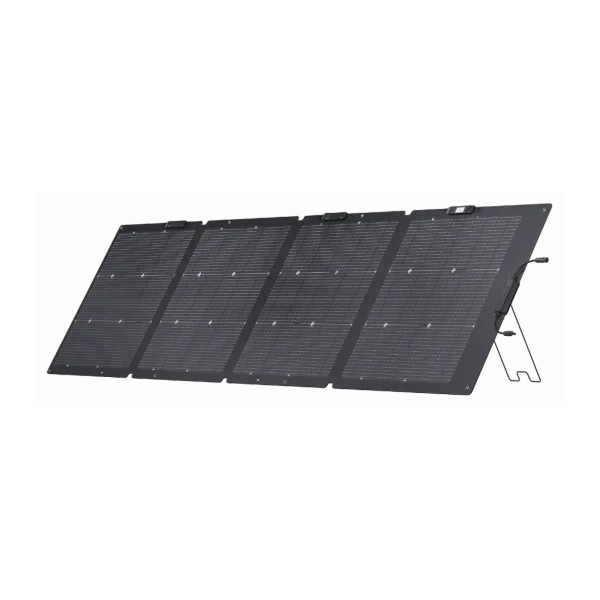 EcoFlow NextGen 220W Bifacial Portable Solar Panel | 220 W | 6 | 1,320 W |
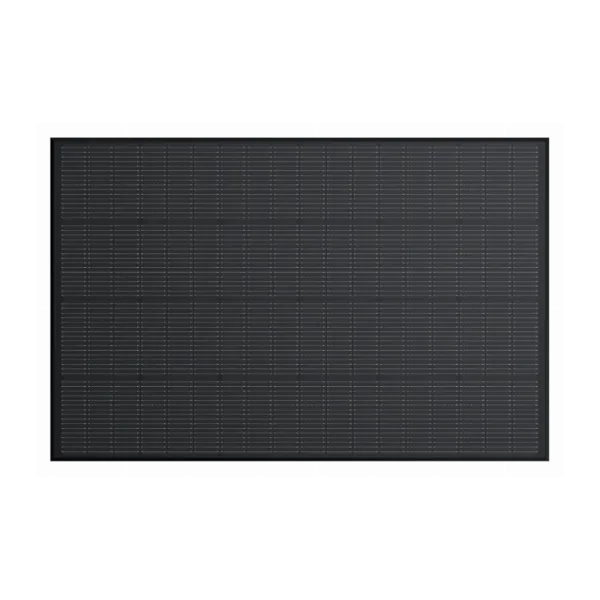 EcoFlow 175W Rigid Solar Panel | 175 W | 7 | 1,225 W |
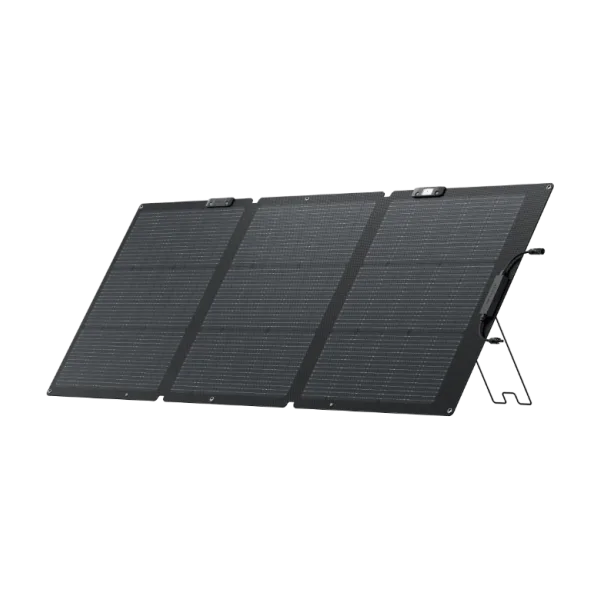 EcoFlow NextGen 160W Portable Solar Panel | 160 W | 8 | 1,280 W |
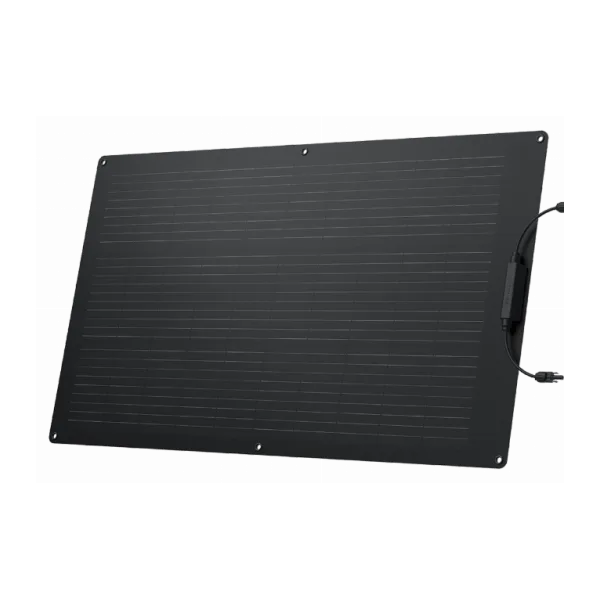 EcoFlow 100W Flexible Solar Panel | 100 W | 12 | 1,200 W |
Panel count is the target divided by the rated power, rounded up. Our solar sizing guide covers string voltage and how to match an array to a unit’s input window.
Recharging from the wall
EcoFlow’s spec page does not give one clear wall-charging figure. Its spec table lists the AC charging input as 100–240 V at up to 15 A with no watts, an answer in its FAQ says the US model’s grid charging port takes 120 V at up to 2,000 W, and its headline claim of 0 to 80% in 50 minutes sits beside a line saying combined charging sources reach up to 7,000 W. The grid charging port alone cannot do that: 80% of 4,096 Wh is 3,277 Wh, and adding that in 50 minutes takes about 3,930 W on average (3,277 × 60 ÷ 50), nearly twice the 2,000 W the FAQ gives for that port and more than 15 A carries even at 240 V (3,600 W). The FAQ names one faster single route: a 240 V Level 2 EV charging station, plugged into the AC Power IN/OUT port through EcoFlow’s separately sold EV X-Stream Adapter, charges it at up to 4,000 W. A comparison chart on the same page shows 200–240 V at 12.5 A, but that column is the DELTA Pro Ultra’s; the DELTA Pro 3’s own spec list gives only 100–240 V at 15 A. Charge time is capacity ÷ charging watts, and the result is a floor: charging slows near full and the conversion loses some energy. The wall outlet may be the real limit, so the table starts from what a household circuit can deliver.
| Charging power | Where that figure comes from | Time from empty |
|---|---|---|
| 1,440 W | A 120 V, 15 A circuit at the 80% continuous limit (120 × 15 × 0.8) | 2 hr 51 min |
| 1,800 W | The AC input the Anker SOLIX F3800 and BLUETTI Apex 300 list | 2 hr 17 min |
| 1,920 W | A 120 V, 20 A circuit at the 80% limit (120 × 20 × 0.8) | 2 hr 8 min |
| 3,600 W | The AC input the Pecron F5000LFP lists, shown for scale only | 1 hr 8 min |
On an ordinary household circuit (the 1,440 W and 1,920 W lines), a full refill takes roughly two to three hours at best. The 1,800 W and 3,600 W figures are other makers’ inputs. The 3,600 W line is not a promise: EcoFlow’s spec table gives no wall-charging watt figure for this unit, so whether it takes anything like 3,600 W from the wall is unconfirmed. Among the rivals below, EcoFlow lists 1,800 W at 120 V (3,000 W at 240 V) for the DELTA Pro, ALLPOWERS lists 2,000 W for the R4000, and Jackery lists 120 V at 15 A, about 3.5 hours to full, for the 5000 Plus (EcoFlow, ALLPOWERS and Jackery spec pages, checked October 2026). If outages come with short windows of restored power, that single number is worth confirming before you buy.
Running loads while it is plugged in
EcoFlow lists a separate limit for bypass, when grid power passes through the unit to its outlets: 100–120 V at 15 A for up to 3 hours, then 12 A continuously. At 120 V that is 1,800 W for the first three hours and 1,440 W after (120 × 15 and 120 × 12), the same 1,440 W as the 15 A circuit line in the table above. EcoFlow says the full 4,000 W output stays available during pass-through charging, so whatever the outlets draw above the bypass figure comes from the battery. A 1,500 W space heater plus a fridge running at 150 W needs 1,650 W: inside the limit for the first three hours, but 210 W over it after that, so the pack slowly drains while plugged in instead of charging.
Adding capacity
The DELTA Pro 3 is expandable with the EcoFlow DELTA Pro 3 Smart Extra Battery. EcoFlow lists it at 4,096 Wh (extra battery spec page), the same as the main unit, and its DELTA Pro 3 page puts a single unit’s limit at two of them, 12 kWh in total (both checked October 2026). None of the runtimes above include it. An extra battery is storage; the inverter that sets the 4,000 W ceiling stays the same. The arithmetic is linear: each extra 1,000 Wh adds 850 Wh usable, which is another 5.7 hours of a 150 W fridge at its running draw (850 ÷ 150) or 34 minutes of the 1,500 W heater (850 ÷ 1,500 = 0.57 hr). One extra battery adds 3,482 Wh usable (4,096 × 0.85), doubling every runtime in the table above.
Connecting it to a house
The DELTA Pro 3 can feed house circuits, not only appliances plugged into its panel. EcoFlow’s DELTA Pro 3 page (checked October 2026) lists three ways to connect it to a home:
- Manual transfer switch. EcoFlow lists its Transfer Switch 306A for one DELTA Pro 3: six circuits, rated 30 A at 250 V, with an L14-30 power inlet that a cord from the unit’s L14-30R outlet plugs into. EcoFlow says that cord (L14-30R to L14-30P) is no longer sold on its US site and will not be restocked, so buy one with the same specifications from another retailer. It also says a qualified electrician must install the switch and that it works only with indoor breaker panels. Our manual transfer switch guide explains how they work, what they cost and how to size one.
- Inlet box. EcoFlow also pairs the L14-30R outlet with an inlet box to power 120 V and 240 V household loads. A standard inlet box is only a weatherproof outdoor socket for the cord, and switching over means flipping switches by hand. EcoFlow’s Smart Inlet Box is wired to the breaker panel and switches over automatically in an outage; EcoFlow likens it to an automatic transfer switch.
- Smart Home Panel 2. Up to three DELTA Pro 3 units connect to it. EcoFlow lists a 20 ms switchover in an outage and app control of up to 12 circuits, and says the panel must be installed before use, with the installation fee set after an assessment. Its system figures for three units with six extra batteries are 36 kWh and 12 kW.
Two limits come with the L14-30R routes. EcoFlow rates that outlet at 16.7 A, which at 240 V is about the unit’s 4,000 W (240 × 16.7), not the 30 A the plug type is named for, so a 30 A switch fed by one unit still gets 4,000 W at most. And the L14-30R only works with the 240 V button on, which switches the unit’s own 120 V outlets off. On a single unit, every pump or compressor on the backed-up circuits still has to start inside the 8,000 W surge rating covered above.
Never feed house wiring by plugging the unit into a wall outlet. The CPSC warns that this practice, called backfeeding, puts utility workers and neighbors served by the same transformer at risk of electrocution, and OSHA says a generator should be connected to a building only through a transfer switch a qualified electrician has installed. A power station feeding the same wiring carries the same risk. Have a licensed electrician do the installation, and ask whether your town requires a permit.
How it compares with the closest rivals
The four rivals are its predecessor, the closest large Anker SOLIX, the closest large ALLPOWERS and the Jackery 5000 Plus, another unit with more than 4,000 Wh and 4,000 W. The Mango Power E, also close in capacity, appears in the second table below. Figures are each maker’s published specifications; the Jackery’s surge and solar figures come from its spec page, checked October 2026, and AC charging inputs are compared in the wall-charging section above.
| Model | Wh | AC W | Surge W | Cycles | Warranty (yr) | Solar in W | Weight (lb) |
|---|---|---|---|---|---|---|---|
| EcoFlow DELTA Pro 3 | 4,096 | 4,000 | 8,000 | 4,000 | 5 | 2,600 | 113.5 |
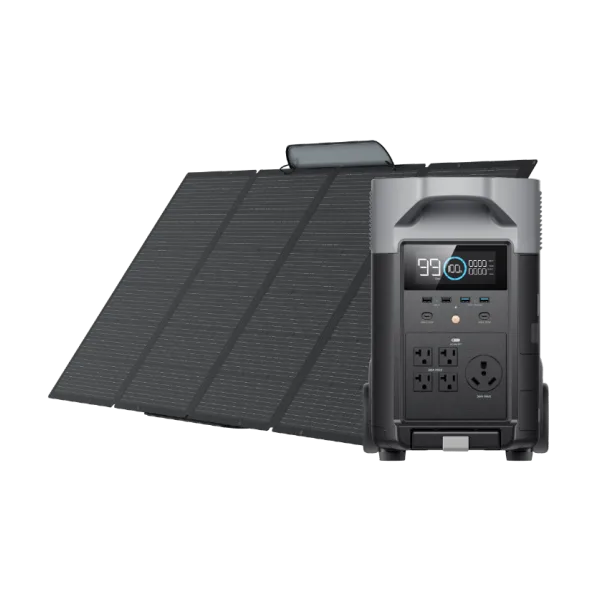 EcoFlow DELTA Pro (our page) | 3,600 | 3,600 | 7,200 | 3,500 | 5 | 1,600 | 99 |
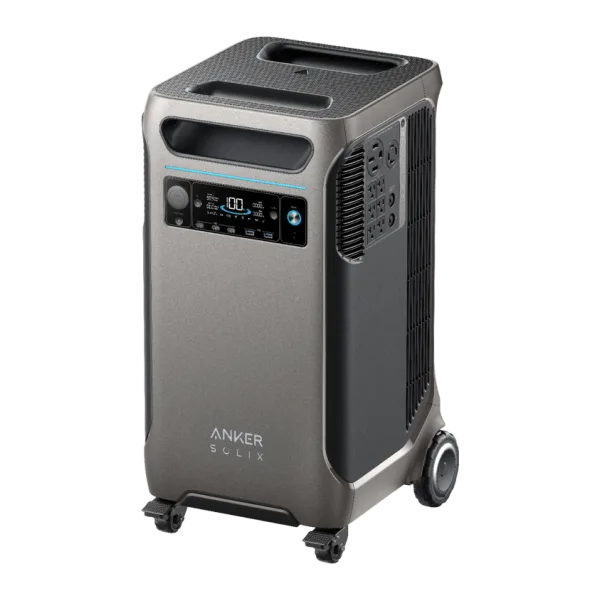 Anker SOLIX F3800 | 3,840 | 6,000 | 9,000 | 3,000 | 5 | 2,400 | 132.3 |
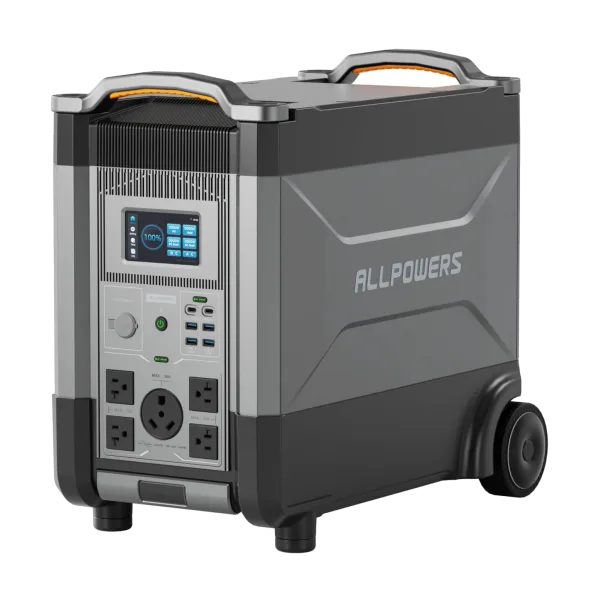 ALLPOWERS R4000 | 3,456 | 3,600 | 6,000 | 3,500 | 5 | 2,000 | 99.2 |
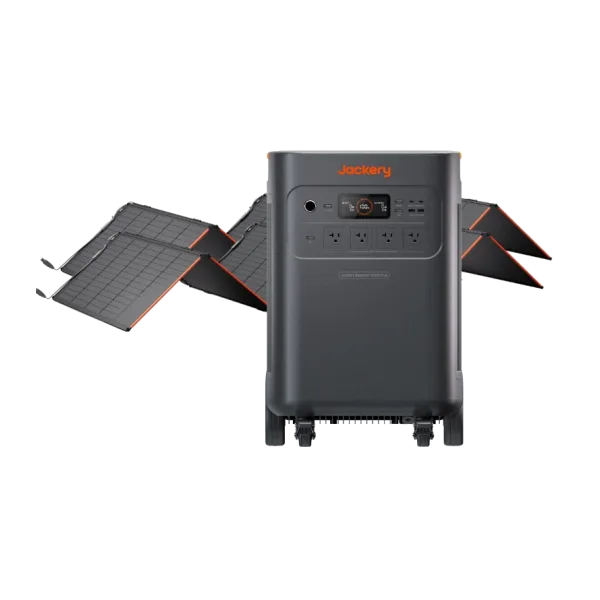 Jackery Solar Generator 5000 Plus | 5,040 | 7,200 | 14,400 | 4,000 | 5 | 4,000 | 134.5 |
Against its predecessor. The DELTA Pro lists 3,600 Wh and 3,600 W. The DELTA Pro 3 adds 496 Wh (13.8% more) and 400 W (11.1% more), and it carries the higher cycle rating (4,000 cycles to 80% capacity, against the DELTA Pro’s 3,500). Both list a 5-year warranty, and the DELTA Pro is about 14 lb lighter. See the DELTA Pro page for its own numbers.
Against the Anker SOLIX F3800. The Anker gives 2,000 W more continuous output and 9,000 W of surge (against 8,000 W) from 256 Wh less storage, while EcoFlow lists more solar input for the DELTA Pro 3 (2,600 W against 2,400 W), the same 5-year warranty (3 years plus 2 with registration in the EcoFlow app) and a lower weight (about 113.5 lb against 132.3 lb). EcoFlow also lists a 6,000 W X-Boost mode and both 120 V and 240 V outputs. The Anker SOLIX F3800 Plus lists the same capacity, output, cycles, warranty and AC input with 1,600 W of solar input instead of 2,400 W. At the full rated output the F3800 empties in 33 minutes, against 52 for the EcoFlow, because the Anker’s inverter is larger relative to its battery. Its cycle rating is also lower (3,000 against 4,000). Our EcoFlow vs Anker SOLIX comparison covers the brands across all sizes.
Against the ALLPOWERS R4000. The R4000 stores 640 Wh less and outputs 400 W less, but lists a 5-year warranty, a 2,000 W solar input and a published weight of 99.2 lb, about the same as the DELTA Pro’s 99 lb. The Anker and the Jackery are both over 130 lb.
Against the Jackery 5000 Plus. The Jackery stores 944 Wh more (23% more) and outputs 3,200 W more, with the same 4,000-cycle rating, a 5-year warranty and a published 134.5 lb. Jackery lists 14,400 W of surge and up to 4,000 W of solar input; our Explorer 5000 Plus page summarizes what its manual adds. For brand-level comparisons see EcoFlow vs Jackery.
Minutes at full output
Capacity and output pull against each other, so this table divides usable energy (Wh × 0.85) by the rated output. A longer time means the battery is large for its inverter.
| Model | Usable energy | Continuous AC | Minutes at full output |
|---|---|---|---|
| Mango Power E | 3,003 Wh | 3,000 W | 60 |
| EcoFlow DELTA Pro 3 | 3,482 Wh | 4,000 W | 52 |
| EcoFlow DELTA Pro | 3,060 Wh | 3,600 W | 51 |
| ALLPOWERS R4000 | 2,938 Wh | 3,600 W | 49 |
| Jackery 5000 Plus | 4,284 Wh | 7,200 W | 36 |
| Anker SOLIX F3800 | 3,264 Wh | 6,000 W | 33 |
Running flat out is rare, so this is a way to read the design, not a use case. The EcoFlow, its predecessor and the R4000 are balanced batteries; the Anker and Jackery are built for big loads that end sooner.
Who it suits
- Backup with heavy, intermittent loads. A half-horsepower well pump, a space heater and a fridge draw about 2,650 W running together, inside 4,000 W, and 3,482 Wh usable sustains that combined load for about 1 hr 19 min (3,482 ÷ 2,650). Pumps and heaters cycle, so in practice they stretch it.
- Buyers who expect to add storage. EcoFlow lists it as expandable to 12 kWh with two extra batteries, so capacity can grow without replacing the inverter.
- People who care about cycle rating on paper. 4,000 cycles is the best EcoFlow publishes. At one full cycle a day that is 4,000 ÷ 365 = 11 years; at one a week it is 77 years. Those are the maker’s ratings, not evidence of how a pack ages in use.
If that fits, the retailer page for EcoFlow DELTA Pro 3 shows the current price and warranty.
Who should buy something else
- You need more than 4,000 W. The Anker SOLIX F3800 (6,000 W continuous, 9,000 W surge) covers a 4,500 W water heater on its published figures, though its surge is still below the 9,600 to 11,200 W locked-rotor draw of a 1 hp pump. The Jackery 5000 Plus (7,200 W continuous, 14,400 W surge by Jackery’s figures) covers the heater. You trade away minutes at full load, as the table above shows. The 5000 watt solar generator page covers every power station we track with 4,500 W or more of output.
- Your loads are small and steady. The essentials day averages about 100 W, so the 4,000 W inverter sits mostly idle. If one day of cover is enough, a smaller unit does it: EcoFlow lists the DELTA 3 Ultra at 3,072 Wh and 3,600 W with a 5-year warranty, and its 2,611 Wh usable (3,072 × 0.85) covers 1.08 days of that load (2,611 ÷ 2,420). What size power station do I need shows how to size from your own load.
- Cost per watt-hour is your first filter. EcoFlow is the priciest of these brands per watt-hour: across the 19 EcoFlow models we track prices for, the median is about $0.71 per Wh as of October 2026, against $0.38 for ALLPOWERS, $0.47 for Anker SOLIX, $0.57 for Jackery and $0.515 for BLUETTI. Medians cover every size, so they are not like-for-like, but two large rivals cost less per Wh: Mango Power E (3,533 Wh, 3,000 W, 6,000 cycles, a 10-year warranty) works out at $0.37 per Wh and the ALLPOWERS R4000 at $0.55. EcoFlow’s own store showed the DELTA Pro 3 at $3,299 (maker list price, October 2026), marked down to $2,799: $0.81 per Wh at list and $0.68 on sale (3,299 ÷ 4,096 and 2,799 ÷ 4,096), more per Wh than either rival even at the sale price. List prices move with sales, so check the retailer’s current price.
- You want a higher cycle rating and a lighter unit. The BLUETTI Apex 300 lists 6,000 cycles, a 5-year warranty and 83.8 lb, but stores 2,765 Wh, about a third less (2,765 ÷ 4,096 = 0.68), with 3,840 W of output; see our Apex 300 page.
- You want a permanently installed home battery. The DELTA Pro 3 can feed house circuits through a transfer switch or Smart Home Panel 2, as the section above explains, but it stays a portable unit, and one unit tops out at 4,000 W. Home battery backup compares the routes.
Questions about this model
How long does the DELTA Pro 3 last at its full 4,000 W?
About 52 minutes: 4,096 × 0.85 ÷ 4,000 = 0.87 hr. Nothing in the common-loads table comes near that. A 1,500 W space heater alone lasts 2 hr 19 min, and the 100 W essentials day lasts 34 hours.
Can it start a 1 hp well pump?
Probably not without a soft starter. A 1 hp pump draws about 1,600 W running, well inside 4,000 W, and needs about 6,000 W to start on a generator, but a power station has to survive its locked-rotor draw, about 9,600 to 11,200 W, which is above the 8,000 W surge rating EcoFlow lists. Check the locked-rotor amps on the pump’s nameplate, times 240 V, against that before relying on it. A half-horsepower pump (about 1,000 W running, a locked-rotor draw of about 5,300 to 7,400 W) runs inside the continuous rating and starts inside the surge rating on these figures, with little to spare for a 2-wire pump.
What does 4,000 cycles mean in years?
At one full charge and discharge a day, 4,000 ÷ 365 = 11 years; at one a week, 4,000 ÷ 52 = 77 years. EcoFlow rates the pack to keep 80% of its capacity at 4,000 cycles; use the figure to compare units, not to promise a lifespan. For the chemistry itself, see LiFePO4 portable power stations.
What does “UL9540 Certificated” in the product name mean?
EcoFlow’s own store names the unit “EcoFlow DELTA Pro 3 Portable Power Station (UL9540 Certificated)”. UL 9540 is a safety standard for energy storage systems. The wording is EcoFlow’s claim and we have not seen a certificate, so we cannot confirm it. If an installer, inspector or insurer asks for listed equipment, get the certificate number from EcoFlow or the seller instead of relying on the product title.
How these figures were built
Specifications are each maker’s published figures for the current power stations we track, with discontinued and refurbished units excluded; where we checked a maker’s spec page for a figure, the text says so. Runtimes are capacity × 0.85 ÷ load, solar harvest is array watts × 0.7 × sun hours, and charge times are capacity ÷ charging watts. Appliance draws are the typical figures used across the site. Apart from EcoFlow’s dated store price for the DELTA Pro 3 and per-Wh figures from our price data, prices are left off this page because the retailer shows the current one. We have not tested this unit, so nothing here describes how it performs in use.